
吴裕雄 python深度学习与实践(14)
import numpy as np

import tensorflow as tf

import matplotlib.pyplot as plt

threshold = 1.0e-2

x1_data = np.random.randn(100).astype(np.float32)

x2_data = np.random.randn(100).astype(np.float32)

y_data = x1_data * 2 + x2_data * 3  + 1.5

weight1 = tf.Variable(1.)

weight2 = tf.Variable(1.)

bias = tf.Variable(1.)

x1_ = tf.placeholder(tf.float32)

x2_ = tf.placeholder(tf.float32)

y_ = tf.placeholder(tf.float32)

y_model = tf.add(tf.add(tf.multiply(x1_, weight1), tf.multiply(x2_, weight2)),bias)

loss = tf.reduce_mean(tf.pow((y_model - y_),2))

train_op = tf.train.GradientDescentOptimizer(0.01).minimize(loss)

sess = tf.Session()

init = tf.initialize_all_variables()

sess.run(init)

flag = 1

while(flag):

    for (x,y) in zip(zip(x1_data, x2_data),y_data):

        sess.run(train_op, feed_dict={x1_:x[0],x2_:x[1], y_:y})

    if sess.run(loss, feed_dict={x1_:x[0],x2_:x[1], y_:y}) <= threshold:

        flag = 0

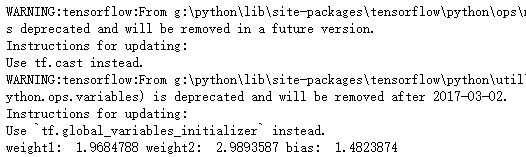
print("weight1: " ,weight1.eval(sess),"weight2: " ,weight2.eval(sess),"bias: " ,bias.eval(sess))
import tensorflow as tf

matrix1 = tf.constant([[3., 3.]])

matrix2 = tf.constant([3., 3.])

sess = tf.Session()

print(matrix1)

print(sess.run(matrix1))

print("----------------------")

print(matrix2)

print(sess.run(matrix2))

import tensorflow as tf

matrix1 = tf.constant([[3., 3.]])

matrix2 = tf.constant([3., 3.])

sess = tf.Session()

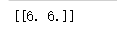
print(sess.run(tf.add(matrix1,matrix2)))
import tensorflow as tf

matrix1 = tf.constant([1, 2, 3, 4, 5, 6], shape=[2, 3])

matrix2 = tf.constant([1, 1, 1, 1, 1, 1], shape=[2, 3])

result1 = tf.multiply(matrix1,matrix2)

sess = tf.Session()

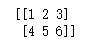
print(sess.run(result1))
import tensorflow as tf

matrix1 = tf.constant([1, 2, 3, 4, 5, 6], shape=[2, 3])

matrix2 = tf.constant([1, 1, 1, 1, 1, 1], shape=[3, 2])

result2 = tf.matmul(matrix1,matrix2)

sess = tf.Session()

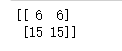
print(sess.run(result2))
import tensorflow as tf

matrix1 = tf.Variable(tf.ones([3,3]))

matrix2 = tf.Variable(tf.zeros([3,3]))

result = tf.matmul(matrix1,matrix2)

init=tf.initialize_all_variables()

sess = tf.Session()

sess.run(init)

print(sess.run(matrix1))

print("--------------")

print(sess.run(matrix2))
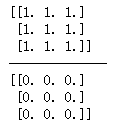
import tensorflow as tf

a = tf.constant([[1,2],[3,4]])

matrix2 = tf.placeholder('float32',[2,2])

matrix1 = matrix2

sess = tf.Session()

a = sess.run(a)

print(sess.run(matrix1,feed_dict={matrix2:a}))
import tensorflow as tf

import numpy as np

houses = 100

features = 2

#设计的模型为 2 * x1 + 3 * x2

x_data = np.zeros([houses,2])

for house in range(houses):

    x_data[house,0] = np.round(np.random.uniform(50., 150.))

    x_data[house,1] = np.round(np.random.uniform(3., 7.))

weights = np.array([[2.],[3.]])

y_data = np.dot(x_data,weights)

x_data_ = tf.placeholder(tf.float32,[None,2])

y_data_ = tf.placeholder(tf.float32,[None,1])

weights_ = tf.Variable(np.ones([2,1]),dtype=tf.float32)

y_model = tf.matmul(x_data_,weights_)

loss = tf.reduce_mean(tf.pow((y_model - y_data_),2))

train_op = tf.train.GradientDescentOptimizer(0.01).minimize(loss)

sess = tf.Session()

init = tf.global_variables_initializer()

sess.run(init)

for _ in range(10):

    for x,y in zip(x_data,y_data):

        z1 = x.reshape(1,2)

        z2 = y.reshape(1,1)

        sess.run(train_op,feed_dict={x_data_:z1,y_data_:z2})

    print(weights_.eval(sess))

import tensorflow as tf

import numpy as np

houses = 100

features = 2

#设计的模型为 2 * x1 + 3 * x2

x_data = np.zeros([100,2])

for house in range(houses):

    x_data[house,0] = np.round(np.random.uniform(50., 150.))

    x_data[house,1] = np.round(np.random.uniform(3., 7.))

weights = np.array([[2.],[3.]])

y_data = np.dot(x_data,weights)

x_data_ = tf.placeholder(tf.float32,[None,2])

weights_ = tf.Variable(np.ones([2,1]),dtype=tf.float32)

y_model = tf.matmul(x_data_,weights_)

loss = tf.reduce_mean(tf.pow((y_model - y_data),2))

train_op = tf.train.GradientDescentOptimizer(0.01).minimize(loss)

sess = tf.Session()

init = tf.initialize_all_variables()

sess.run(init)

for _ in range(20):

    sess.run(train_op,feed_dict={x_data_:x_data})

    print(weights_.eval(sess))
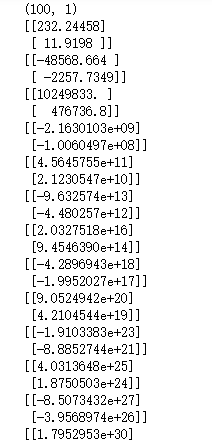
import numpy as np

a = np.array([[1,2,3],[4,5,6]])

print(a)

b = a.flatten()

print(b)
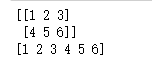
import numpy as np

import tensorflow as tf

filename_queue = tf.train.string_input_producer(["D:\\F\\TensorFlow_deep_learn\\data\\cancer.txt"], shuffle=False)

reader = tf.TextLineReader()

key, value = reader.read(filename_queue)

record_defaults = [[1.0], [1.0], [1.0], [1.0], [1.0], [1.0], [1.0]]

col1, col2, col3, col4, col5 , col6 , col7 = tf.decode_csv(value,record_defaults=record_defaults)

print(col1)

import numpy as np

import tensorflow as tf

def readFile(filename):

    filename_queue = tf.train.string_input_producer(filename, shuffle=False)

    reader = tf.TextLineReader()

    key, value = reader.read(filename_queue)

    record_defaults = [[1.0], [1.0], [1.0], [1.0], [1.0], [1.0], [1.0]]

    col1, col2, col3, col4, col5 , col6 , col7 = tf.decode_csv(value,record_defaults=record_defaults)

    label = tf.stack([col1,col2])

    features = tf.stack([col3, col4, col5, col6, col7])

    example_batch, label_batch = tf.train.shuffle_batch([features,label],batch_size=3, capacity=100, min_after_dequeue=10)

    return example_batch,label_batch

example_batch,label_batch = readFile(["D:\\F\\TensorFlow_deep_learn\\data\\cancer.txt"])

weight = tf.Variable(np.random.rand(5,1).astype(np.float32))

bias = tf.Variable(np.random.rand(3,1).astype(np.float32))

x_ = tf.placeholder(tf.float32, [None, 5])

y_model = tf.matmul(x_, weight) + bias

y = tf.placeholder(tf.float32, [None, 1])

loss = -tf.reduce_sum(y*tf.log(y_model))

train = tf.train.GradientDescentOptimizer(0.1).minimize(loss)

init = tf.initialize_all_variables()

with tf.Session() as sess:

    sess.run(init)

    coord = tf.train.Coordinator()

    threads = tf.train.start_queue_runners(coord=coord)

    flag = 1

    while(flag):

        e_val, l_val = sess.run([example_batch, label_batch])

        sess.run(train, feed_dict={x_: e_val, y: l_val})

        if sess.run(loss,{x_: e_val, y: l_val}) <= 1:

            flag = 0

    print(sess.run(weight))
吴裕雄 python深度学习与实践(14)的更多相关文章
- 吴裕雄 python深度学习与实践(15)
import tensorflow as tf import tensorflow.examples.tutorials.mnist.input_data as input_data mnist = ...
- 吴裕雄 python深度学习与实践(18)
# coding: utf-8 import time import numpy as np import tensorflow as tf import _pickle as pickle impo ...
- 吴裕雄 python深度学习与实践(17)
import tensorflow as tf from tensorflow.examples.tutorials.mnist import input_data import time # 声明输 ...
- 吴裕雄 python深度学习与实践(16)
import struct import numpy as np import matplotlib.pyplot as plt dateMat = np.ones((7,7)) kernel = n ...
- 吴裕雄 python深度学习与实践(13)
import numpy as np import matplotlib.pyplot as plt x_data = np.random.randn(10) print(x_data) y_data ...
- 吴裕雄 python深度学习与实践(12)
import tensorflow as tf q = tf.FIFOQueue(,"float32") counter = tf.Variable(0.0) add_op = t ...
- 吴裕雄 python深度学习与实践(11)
import numpy as np from matplotlib import pyplot as plt A = np.array([[5],[4]]) C = np.array([[4],[6 ...
- 吴裕雄 python深度学习与实践(10)
import tensorflow as tf input1 = tf.constant(1) print(input1) input2 = tf.Variable(2,tf.int32) print ...
- 吴裕雄 python深度学习与实践(9)
import numpy as np import tensorflow as tf inputX = np.random.rand(100) inputY = np.multiply(3,input ...
随机推荐
- Open Nginx gzip
默认情况下,Nginx的gzip压缩是关闭的, gzip压缩功能就是可以让你节省不少带宽,但是会增加服务器CPU的开销哦,Nginx默认只对text/html进行压缩 ,如果要对html之外的内容进行 ...
- PAT 乙级 1089 狼人杀 && 1090 危险品装箱 (我的时间最短哦)
1 1089的点在注释里面,核心就是遍历任意两个人说谎,看结果是否满足题目要求 2 1090 是一道好题目, 考虑到了时间复杂度 通常想法是看清单中每一个物品 是否存在与其不能存放的物品 那么复杂 ...
- 2018.4.27 java容器
一.容器的概念 在Java当中,如果有一个类专门用来存放其它类的对象,这个类就叫做容器,或者就叫做集合,集合就是将若干性质相同或相近的类对象组合在一起而形成的一个整体 二.容器与数组的关系 之所以需要 ...
- MySQL:System.Data.Entity ,MySqlCommand, MySqlParameter and "LIKE" %
Introduction Using GetSqlStringCommand with a text comparative, with LIKE, in ADO.NET and the MySQLP ...
- postgresql jdbc 连接数据库测试
转载自:http://blog.csdn.net/southflow/article/details/5944107 1. 下载postgresql-8.4-702.jdbc4.jar 2. 点击 ...
- Java8 新特性学习
摘自:https://blog.csdn.net/shuaicihai/article/details/72615495 Lambda 表达式 Lambda 是一个匿名函数,我们可以把 Lambda ...
- powershell中设置变量并启动Tomcat
假设tomcat安装在 C:\GreenSoftware\apache-tomcat-9.0.14 目录. 使用powershell进入到此目录.执行命令 $Env:JAVA_HOME="C ...
- Matlab中调用VS编译的exe文件并传递变量 的方法
经历::在网上找了很多方法,都没有实现在matlab中调用vs的exe文件并且能够传递变量参数,一些小细节花费了自己很多时间,比喻忽略了一些空格! 网上很多的方法都是纯粹复制别人的方法,自己都没有去 ...
- 如何配置nginx负载均衡配置(轮询,权重,ip绑定)
集群是为了解决单节点无法服务高并发的情况,在集群中nginx是如何分配将来自客户端的请求 转发给服务器的 负载均衡可以提高网站的吞吐量(接受和响应),减轻单台服务器的压力 负载均衡提供了三种策略:轮询 ...
- redis总结问题
简单回顾了redis,在这过程中 首先得了解redis是什么,redis的运用场景,redis支持哪些数据格式,redis如何操作数据,redis如何实现高可用 redis是什么: Redis 是一个 ...