
Entity Framework Tutorial Basics(4):Setup Entity Framework Environment
Setup Entity Framework Environment:
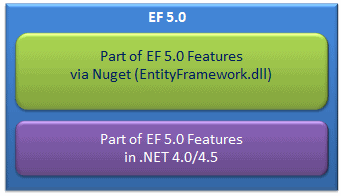
Entity Framework 5.0 API was distributed in two places, in NuGet package and in .NET framework. The .NET framework 4.0/4.5 included EF core API, whereas EntityFramework.dll via NuGet package included EF 5.0 specific features.
This has been changed with EF 6.0 which is included in EntityFramework.dll only and is not dependent on .NET framework.
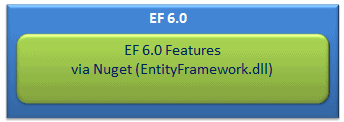
For the basic tutorials, we will use EF 6.0, the latest version of entity framework as of this writing.
Install the following tools to work with entity framework:
- .NET Framework 4.5
- Visual Studio 2012
- MS SQL Server 2005/2008/2012 Express
Install EF via Nuget:
You can install entity framework into your project via nuget. Here, we will install EF (EntityFramework.dll) via nuget in the console application in VS 2012. You can install EF via NuGet the same way in any version of Visual Studio.
Right click on project in the solution explorer and select Manage NuGet Packages..
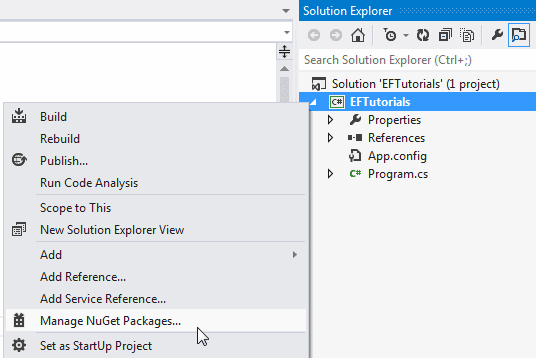
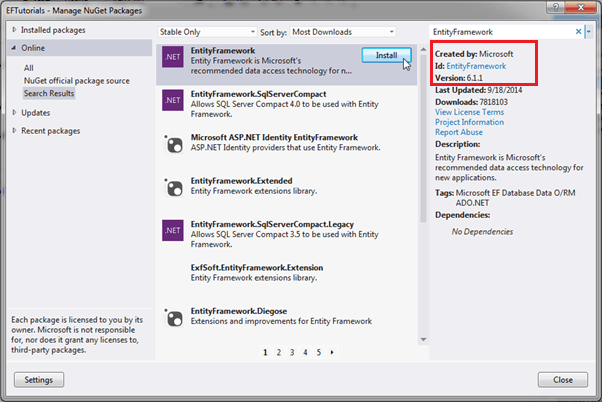
This will open Manage NuGet packages dialogue box. Now, select Online in left bar and search for EntityFramework as shown below.
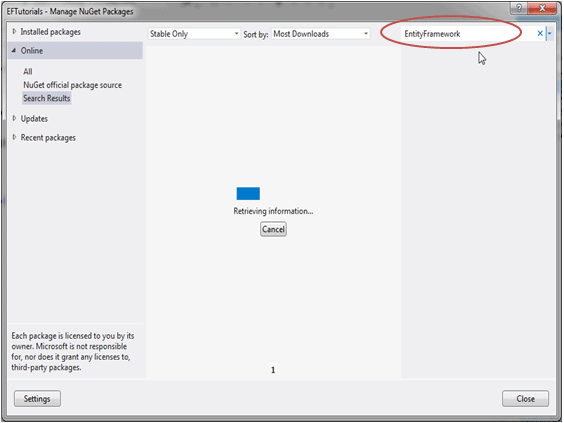
This will search for all the packages related to Entity Framework. Select EntityFramework and click on Install.
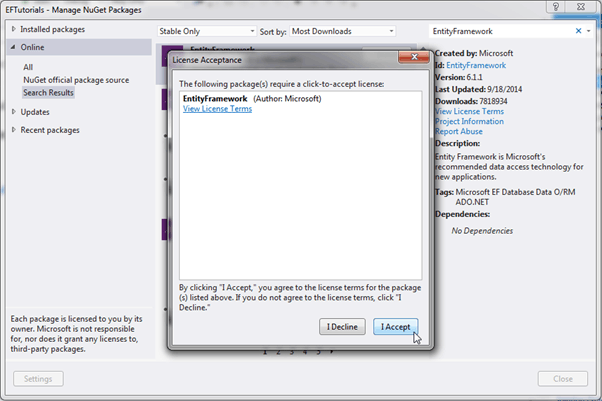
Click on the I Accept button in License Acceptance dialogue box. This will start the installation.
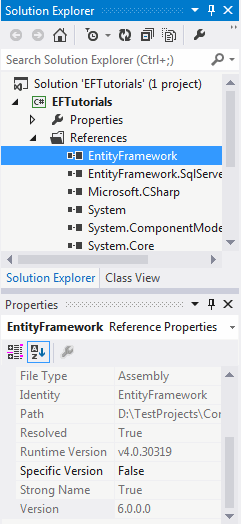
After installation, make sure that the appropriate version of EntityFramework.dll is included in the project.
Now, you are ready to use Entity Framework in your project.
Setting up the database:
This tutorial will use sample SchoolDB which has different tables, stored procedures and views. The SchoolDB database design is shown below:
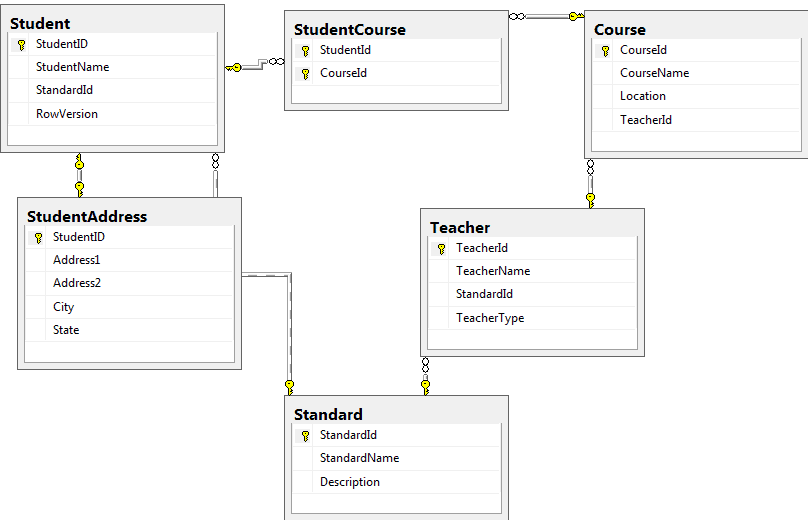
You can see in the above diagram that the sample SchoolDB database includes tables with the following relationships, for demo purpose.
- One-to-One: Student and StudentAddress have a one-to-one relationship eg. Student has zero or one StudentAddress.
- One-to-Many: Standard and Teacher have a one-to-many relationship eg. many Teachers can be associate with one Standard.
- Many-to-Many: Student and Course have a many-to-many relationship using StudentCourse table where StudentCourse table includes StudentId and CourseId. So one student can join many courses and one course also can have many students.
Download Sample Project for all the tutorials on entity framework.
Let's create first simple Entity Data Model for sample School database in the next section.
Entity Framework Tutorial Basics(4):Setup Entity Framework Environment的更多相关文章
- Entity Framework Tutorial Basics(27):Update Entity Graph
Update Entity Graph using DbContext: Updating an entity graph in disconnected scenario is a complex ...
- Entity Framework Tutorial Basics(26):Add Entity Graph
Add Entity Graph using DbContext: Adding entity graph with all new entities is a simple task. We can ...
- Entity Framework Tutorial Basics(42):Colored Entity
Colored Entity in Entity Framework 5.0 You can change the color of an entity in the designer so that ...
- Entity Framework Tutorial Basics(5):Create Entity Data Model
Create Entity Data Model: Here, we are going to create an Entity Data Model (EDM) for SchoolDB datab ...
- Entity Framework Tutorial Basics(40):Validate Entity
Validate Entity You can write custom server side validation for any entity. To accomplish this, over ...
- Entity Framework Tutorial Basics(1):Introduction
以下系列文章为Entity Framework Turial Basics系列 http://www.entityframeworktutorial.net/EntityFramework5/enti ...
- Entity Framework Tutorial Basics(32):Enum Support
Enum in Entity Framework: You can now have an Enum in Entity Framework 5.0 onwards. EF 5 should targ ...
- Entity Framework Tutorial Basics(31):Migration from EF 4.X
Migration from Entity Framework 4.1/4.3 to Entity Framework 5.0/6.0 To migrate your existing Entity ...
- Entity Framework Tutorial Basics(22):Disconnected Entities
Disconnected Entities: Before we see how to perform CRUD operation on disconnected entity graph, let ...
随机推荐
- SFTP服务器使用指南(1)——安装搭建freeSSHd
为什么选择freeSSHd 此软件免费 功能非常丰富且强大,同时支持软件用户.本地系统用户和域用户验证 对各用户选择性开放SFTP,Telnet, Tunneling服务 功能和服务完全不受限制的使用 ...
- boost bind function用法说明
目录(?)[+] 1 bind/function 引 (1)头文件 bind函数#include <boost/bind.hpp> function使用头文件#include <bo ...
- web 压力测试工具ab压力测试详解
Web性能压力测试工具之ApacheBench(ab)详解 原文:http://www.ha97.com/4617.html PS:网站性能压力测试是性能调优过程中必不可少的一环.只有让服务器处在高压 ...
- thinkphp3.0中ajax的发送
系统支持任何的AJAX类库,Action类提供了ajaxReturn方法用于 AJAX调用后返回数据给客户端.并且支持JSON.XML和EVAL三种方式给客户端接受数据,通过配置DEFAULT_AJA ...
- 如何用nodejs启一个前端服务
1.新建文件夹,如 notice 2.新建页面和js文件,如 index.html server.js 3.index.html页面内容随你写,如: <!DOCTYPE html> < ...
- Maven:Resource Path Location Type Project configuration is not up-to-date with pom.xml. Run project configuration update
Maven构建项目的时候提示: Description Resource Path Location Type Project configuration is not up-to-date with ...
- bzoj 4503 两个串——FFT
题目:https://www.lydsy.com/JudgeOnline/problem.php?id=4503 翻转T,就变成卷积.要想想怎么判断. 因为卷积是乘积求和,又想到相等的话相减为0,所以 ...
- 某个应用使cpu使用率100%
--CPU使用率 Linux是一个多任务的操作系统,将每个cpu的时间划分为很短的时间片,再通过调度器轮流分配给各个任务使用,因此造成多任务同时运行的错觉 为了维护cpu时间,linux通过事先定义的 ...
- 侯捷STL学习(八)-- 深度探索deque
layout: post title: 侯捷STL学习(八) date: 2017-07-19 tag: 侯捷STL --- 第十八节 深度探索deque上 duque内存结构 分段连续,用户看起来是 ...
- HDLM命令dlnkmgr详解之二__help/clear
1.help操作 主要显示命令的帮助信息. 显示所有操作的帮助信息 -bash-3.2# dlnkmgr help dlnkmgr: Format dlnkmgr { clear | help | o ...