
HDU1890 Robotic Sort[splay 序列]
Robotic Sort
Time Limit: 6000/2000 MS (Java/Others) Memory Limit: 32768/32768 K (Java/Others)
Total Submission(s): 3913 Accepted Submission(s): 1717
In this task, you are to write software for a robot that handles samples in such a laboratory. Imagine there are material samples lined up on a running belt. The samples have different heights, which may cause troubles to the next processing unit. To eliminate such troubles, we need to sort the samples by their height into the ascending order.
Reordering is done by a mechanical robot arm, which is able to pick up any number of consecutive samples and turn them round, such that their mutual order is reversed. In other words, one robot operation can reverse the order of samples on positions between A and B.
A possible way to sort the samples is to find the position of the smallest one (P1) and reverse the order between positions 1 and P1, which causes the smallest sample to become first. Then we find the second one on position P and reverse the order between 2 and P2. Then the third sample is located etc.
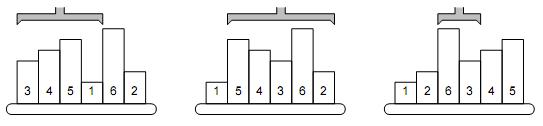
The picture shows a simple example of 6 samples. The smallest one is on the 4th position, therefore, the robot arm reverses the first 4 samples. The second smallest sample is the last one, so the next robot operation will reverse the order of five samples on positions 2–6. The third step will be to reverse the samples 3–4, etc.
Your task is to find the correct sequence of reversal operations that will sort the samples using the above algorithm. If there are more samples with the same height, their mutual order must be preserved: the one that was given first in the initial order must be placed before the others in the final order too.
The last scenario is followed by a line containing zero.
Each Pi must be an integer (1 ≤ Pi ≤ N ) giving the position of the i-th sample just before the i-th reversal operation.
Note that if a sample is already on its correct position Pi , you should output the number Pi anyway, indicating that the “interval between Pi and Pi ” (a single sample) should be reversed.
3 4 5 1 6 2
4
3 3 2 1
0
4 2 4 4
//

//  main.cpp

//  hdu1890

//

//  Created by Candy on 30/11/2016.

//  Copyright © 2016 Candy. All rights reserved.

//

#include <iostream>

#include <cstdio>

#include <cstring>

#include <algorithm>

#include <cmath>

using namespace std;

#define pa t[x].fa

#define lc t[x].ch[0]

#define rc t[x].ch[1]

const int N=1e5+;

inline int read(){

    char c=getchar();int x=,f=;

    while(c<''||c>''){if(c=='-')f=-;c=getchar();}

    while(c>=''&&c<=''){x=x*+c-'';c=getchar();}

    return x*f;

}

struct node{

    int fa,ch[],w,size,flp;

}t[N];

int root;

inline void update(int x){t[x].size=t[lc].size+t[rc].size+t[x].w;}

inline int wh(int x){return t[pa].ch[]==x;}

inline void pushDown(int x){

    if(t[x].flp){

        swap(lc,rc);

        t[lc].flp^=;t[rc].flp^=;

        t[x].flp=;

    }

}

inline void rotate(int x){

    int f=t[x].fa,g=t[f].fa,c=wh(x);

    if(g) t[g].ch[wh(f)]=x;t[x].fa=g;

    t[f].ch[c]=t[x].ch[c^];t[t[f].ch[c]].fa=f;

    t[x].ch[c^]=f;t[f].fa=x;

    update(f);update(x);

}

inline void splay(int x,int tar){

    for(;t[x].fa!=tar;rotate(x))

        if(t[pa].fa!=tar) rotate(wh(pa)==wh(x)?pa:x);

    if(tar==) root=x;

}

int ne[N];

void spl(int x,int tar){

    int _=x;

    while(x!=tar) ne[pa]=x,x=pa;

    x=_;

    for(int i=tar;i!=x;i=ne[i]) pushDown(i);

    pushDown(x);

    splay(x,tar);

}

int build(int l,int r){

    if(l>r) return ;

    int x=(l+r)>>;

    lc=build(l,x-);rc=build(x+,r);

    t[lc].fa=t[rc].fa=x;

    t[x].w=;t[x].flp=;

    update(x);

    //printf("build %d %d %d\n",x,lc,rc);

    return x;

}

int kth(int k){

    int x=root,ls=;

    while(x!=){

        pushDown(x);

        int _=ls+t[lc].size;

        if(_<k&&k<=_+t[x].w) return x;

        if(k<=_) x=lc;

        else ls=_+t[x].w,x=rc;

    }

    return -;

}

void rever(int l,int r){//printf("rev %d %d ",l,r);

    splay(kth(l),);

    int x=kth(r+);//printf("x %d\n",x);

    splay(x,root);

    t[lc].flp^=;

}

int n;

struct data{

    int id,v;

    bool operator <(const data &a)const{

        if(v==a.v) return id<a.id;

        return v<a.v;

    }

}a[N];

int main(int argc, const char * argv[]){

    while(scanf("%d",&n)!=EOF&&n){

        memset(t,,sizeof(t));

        for(int i=;i<=n;i++) a[i].v=read(),a[i].id=i+;

        sort(a+,a++n);

        root=build(,n+);

        for(int i=;i<=n;i++){

            int x=a[i].id;//printf("hi %d %d\n",i,x);

            spl(x,);

            printf("%d%c",t[lc].size,i<n?' ':'\n');

            rever(i,t[lc].size);

        }

    }

    return ;

}
HDU1890 Robotic Sort[splay 序列]的更多相关文章
- hdu1890 Robotic Sort (splay+区间翻转单点更新)
Problem Description Somewhere deep in the Czech Technical University buildings, there are laboratori ...
- HDU1890 Robotic Sort Splay tree反转,删除
题目链接:http://acm.hdu.edu.cn/showproblem.php?pid=1890 题目中涉及数的反转和删除操作,需要用Splay tree来实现.首先对数列排序,得到每个数在数列 ...
- HDU 1890 Robotic Sort | Splay
Robotic Sort Time Limit: 6000/2000 MS (Java/Others) Memory Limit: 32768/32768 K (Java/Others) [Pr ...
- BZOJ 1552: [Cerc2007]robotic sort( splay )
kpm大神说可以用块状链表写...但是我不会...写了个splay.... 先离散化 , 然后splay结点加个min维护最小值 , 就可以了... ( ps BZOJ 3506 题意一样 , 双倍经 ...
- hdu 1890 Robotic Sort(splay 区间反转+删点)
题目链接:hdu 1890 Robotic Sort 题意: 给你n个数,每次找到第i小的数的位置,然后输出这个位置,然后将这个位置前面的数翻转一下,然后删除这个数,这样执行n次. 题解: 典型的sp ...
- 【BZOJ1552】[Cerc2007]robotic sort Splay
[BZOJ1552][Cerc2007]robotic sort Description Input 输入共两行,第一行为一个整数N,N表示物品的个数,1<=N<=100000.第二行为N ...
- 【bzoj1552/3506】[Cerc2007]robotic sort splay翻转,区间最值
[bzoj1552/3506][Cerc2007]robotic sort Description Input 输入共两行,第一行为一个整数N,N表示物品的个数,1<=N<=100000. ...
- [BZOJ1552] [Cerc2007] robotic sort (splay)
Description Input 输入共两行,第一行为一个整数N,N表示物品的个数,1<=N<=100000.第二行为N个用空格隔开的正整数,表示N个物品最初排列的编号. Output ...
- HDU 1890 - Robotic Sort - [splay][区间反转+删除根节点]
题目链接:http://acm.hdu.edu.cn/showproblem.php?pid=1890 Time Limit: 6000/2000 MS (Java/Others) Memory Li ...
随机推荐
- 背水一战 Windows 10 (13) - 绘图: Stroke, Brush
[源码下载] 背水一战 Windows 10 (13) - 绘图: Stroke, Brush 作者:webabcd 介绍背水一战 Windows 10 之 绘图 Stroke - 笔划 Brush ...
- gSOAP MTOM
前言 需要准备的知识:wsdl,soap,gSOAP,C++,fidder. 首先介绍几个相关的概念 1.MTOM基础概念 MTOM(Message Transmission Optimiz ...
- 【工匠大道】一些Vim(Linux)不常见但很逼格的命令(不断更新中)
本文地址 分享提纲: 1. :Tlist 2. :colorscheme 3. :set cursorline 4. ma 5. vim -x 6. CTRL-] 7. 折叠 8. 向别的用户终端写信 ...
- AMD and CMD are dead之KMDjs内核之分号
在老版本的kmdjs中,强制了分号的要求.但是总感觉不爽,因为在开发Ket - Kmdjs Extension Tools的时候,总需要导入一些开源的库,然后痛苦就来了,总是报错,一查,就是缺少分号! ...
- Struts2(2) —— Action
Struts2框架中的Action类是一个单独的javabean对象.不像Struts1中还要去继承HttpServlet,耦合度减小了. 1,流程 拦截器拦截请求,创建代理Action对象,执行方法 ...
- ListDefinition Tips
1)ListTemplate.Type位数不能太长(最长7位),否则启用内容类型后,列表设置中会抛异常. <ListTemplate Name="List1" Type=&q ...
- 基本动画CABasicAnimation - 完成之后闪回初始状态
基本动画CABasicAnimation 结束之后,默认闪回初始状态,那怎么解决呢? position需要设备两个属性: // MARK: - 结束后不要闪回去 anim.removedOnCompl ...
- 2016最新cocoapods安装流程,安装过程中遇到的问题及解决方法
现在的cocoapods与之前比较.有很多不一样的地方.自己试了一试,终于搞定.现在大概纪录一下. 1.首先查看ruby是否是最新版的. ruby是通过rvm安装的所以需要先安装rvm后查看ruby是 ...
- React Native知识2-Text组件
Text用于显示文本的React组件,并且它也支持嵌套.样式,以及触摸处理.在下面的例子里,嵌套的标题和正文文字会继承来自styles.baseText的fontFamily字体样式,不过标题上还附加 ...
- Objective-C内存管理之-引用计数
本文会继续深入学习OC内存管理,内容主要参考iOS高级编程,Objective-C基础教程,疯狂iOS讲义,是我学习内存管理的笔记 内存管理 1 内存管理的基本概念 1.1 Objective-C中的 ...