
hdu1890 Robotic Sort (splay+区间翻转单点更新)
multimedia lab. But there are still others, serving to their original purposes.
In this task, you are to write software for a robot that handles samples in such a laboratory. Imagine there are material samples lined up on a running belt. The samples have different heights, which may cause troubles to the next processing unit. To eliminate
such troubles, we need to sort the samples by their height into the ascending order.
Reordering is done by a mechanical robot arm, which is able to pick up any number of consecutive samples and turn them round, such that their mutual order is reversed. In other words, one robot operation can reverse the order of samples on positions between
A and B.
A possible way to sort the samples is to find the position of the smallest one (P1) and reverse the order between positions 1 and P1, which causes the smallest sample to become first. Then we find the second one on position P and reverse the order between 2
and P2. Then the third sample is located etc.
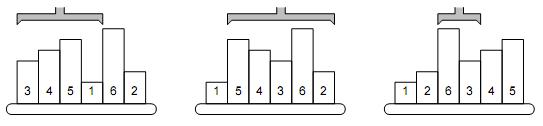
The picture shows a simple example of 6 samples. The smallest one is on the 4th position, therefore, the robot arm reverses the first 4 samples. The second smallest sample is the last one, so the next robot operation will reverse the order of five samples on
positions 2–6. The third step will be to reverse the samples 3–4, etc.
Your task is to find the correct sequence of reversal operations that will sort the samples using the above algorithm. If there are more samples with the same height, their mutual order must be preserved: the one that was given first in the initial order must
be placed before the others in the final order too.
of individual samples and their initial order.
The last scenario is followed by a line containing zero.
Each Pi must be an integer (1 ≤ Pi ≤ N ) giving the position of the i-th sample just before the i-th reversal operation.
Note that if a sample is already on its correct position Pi , you should output the number Pi anyway, indicating that the “interval between Pi and Pi ” (a single sample) should be reversed.
3 4 5 1 6 2
4
3 3 2 1
0
4 2 4 4
题意:给一个长度为n的数列,每次选取值最小的元素并翻转前面的数列,然后删除这个元素。请在每次操作之前输出这个最小元素的位置。
思路:先对原来的序列排序,然后预处理出第i大的数在树上的节点编号,然后每一次把第i大的节点旋到根节点,那么答案就是i+sz[ch[rt][0] ],然后删除这个节点。
#include<iostream>

#include<stdio.h>

#include<stdlib.h>

#include<string.h>

#include<math.h>

#include<vector>

#include<map>

#include<set>

#include<string>

#include<bitset>

#include<algorithm>

using namespace std;

#define lson th<<1

#define rson th<<1|1

typedef long long ll;

typedef long double ldb;

#define inf 99999999

#define pi acos(-1.0)

#define maxn 100050

#define Key_value ch[ch[root][1]][0]

int n;

struct edge{

    int idx,num;

}a[maxn];

int mp[maxn],mp1[maxn];

bool cmp(edge a,edge b){

    if(a.num==b.num)return a.idx<b.idx;

    return a.num<b.num;

}

int cnt,rt;

int pre[maxn],ch[maxn][2],sz[maxn],rev[maxn];

void newnode(int &x,int father)

{

    x=++cnt;

    pre[x]=father;ch[x][0]=ch[x][1]=0;sz[x]=1;rev[x]=0;

}

void update_rev(int x)

{

    if(x==0)return;       //!!!

    rev[x]^=1;

    swap(ch[x][0],ch[x][1]);

}

void pushdown(int x)

{

    int y;

    if(rev[x]){

        update_rev(ch[x][0]);

        update_rev(ch[x][1]);

        rev[x]=0;

    }

}

void pushup(int x)

{

    sz[x]=sz[ch[x][0] ]+sz[ch[x][1] ]+1;

}

void build(int &x,int l,int r,int father)

{

    if(l>r)return;

    int mid=(l+r)/2;

    newnode(x,father);mp1[mp[mid] ]=cnt;

    build(ch[x][0],l,mid-1,x);

    build(ch[x][1],mid+1,r,x);

    pushup(x);

}

void init()

{

    cnt=rt=0;

    pre[rt]=ch[rt][0]=ch[rt][1]=sz[rt]=rev[rt]=0;

    build(rt,1,n,0);

}

void rotate(int x,int p)

{

    int y=pre[x];

    pushdown(y);pushdown(x);

    ch[y][!p]=ch[x][p];

    pre[ch[x][p] ]=y;

    if(pre[y])ch[pre[y] ][ch[pre[y] ][1]==y ]=x;

    pre[x]=pre[y];

    ch[x][p]=y;

    pre[y]=x;

    pushup(y);pushup(x);

}

void splay(int x,int goal)

{

    pushdown(x);

    while(pre[x]!=goal){

        if(pre[pre[x] ]==goal){

            pushdown(pre[x]);pushdown(x);

            rotate(x,ch[pre[x]][0]==x);

        }

        else{

            int y=pre[x];int z=pre[y];

            pushdown(z);pushdown(y);pushdown(x);

            int p=ch[pre[y] ][0]==y;

            if(ch[y][p]==x )rotate(x,!p);

            else rotate(y,p);

            rotate(x,p);

        }

    }

    if(goal==0)rt=x;

    pushup(x);

}

void del()

{

    if(ch[rt][0]==0 ){

        rt=ch[rt][1];

        pre[rt]=0;

    }

    else{

        int y=ch[rt][0];

        int x=ch[rt][1];

        pushdown(y);

        while(ch[y][1]){

            y=ch[y][1];pushdown(y);

        }

        splay(y,rt);

        ch[y][1]=x;

        pre[x]=y;

        rt=y;

        pre[rt]=0;

        pushup(rt);

    }

}

int main()

{

    int m,i,j;

    while(scanf("%d",&n)!=EOF && n!=0)

    {

        for(i=1;i<=n;i++){

            scanf("%d",&a[i].num);

            a[i].idx=i;

        }

        sort(a+1,a+1+n,cmp);

        for(i=1;i<=n;i++)mp[a[i].idx ]=i;

        init();

        for(i=1;i<n;i++){

            splay(mp1[i],0);

            update_rev(ch[rt][0]);

            printf("%d ",i+sz[ch[rt][0]]);

            del();

        }

        printf("%d\n",n);

    }

    return 0;

}
hdu1890 Robotic Sort (splay+区间翻转单点更新)的更多相关文章
- hdu 1890 Robotic Sort(splay 区间反转+删点)
题目链接:hdu 1890 Robotic Sort 题意: 给你n个数,每次找到第i小的数的位置,然后输出这个位置,然后将这个位置前面的数翻转一下,然后删除这个数,这样执行n次. 题解: 典型的sp ...
- HDU1890 Robotic Sort[splay 序列]
Robotic Sort Time Limit: 6000/2000 MS (Java/Others) Memory Limit: 32768/32768 K (Java/Others)Tota ...
- hdu-1890-Robotic Sort splay区间翻转
题意: 依次找第i大的数下标pos[i],然后将区间[i,pos[i]]翻转 分析: splay树区间翻转 // File Name: ACM/HDU/1890.cpp // Author: Zlbi ...
- HDU 1890 - Robotic Sort - [splay][区间反转+删除根节点]
题目链接:http://acm.hdu.edu.cn/showproblem.php?pid=1890 Time Limit: 6000/2000 MS (Java/Others) Memory Li ...
- HDU1890 Robotic Sort Splay tree反转,删除
题目链接:http://acm.hdu.edu.cn/showproblem.php?pid=1890 题目中涉及数的反转和删除操作,需要用Splay tree来实现.首先对数列排序,得到每个数在数列 ...
- 【bzoj1552/3506】[Cerc2007]robotic sort splay翻转,区间最值
[bzoj1552/3506][Cerc2007]robotic sort Description Input 输入共两行,第一行为一个整数N,N表示物品的个数,1<=N<=100000. ...
- bzoj 1251序列终结者 splay 区间翻转,最值,区间更新
序列终结者 Time Limit: 20 Sec Memory Limit: 162 MBSubmit: 4594 Solved: 1939[Submit][Status][Discuss] De ...
- HDU 1890 Robotic Sort | Splay
Robotic Sort Time Limit: 6000/2000 MS (Java/Others) Memory Limit: 32768/32768 K (Java/Others) [Pr ...
- BZOJ 1552: [Cerc2007]robotic sort( splay )
kpm大神说可以用块状链表写...但是我不会...写了个splay.... 先离散化 , 然后splay结点加个min维护最小值 , 就可以了... ( ps BZOJ 3506 题意一样 , 双倍经 ...
随机推荐
- node.js中使用http-proxy-middleware请求转发给其它服务器
var express = require('express');var proxy = require('http-proxy-middleware'); var app = express(); ...
- PC个人隐私保护小方法
前言 近期爆出了腾讯读取用户浏览器浏览记录的消息.话不过说直接上图,懂的自然懂. 网上也有详细的分析文章,不管它读取后用来做什么,在你不知情的情况下读取了你的浏览器浏览记录,你说气不气. 虽然在整体大 ...
- linux硬盘分区和fdisk命令
分区的几个概念 硬盘分区有三种,主分区.扩展分区.逻辑分区.一个硬盘主分区至少有1个,最多4个,扩展分区可以没有,最多1个.且主分区+扩展分区总共不能超过4个.逻辑分区可以有若干个.在windows下 ...
- Spring Cloud微服务Sentinel+Apollo限流、熔断实战总结
在Spring Cloud微服务体系中,由于限流熔断组件Hystrix开源版本不在维护,因此国内不少有类似需求的公司已经将眼光转向阿里开源的Sentinel框架.而以下要介绍的正是作者最近两个月的真实 ...
- 【Linux】cp命令的各种妙用
CP 功能: 复制文件或目录 说明: cp指令用于复制文件或目录,如同时指定两个以上的文件或目录,且最后的目的地是一个已经存在的目录,则它会把前面指定的所有文件或目录复制到此目录中.若同时指定多个文件 ...
- ctfhub技能树—文件上传—文件头检查
打开靶机 尝试上传一个php文件 抓包修改 放包 制作图片马 上传图片马,并修改文件类型为png 测试连接 查找flag 成功拿到flag
- JAVA编程中button按钮,actionlistener和mouseClicked区别
在java的编程中,对于按钮button 有两个事件: 1.actionPerformed 2.mouseClicked 区别: actionPerformed:一般事件,仅侦听鼠标左键的单击事件,右 ...
- 基于FPGA的光口通信开发案例|基于Kintex-7 FPGA SFP+光口的10G UDP网络通信开发案例
前言 自著名华人物理学家高锟先生提出"光传输理论",实用化的光纤传输产品始于1976年,经历了PDH→SDH→DWDM→ASON→MSTP的发展历程.本世纪初期,ASON/OADM ...
- 微信登录2-生成授权URL
一.准备工作 1.注册 微信开放平台:https://open.weixin.qq.com 2.邮箱激活 3.完善开发者资料 4.开发者资质认证 准备营业执照,1-2个工作日审批.300元 5.创建网 ...
- b站视频_下载_去水印_视频转mp4-批量下载神器
b站下载_视频_去水印_转mp4_批量下载的解决办法 以下问题均可解决 b站下载的视频如何保存到本地 b站下载的视频在那个文件夹里 b站下载视频转mp4 b站下载app b站下载在哪 b站下载视频电脑 ...