
B - Space Ant
The most exciting space discovery occurred at the end of the 20th century. In 1999, scientists traced down an ant-like creature in the planet Y1999 and called it M11. It has only one eye on the left side of its head and just three feet all on the right side of its body and suffers from three walking limitations:
It can not turn right due to its special body structure.
It leaves a red path while walking.
It hates to pass over a previously red colored path, and never does that.
The pictures transmitted by the Discovery space ship depicts that plants in the Y1999 grow in special points on the planet. Analysis of several thousands of the pictures have resulted in discovering a magic coordinate system governing the grow points of the plants. In this coordinate system with x and y axes, no two plants share the same x or y.
An M11 needs to eat exactly one plant in each day to stay alive. When it eats one plant, it remains there for the rest of the day with no move. Next day, it looks for another plant to go there and eat it. If it can not reach any other plant it dies by the end of the day. Notice that it can reach a plant in any distance.
The problem is to find a path for an M11 to let it live longest.
Input is a set of (x, y) coordinates of plants. Suppose A with the coordinates (xA, yA) is the plant with the least y-coordinate. M11 starts from point (0,yA) heading towards plant A. Notice that the solution path should not cross itself and all of the turns should be counter-clockwise. Also note that the solution may visit more than two plants located on a same straight line.
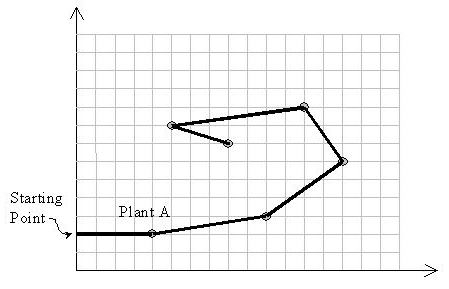
Input
The first line of the input is M, the number of test cases to be solved (1 <= M <= 10). For each test case, the first line is N, the number of plants in that test case (1 <= N <= 50), followed by N lines for each plant data. Each plant data consists of three integers: the first number is the unique plant index (1..N), followed by two positive integers x and y representing the coordinates of the plant. Plants are sorted by the increasing order on their indices in the input file. Suppose that the values of coordinates are at most 100.
Output
Output should have one separate line for the solution of each test case. A solution is the number of plants on the solution path, followed by the indices of visiting plants in the path in the order of their visits.
Sample Input
2
10
1 4 5
2 9 8
3 5 9
4 1 7
5 3 2
6 6 3
7 10 10
8 8 1
9 2 4
10 7 6
14
1 6 11
2 11 9
3 8 7
4 12 8
5 9 20
6 3 2
7 1 6
8 2 13
9 15 1
10 14 17
11 13 19
12 5 18
13 7 3
14 10 16
Sample Output
10 8 7 3 4 9 5 6 2 1 10
14 9 10 11 5 12 8 7 6 13 4 14 1 3 2
凸包,从第一个开始不停的进行排序就好了;
#include<iostream>

#include<stdio.h>

#include<stdlib.h>

#include <iomanip>

#include<cmath>

#include<float.h>

#include<string.h>

#include<algorithm>

#define sf scanf

#define pf printf

#define mm(x,b) memset((x),(b),sizeof(x))

#include<vector>

#include<queue>

#include<stack>

#include<map>

#define rep(i,a,n) for (int i=a;i<n;i++)

#define per(i,a,n) for (int i=a;i>=n;i--)

typedef long long ll;

typedef long double ld;

typedef double db;

const ll mod=1e9+100;

const db e=exp(1);

using namespace std;

const double pi=acos(-1.0);

const int INF=0xfffffff;

struct Point{

    int x,y,temp,num;

}p[50005],s[50005];

int top;

int direction(Point p1,Point p2,Point p3) { return (p3.x-p1.x)*(p2.y-p1.y)-(p2.x-p1.x)*(p3.y-p1.y); }//点2和3,按哪个和点一的角度更小排,相同的话按哪个更近排

double dis(Point p1,Point p2) { return sqrt((p2.x-p1.x)*(p2.x-p1.x)+(p2.y-p1.y)*(p2.y-p1.y)); }

bool cmp(Point p1,Point p2)//极角排序

{

    int temp=direction(p[top],p1,p2);

    if(temp<0)return true ;

    if(temp==0&&dis(p[top],p1)<dis(p[top],p2))return true;

	return false;

}

/*vector<int>v;

void Graham(int n)

{

    int pos,minx,miny;

    minx=miny=INF;

    for(int i=0;i<n;i++)//找最下面的基点

        if(p[i].y<miny||(p[i].y==miny&&p[i].x<minx))

        {

            minx=p[i].x;

            miny=p[i].y;

            pos=i;

        }

    swap(p[0],p[pos]);

    sort(p+1,p+n,cmp);

    p[n]=p[0];

    s[0]=p[0];s[1]=p[1];s[2]=p[2];

    p[0].temp=1;p[1].temp=1;p[2].temp=1;

    top=2;int i=3;

    while(top<n)

    {

    	while(p[i].temp)

		{

			i++;

			if(i==n) i=0;

		}

        while(direction(s[top-1],s[top],p[i])>=0&&top>=2)

		{

			p[s[top].num].temp=0;

			top--;

		}

        s[++top]=p[i];

        p[i].temp=1;

    }

}*/

int main()

{

	int re;

	sf("%d",&re);

	while(re--)

	{

		top=0;

		int n;

	cin>>n;

	rep(i,0,n)

	{

		p[i].temp=0;sf("%d%d%d",&p[i].num,&p[i].x,&p[i].y);

	}

	int pos,minx,miny;

    minx=miny=INF;

    for(int i=0;i<n;i++)//找最下面的基点

        if(p[i].y<miny||(p[i].y==miny&&p[i].x<minx))

        {

            minx=p[i].x;

            miny=p[i].y;

            pos=i;

        }

    swap(p[0],p[pos]);

    pf("%d",n);

	rep(i,1,n)

	{

		sort(p+i,p+n,cmp);top++;

	}

	rep(i,0,n)

	pf(" %d",p[i].num);

	pf("\n");

	}

	return 0;

}
B - Space Ant的更多相关文章
- poj 1696 Space Ant (极角排序)
链接:http://poj.org/problem?id=1696 Space Ant Time Limit: 1000MS Memory Limit: 10000K Total Submissi ...
- POJ 1696 Space Ant(极角排序)
Space Ant Time Limit: 1000MS Memory Limit: 10000K Total Submissions: 2489 Accepted: 1567 Descrip ...
- poj 1696 Space Ant(模拟+叉积)
Space Ant Time Limit: 1000MS Memory Limit: 10000K Total Submissions: 3840 Accepted: 2397 Descrip ...
- POJ 1696 Space Ant 卷包裹法
Space Ant Time Limit: 1000MS Memory Limit: 10000K Total Submissions: 3316 Accepted: 2118 Descrip ...
- POJ 1696 Space Ant(点积的应用)
Space Ant 大意:有一仅仅蚂蚁,每次都仅仅向当前方向的左边走,问蚂蚁走遍全部的点的顺序输出.開始的点是纵坐标最小的那个点,開始的方向是開始点的x轴正方向. 思路:从開始点開始,每次找剩下的点中 ...
- Space Ant
Space Ant The most exciting space discovery occurred at the end of the 20th century. In 1999, scient ...
- poj1696 Space Ant【计算几何】
含极角序排序模板. Space Ant Time Limit: 1000MS Memory Limit: 10000K Total Submissions: 5334 Accepted: ...
- Space Ant(极角排序)
Space Ant http://poj.org/problem?id=1696 Time Limit: 1000MS Memory Limit: 10000K Total Submissions ...
- 2018.07.04 POJ 1696 Space Ant(凸包卷包裹)
Space Ant Time Limit: 1000MS Memory Limit: 10000K Description The most exciting space discovery occu ...
- poj 1696:Space Ant(计算几何,凸包变种,极角排序)
Space Ant Time Limit: 1000MS Memory Limit: 10000K Total Submissions: 2876 Accepted: 1839 Descrip ...
随机推荐
- Visio画流程图风格设置
第一步:选取设计下选用“简单” 第二步:设置颜色为“铅笔” 第三步:设置效果为“辐射” 第四步:效果
- PC高级语言与施耐德、罗克韦尔、台达等PLC的Modbus通讯源代码(ModbusTCP.DLL/ModbusRTU.DLL)
1.0 通讯组件概述 该类通讯组件适用于基于PC高级语言的工业自动化控制系统,用于PC与可编程控制器(PLC).智能仪表等进行数据通讯.组件采用动态链接库文件(*.DLL)的形式,在PC系统的项目工 ...
- Spring AOP获取拦截方法的参数名称跟参数值
注意:这种方式需要JDK1.8版本支持 开始:http://www.cnblogs.com/wing7319/p/9592184.html 1.aop配置: <aop:aspectj-autop ...
- 【T07】不要低估tcp的性能
1.tcp在ip的基础上增加了校验和.可靠性和流量控制的功能,而udp只增加了校验和的功能,看起来udp应该会比tcp快很多, 但事实不是这样,有时候tcp比udp的性能还要好. 2.思考,在什么情况 ...
- 日志分析利器elk与logback(log4j)实战
https://blog.csdn.net/puhaiyang/article/details/69664891
- 原创:vsphere概念深入系列四:Nic Teaming若干问题
参考文档:http://www.hyper-v.nu/archives/marcve/2013/01/lbfo-hyper-v-switch-qos-and-actual-performance-pa ...
- error C2039: 'SetWindowTextA' : is not a member of 'CString'
m_OpenPath.SetWindowText(strPath); 错误原因:在给控件关联变量m_OpenPath时,变量类型选择错误 解决办法:
- 译:7.使用Spring MVC服务Web内容
本指南向您介绍了使用Spring创建“hello world”网站的过程.阅读原文:Serving Web Content with Spring MVC 1. 你将会构建什么? 您将构建一个具有静态 ...
- [svc]find+xargs/sed&sed后向引用+awk多匹配符+过滤行绝招总结&&产生随机数
30天内的文件打包 find ./test_log -type f -mtime -30|xargs tar -cvf test_log.tar.gz find,文件+超过7天+超过1M的+按日期为文 ...
- 9-9-B+树-查找-第9章-《数据结构》课本源码-严蔚敏吴伟民版
课本源码部分 第9章 查找 - B+树 ——<数据结构>-严蔚敏.吴伟民版 源码使用说明 链接☛☛☛ <数据结构-C语言版>(严蔚敏,吴伟民版)课本源码+习题 ...