
[LeetCode] The Maze III 迷宫之三
There is a ball in a maze with empty spaces and walls. The ball can go through empty spaces by rolling up (u), down (d), left (l) or right (r), but it won't stop rolling until hitting a wall. When the ball stops, it could choose the next direction. There is also a hole in this maze. The ball will drop into the hole if it rolls on to the hole.
Given the ball position, the hole position and the maze, find out how the ball could drop into the hole by moving the shortest distance. The distance is defined by the number of empty spaces traveled by the ball from the start position (excluded) to the hole (included). Output the moving directions by using 'u', 'd', 'l' and 'r'. Since there could be several different shortest ways, you should output the lexicographically smallest way. If the ball cannot reach the hole, output "impossible".
The maze is represented by a binary 2D array. 1 means the wall and 0 means the empty space. You may assume that the borders of the maze are all walls. The ball and the hole coordinates are represented by row and column indexes.
Example 1
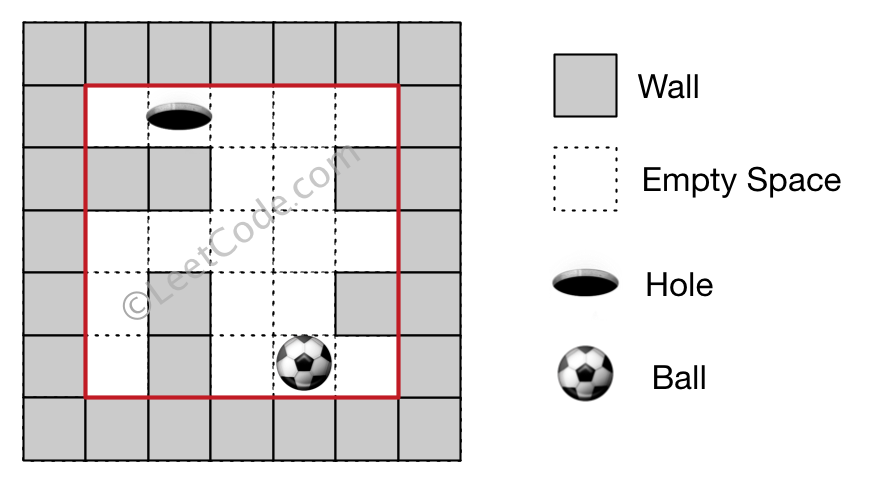
Input 1: a maze represented by a 2D array

0 0 0 0 0

1 1 0 0 1

0 0 0 0 0

0 1 0 0 1

0 1 0 0 0

Input 2: ball coordinate (rowBall, colBall) = (4, 3)

Input 3: hole coordinate (rowHole, colHole) = (0, 1)

Output: "lul"

Explanation: There are two shortest ways for the ball to drop into the hole.

The first way is left -> up -> left, represented by "lul".

The second way is up -> left, represented by 'ul'.

Both ways have shortest distance 6, but the first way is lexicographically smaller because 'l' < 'u'. So the output is "lul".
Example 2
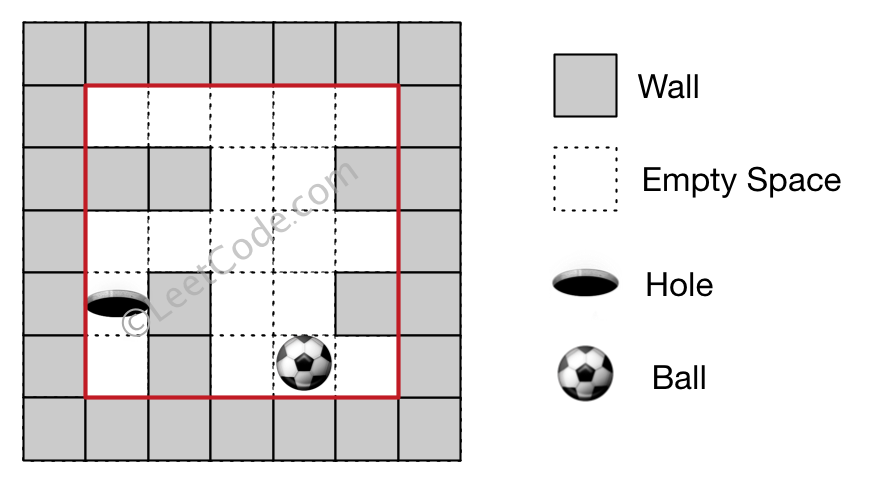
Input 1: a maze represented by a 2D array

0 0 0 0 0

1 1 0 0 1

0 0 0 0 0

0 1 0 0 1

0 1 0 0 0

Input 2: ball coordinate (rowBall, colBall) = (4, 3)

Input 3: hole coordinate (rowHole, colHole) = (3, 0)

Output: "impossible"

Explanation: The ball cannot reach the hole.
Note:
- There is only one ball and one hole in the maze.
- Both the ball and hole exist on an empty space, and they will not be at the same position initially.
- The given maze does not contain border (like the red rectangle in the example pictures), but you could assume the border of the maze are all walls.
- The maze contains at least 2 empty spaces, and the width and the height of the maze won't exceed 30.
这道题在之前的两道The Maze II和The Maze的基础上又做了些改变,在路径中间放了个陷阱,让球在最小步数内滚到陷阱之中,此时返回的并不是最小步数,而是滚动的方向,用u, r, d, l 这四个字母来分别表示上右下左,而且在步数相等的情况下,让我们返回按字母排序小的答案。相对于迷宫二那题来说,难度是增加了一些,但我们还是可以借鉴之前那道题的思路,我们还是需要用一个二位数组dists,其中dists[i][j]表示到达(i,j)这个位置时需要的最小步数,我们都初始化为整型最大值,在后在遍历的过程中不断用较小值来更新每个位置的步数值。我们还需要用一个哈希表来建立每个位置跟滚到该位置的方向字符串之间的映射,这里我们用一个trick,将二维坐标转(i,j)为一个数字i*n+j,这实际上就是把二维数组拉成一维数组的操作,matlab中很常见的操作。还有需要注意的是,一滚到底的操作需要稍作修改,之前我们都是一直滚到墙里面或者界外才停止,然后做退一步处理,就是小球能滚到的位置,这里我们滚的时候要判断陷阱,如果滚到了陷阱,那么我们也停下来,注意这时候不需要做后退一步处理。然后我们还是比较当前步数是否小于dists中的原有步数,小于的话就更新dists,然后更新哈希表中的映射方向字符串,然后对于不是陷阱的点,我们加入队列queue中继续滚。另一点跟迷宫二不同的之处在于,这里还要处理另一种情况,就是当最小步数相等的时候,并且新的滚法的方向字符串的字母顺序要小于原有的字符串的时候,我们也需要更新哈希表的映射,并且判断是否需要加入队列queue中,参见代码如下:
解法一:
class Solution {

public:

    string findShortestWay(vector<vector<int>>& maze, vector<int>& ball, vector<int>& hole) {

        int m = maze.size(), n = maze[].size();

        vector<vector<int>> dists(m, vector<int>(n, INT_MAX));

        vector<vector<int>> dirs{{,-},{-,},{,},{,}};

        vector<char> way{'l','u','r','d'};

        queue<pair<int, int>> q;

        unordered_map<int, string> u;

        dists[ball[]][ball[]] = ;

        q.push({ball[], ball[]});

        while (!q.empty()) {

            auto t = q.front(); q.pop();

            for (int i = ; i < ; ++i) {

                int x = t.first, y = t.second, dist = dists[x][y];

                string path = u[x * n + y];

                while (x >=  && x < m && y >=  && y < n && maze[x][y] ==  && (x != hole[] || y != hole[])) {

                    x += dirs[i][]; y += dirs[i][]; ++dist;

                }

                if (x != hole[] || y != hole[]) {

                    x -= dirs[i][]; y -= dirs[i][]; --dist;

                }

                path.push_back(way[i]);

                if (dists[x][y] > dist) {

                    dists[x][y] = dist;

                    u[x * n + y] = path;

                    if (x != hole[] || y != hole[]) q.push({x, y});

                } else if (dists[x][y] == dist && u[x * n + y].compare(path) > ) {

                    u[x * n + y] = path;

                    if (x != hole[] || y != hole[]) q.push({x, y});

                }

            }

        }

        string res = u[hole[] * n + hole[]];

        return res.empty() ? "impossible" : res;

    }

};
下面这种写法是DFS的解法,可以看出来思路基本上跟上面的解法没有啥区别,写法上稍有不同,参见代码如下:
解法二:
class Solution {

public:

    vector<vector<int>> dirs{{,-},{-,},{,},{,}};

    vector<char> way{'l','u','r','d'};

    string findShortestWay(vector<vector<int>>& maze, vector<int>& ball, vector<int>& hole) {

        int m = maze.size(), n = maze[].size();

        vector<vector<int>> dists(m, vector<int>(n, INT_MAX));

        unordered_map<int, string> u;

        dists[ball[]][ball[]] = ;

        helper(maze, ball[], ball[], hole, dists, u);

        string res = u[hole[] * n + hole[]];

        return res.empty() ? "impossible" : res;

    }

    void helper(vector<vector<int>>& maze, int i, int j, vector<int>& hole, vector<vector<int>>& dists, unordered_map<int, string>& u) {

        if (i == hole[] && j == hole[]) return;

        int m = maze.size(), n = maze[].size();

        for (int k = ; k < ; ++k) {

            int x = i, y = j, dist = dists[x][y];

            string path = u[x * n + y];

            while (x >=  && x < m && y >=  && y < n && maze[x][y] ==  && (x != hole[] || y != hole[])) {

                x += dirs[k][]; y += dirs[k][]; ++dist;

            }

            if (x != hole[] || y != hole[]) {

                x -= dirs[k][]; y -= dirs[k][]; --dist;

            }

            path.push_back(way[k]);

            if (dists[x][y] > dist) {

                dists[x][y] = dist;

                u[x * n + y] = path;

                helper(maze, x, y, hole, dists, u);

            } else if (dists[x][y] == dist && u[x * n + y].compare(path) > ) {

                u[x * n + y] = path;

                helper(maze, x, y, hole, dists, u);

            }

        }

    }

};
类似题目:
参考资料:
https://discuss.leetcode.com/topic/77116/bfs-solution-using-a-queue
https://discuss.leetcode.com/topic/77074/clear-java-accepted-dfs-solution-with-explanation
https://discuss.leetcode.com/topic/77474/similar-to-the-maze-ii-easy-understanding-java-bfs-solution
LeetCode All in One 题目讲解汇总(持续更新中...)
[LeetCode] The Maze III 迷宫之三的更多相关文章
- [LeetCode] 499. The Maze III 迷宫 III
There is a ball in a maze with empty spaces and walls. The ball can go through empty spaces by rolli ...
- [LeetCode] The Maze II 迷宫之二
There is a ball in a maze with empty spaces and walls. The ball can go through empty spaces by rolli ...
- [LeetCode] House Robber III 打家劫舍之三
The thief has found himself a new place for his thievery again. There is only one entrance to this a ...
- Leetcode: The Maze III(Unsolved Lock Problem)
There is a ball in a maze with empty spaces and walls. The ball can go through empty spaces by rolli ...
- [LeetCode] 505. The Maze II 迷宫 II
There is a ball in a maze with empty spaces and walls. The ball can go through empty spaces by rolli ...
- [LeetCode] The Maze 迷宫
There is a ball in a maze with empty spaces and walls. The ball can go through empty spaces by rolli ...
- [LeetCode] 505. The Maze II 迷宫之二
There is a ball in a maze with empty spaces and walls. The ball can go through empty spaces by rolli ...
- Leetcode: The Maze II
There is a ball in a maze with empty spaces and walls. The ball can go through empty spaces by rolli ...
- 3299: [USACO2011 Open]Corn Maze玉米迷宫
3299: [USACO2011 Open]Corn Maze玉米迷宫 Time Limit: 10 Sec Memory Limit: 128 MBSubmit: 137 Solved: 59[ ...
随机推荐
- lua对多个精灵执行一系列动作,延时失效
function MainPlayerCards:sendCards() local winSize = cc.Director:getInstance():getWinSize() local nS ...
- bootstrap 模态框(modal)插件使用
今天用户登陆时,在原网页上弹出新登陆窗口,发现使用的是modal插件,记录下该插件的使用方法,手写强化下. 首先,模态框(modal)是覆盖在父窗体上的子窗体,目的是显示来自一个单独的源的内容,可以在 ...
- div内文字显示两行,多出的文字用省略号显示
用-webkit-私有属性,代码如下:text-overflow: -o-ellipsis-lastline;overflow: hidden;text-overflow: ellipsis;disp ...
- Jupyter Notebook的快捷键
Jupyter Notebook 有两种键盘输入模式. 编辑模式,允许你往单元中键入代码或文本,这时的单元框线是绿色的. 命令模式,键盘输入运行程序命令:这时的单元框线是蓝色. 命令模式 ...
- fetch()函数使用的一些技巧
最近项目用到了一些es6的知识,其中大篇幅在vue框架中使用了fetch()函数,总结了一些使用的技巧: 一, 1,POST带参数)fetch提交json格式的数据到服务器: //fetch替换vue ...
- 敏捷冲刺每日报告四(Java-Team)
第四天报告(10.28 周六) 团队:Java-Team 成员: 章辉宇(284) 吴政楠(286) 陈阳(PM:288) 韩华颂(142) 胡志权(143) github地址:https://gi ...
- B-day5
1.昨天的困难,今天解决的进度,以及明天要做的事情 昨天的困难:昨天虽然完成了风险数据的图表统计,但是界面风格仍然不太满意,还在抓紧调试中:还有登录页的背景图,在想应该如何设计, 什么样的风格才好. ...
- iOS开发UIKit框架-可视化编程-XIB
1. Interface Builder 可视化编程 1> 概述 GUI : 图形用户界面(Graphical User Interface, 简称GUI, 又称图形化界面) 是指采用图形方式显 ...
- 201621123031 《Java程序设计》第2周学习总结
Week02-Java基本语法与类库 1. 本周学习总结 本周讲了Java的基本数据类型,主要分为八类(byte,short,int,long,double,float,char,boolean),其 ...
- python 操作SQLAlchemy
SQLAlchemy python链接 pymysql mysql+pymysql://<username>:<password>@<host>/<dbnam ...