
iphone dev 入门实例3:Delete a Row from UITableView
How To Delete a Row from UITableView
I hope you have a better understanding about Model-View-Controller. Now let’s move onto the coding part and see how we can delete a row from UITableView. To make thing simple, I’ll use the plain version of Simple Table app as an example.
If you thoroughly understand the MVC model, you probably have some ideas how to implement row deletion. There are three main things we need to do:
1. Write code to switch to edit mode for row deletion
2. Delete the corresponding table data from the model
3. Reload the table view in order to reflect the change of table data
1. Write code to switch to edit mode for row deletion
In iOS app, user normally swipes across a row to initiate the delete button. Recalled that we have adopted the UITableViewDataSource protocol, if you refer to the API doc, there is a method namedtableView:commitEditingStyle:forRowAtIndexPath. When user swipes across a row, the table view will check to see if the method has been implemented. If the method is found, the table view will automatically show the “Delete” button.
Simply add the following code to your table view app and run your app:
- (void)tableView:(UITableView *)tableView commitEditingStyle:(UITableViewCellEditingStyle)editingStyle forRowAtIndexPath:(NSIndexPath *)indexPath

{

}
Even the method is empty and doesn’t perform anything, you’ll see the “Delete” button when you swipe across a row.
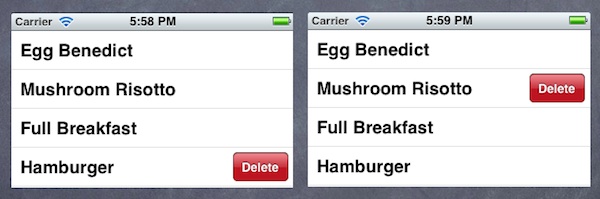
Swipe to Delete a Table Row
2. Delete the corresponding table data from the model
The next thing is to add code to the method and remove the actual table data. Like other table view methods, it passes the indexPath as parameter that tells you the row number for the deletion. So you can make use of this information and remove the corresponding element from the data array.
In the original code of Simple Table App, we use NSArray to store the table data (which is the model). The problem of NSArray is it’s non-editable. That is, you can’t add/remove its content once the array is initialized. Alternatively, we’ll change the NSArray to NSMutableArray, which adds insertion and deletion operations:
@implementation SimpleTableViewController

{

    NSMutableArray *tableData;

}

- (void)viewDidLoad

{

    [super viewDidLoad];

    // Initialize table data

    tableData = [NSMutableArray arrayWithObjects:@"Egg Benedict", @"Mushroom Risotto", @"Full Breakfast", @"Hamburger", @"Ham and Egg Sandwich", @"Creme Brelee", @"White Chocolate Donut", @"Starbucks Coffee", @"Vegetable Curry", @"Instant Noodle with Egg", @"Noodle with BBQ Pork", @"Japanese Noodle with Pork", @"Green Tea", @"Thai Shrimp Cake", @"Angry Birds Cake", @"Ham and Cheese Panini", nil];

}
In the tableView:commitEditingStyle method, add the following code to remove the actual data from the array. Your method should look like this:
- (void)tableView:(UITableView *)tableView commitEditingStyle:(UITableViewCellEditingStyle)editingStyle forRowAtIndexPath:(NSIndexPath *)indexPath

{

    // Remove the row from data model

    [tableData removeObjectAtIndex:indexPath.row];

}
The NSMutableArray provides a number of operations for you to manipulate the content of an array. Here we utilize the “removeObjectAtIndex” method to remove a particular item from the array. You can try to run the app and delete a row. Oops! The app doesn’t work as expected.
It’s not a bug. The app does delete the item from the array. The reason why the deleted item still appears is the view hasn’t been refreshed to reflect the update of the data model.
3. Reload the table view
Therefore, once the underlying data is removed, we need to invoke “reloadData” method to request the table View to refresh. Here is the updated code:
- (void)tableView:(UITableView *)tableView commitEditingStyle:(UITableViewCellEditingStyle)editingStyle forRowAtIndexPath:(NSIndexPath *)indexPath

{

    // Remove the row from data model

    [tableData removeObjectAtIndex:indexPath.row];

    // Request table view to reload

    [tableView reloadData];

}
iphone dev 入门实例3:Delete a Row from UITableView的更多相关文章
- iphone dev 入门实例6:How To Use UIScrollView to Scroll and Zoom and Page
http://www.raywenderlich.com/10518/how-to-use-uiscrollview-to-scroll-and-zoom-content Getting Starte ...
- iphone dev 入门实例7:How to Add Splash Screen in Your iOS App
http://www.appcoda.com/how-to-add-splash-screen-in-your-ios-app/ What’s Splash Screen? For those who ...
- iphone dev 入门实例5:Get the User Location & Address in iPhone App
Create the Project and Design the Interface First, create a new Xcode project using the Single View ...
- iphone dev 入门实例4:CoreData入门
The iPhone Core Data Example Application The application developed in this chapter will take the for ...
- iphone dev 入门实例2:Pass Data Between View Controllers using segue
Assigning View Controller Class In the first tutorial, we simply create a view controller that serve ...
- iphone dev 入门实例1:Use Storyboards to Build Table View
http://www.appcoda.com/use-storyboards-to-build-navigation-controller-and-table-view/ Creating Navig ...
- iphone Dev 开发实例9:Create Grid Layout Using UICollectionView in iOS 6
In this tutorial, we will build a simple app to display a collection of recipe photos in grid layout ...
- iphone Dev 开发实例10:How To Add a Slide-out Sidebar Menu in Your Apps
Creating the Xcode Project With a basic idea about what we’ll build, let’s move on. You can create t ...
- iphone Dev 开发实例8: Parsing an RSS Feed Using NSXMLParser
From : http://useyourloaf.com/blog/2010/10/16/parsing-an-rss-feed-using-nsxmlparser.html Structure o ...
随机推荐
- C与Python变量的区别
C中变量有类型,代表一定内存. 而Python变量只是封装过的指针,没有类型.如果不指向对象,就没有意义,更谈不上类型. python中 a=b,和C中 a=b是完全不同的两个操作.前者只是指针(引用 ...
- HTML里的id等属性命名需要注意
提交 $(function(){ $('#submit').click(function(){ $('#form').submit() }) }) 这里的代码无法完成提交,因为id被命名为submit ...
- 【BZOJ1005】【HNOI2008】明明的烦恼
又是看黄学长的代码写的,估计我的整个BZOJ平推计划都要看黄学长的代码写 原题: 自从明明学了树的结构,就对奇怪的树产生了兴趣......给出标号为1到N的点,以及某些点最终的度数,允许在任意两点间连 ...
- 26 个 jQuery使用技巧
1. 禁用右键点击(Disable right-click) $(document).ready(function(){ $(document).bind("contextmenu" ...
- (转)A Beginner's Guide To Understanding Convolutional Neural Networks
Adit Deshpande CS Undergrad at UCLA ('19) Blog About A Beginner's Guide To Understanding Convolution ...
- 论文笔记之:From Facial Parts Responses to Face Detection: A Deep Learning Approach
From Facial Parts Responses to Face Detection: A Deep Learning Approach ICCV 2015 从以上两张图就可以感受到本文所提方法 ...
- FS拓展设置
一.集群测试说明: 1.该测试的主要目的是:让两个注册在不同FS Server上的账号彼此双方通话. 2.测试工具:eyeBeam .LinPhone 3.FS架构图: 上图中两台FS的分机状况如下: ...
- C语言调试的几种方法
linux系统下,在不gdb调试的情况下,我们如何解决程序崩溃问题呢?首先想到的就是添加log日志信息,其次还有以下几种方法可以帮助我们分析存在的问题: (一)add2line 程序崩溃时会打出一些崩 ...
- proBuilder编辑的模型变黑
----更正: 旧帖中方法有误,解决不了问题. 更正确法: 将proBuilder创建的模型的Static属性由“-”改为去掉勾选: ----旧帖 proBuilder编辑的模型变黑解法: 1,U ...
- fastBinaryJSON
fastBinaryJSON 是基于 fastJSON 的二进制 JSON 序列化器.详细介绍请看这里. 数据编码格式: 序列化速度比较: