
iphone dev 入门实例7:How to Add Splash Screen in Your iOS App
http://www.appcoda.com/how-to-add-splash-screen-in-your-ios-app/
What’s Splash Screen?
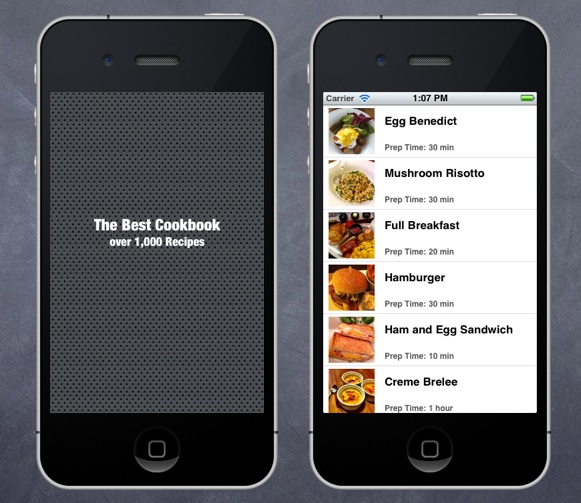
For those who are new to programming and haven’t heard of the term “Splash Screen”, let me first give a brief explanation about it. Splash screen is commonly found in iOS apps, as well as, other desktop applications. This is the first screen you see when launching an application. Usually, splash screen is an image covering the entire screen and disappears after the main screen is loaded. Below figure shows you a few samples of splash screen:

Sample Splash Screens / Launch Images
The primary purpose of splash screen is to let user know your app is loading and give user an introductory screen showing your brand. Splash screen is especially important for apps that take longer time to launch. Perceptually, it gives a better user experience.
Adding Splash Screen in Your App
As mentioned earlier, it’s not required to write any code to display the splash screen. iOS comes with a built-in function called launch image. This image is automatically displayed when user opens the app and disappeared until the app is fully ready to use. You can simply specify your splash screen as launch image in Xcode and it will handle the rest for you.
Preparing Your Splash Screen
As you know, iPhone 4/4S supports a higher screen resolution (what so called Retina Display). In order to support both screen resolution of older iPhone models and latest models, you have to prepare two versions of splash screen images of these sizes:
- 320 x 480 (for iPhone 2G / 3G / 3GS)
- 640 x 960 (for iPhone 4 / 4S)
The splash screen image should be in PNG format. By default, you should name the image file for lower screen resolution as “Default.png”. For the image intended for Retina Display (i.e. 640 x 960 screen resolution), name the file as “Default@2x.png”. The “@2x” is a standard scale modifier used in iOS. All image files designated for displaying in Retina Display should name with the optional string “@2x”.
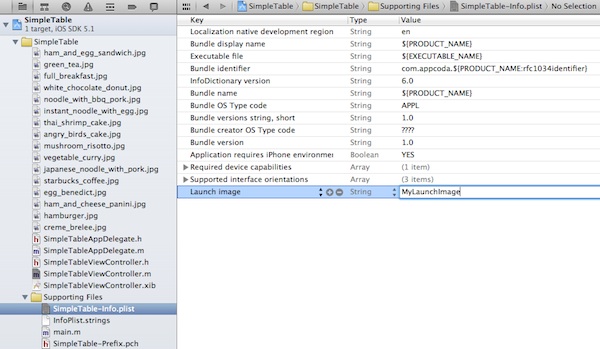
The change instructs iOS to pick “MyLaunchImage.png” and “MyLaunchImage@2x.png” as launch image.
You can design your own splash screen. For testing purpose, you may download the sample splash screens.

Splash Screen for Our Simple Table App
Add Your Launch Image in Xcode
After preparing the launch image, go back to Xcode and open your Xcode project. Here we’ll continue to use our Simple Table project. Right click the “SimpleTable” project and select “Add Files to SimpleTable”. Add both “Default.png” and “Default@2x.png” to your project.

Add File to Xcode Project
If you’ve done everything correctly, you’ll see both files in your project and Xcode automatically recognizes the files as launch images.

Launch Image added in Xcode
Test it Out!
Simply run your app again. This time you’ll see a splash screen shown up instantly as it runs. For now, there is not much thing to load during application startup. (Note: the splash screen only shows up for a second and disappears.)
iphone dev 入门实例7:How to Add Splash Screen in Your iOS App的更多相关文章
- iphone dev 入门实例3:Delete a Row from UITableView
How To Delete a Row from UITableView I hope you have a better understanding about Model-View-Control ...
- iphone dev 入门实例6:How To Use UIScrollView to Scroll and Zoom and Page
http://www.raywenderlich.com/10518/how-to-use-uiscrollview-to-scroll-and-zoom-content Getting Starte ...
- iphone dev 入门实例5:Get the User Location & Address in iPhone App
Create the Project and Design the Interface First, create a new Xcode project using the Single View ...
- iphone dev 入门实例4:CoreData入门
The iPhone Core Data Example Application The application developed in this chapter will take the for ...
- iphone Dev 开发实例10:How To Add a Slide-out Sidebar Menu in Your Apps
Creating the Xcode Project With a basic idea about what we’ll build, let’s move on. You can create t ...
- iphone dev 入门实例2:Pass Data Between View Controllers using segue
Assigning View Controller Class In the first tutorial, we simply create a view controller that serve ...
- iphone dev 入门实例1:Use Storyboards to Build Table View
http://www.appcoda.com/use-storyboards-to-build-navigation-controller-and-table-view/ Creating Navig ...
- iphone Dev 开发实例9:Create Grid Layout Using UICollectionView in iOS 6
In this tutorial, we will build a simple app to display a collection of recipe photos in grid layout ...
- iphone Dev 开发实例8: Parsing an RSS Feed Using NSXMLParser
From : http://useyourloaf.com/blog/2010/10/16/parsing-an-rss-feed-using-nsxmlparser.html Structure o ...
随机推荐
- Makefile---make内嵌函数及make命令显示 (九)
原创博文,转载请标明出处--周学伟http://www.cnblogs.com/zxouxuewei/ 这一节我们讲一下make的函数,在之前的章节已经讲到了几个函数:wildcard.patsubs ...
- Java动物声音模拟器
abstract class Animal{ abstract void cry(); abstract String getAnimalName(); } class Simulator{ void ...
- jQuery select操作控制方法小结
需要注意的是,这里的代码好多是针对jquery 1.32以前的版本(以后的版本已经不支持@),所以替换为空测试下即可. jQuery获取Select选择的Text和Value: 语法解释: 1. $( ...
- NOI 银河英雄传说
并查集水题,记录祖先,大小和深度即可,每次用祖先的大小和深度更新后代的深度. #include <cstdio> #include <iostream> #include &l ...
- 复利计算器4.0 【java版】
import java.util.Scanner; public class FuLi { public static void main(String[] args) { ; Scanner sca ...
- Oracle数据库——Scheduler Job
日常的运维工作中,我们经常使用Linux Server的anacron服务来使得服务器执行一下计划之内的任务,可以按照特定的时间间隔,重复的执行相关的命令或者相关的脚本,来完成预期的目标,能够节省相关 ...
- JavaScript 的字符串转换
数字.布尔值等其他数据类型都可以转换成字符串:一般来说,脚本引擎将根据上下文自动完成这样的转换.例如,当把数字或布尔型变量传给希望接收字符串变量的函数时,就会先隐式地将该数值转换成字符串,再进行处理: ...
- linux概念之/dev/shm
Linux默认(CentOS)/dev/shm分区的大小是系统物理内存的50%, 虽说使用/dev/shm对文件操作的效率会高很多,但是目前各发行软件中却很少有使用它的(除了前面提到的Oracle), ...
- OpenJudge计算概论-细菌的战争
/*====================================================================== 细菌的战争 总时间限制: 1000ms 内存限制: 6 ...
- HTML5之Canvas绘图实例——饼状图
实现饼状分布画图(如下):调试环境:Firefox