
POJ 2007--Scrambled Polygon(计算凸包,点集顺序)
| Time Limit: 1000MS | Memory Limit: 30000K | |
| Total Submissions: 10094 | Accepted: 4765 |
Description
A closed polygon is called convex if the line segment joining any two points of the polygon lies in the polygon. Figure 1 shows a closed polygon which is convex and one which is not convex. (Informally, a closed polygon is convex if its border doesn't have any "dents".) 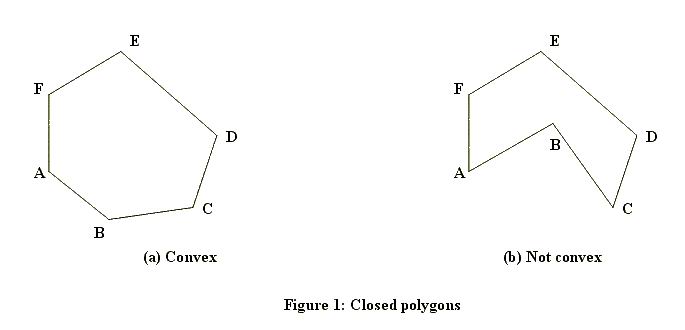
The subject of this problem is a closed convex polygon in the coordinate plane, one of whose vertices is the origin (x = 0, y = 0). Figure 2 shows an example. Such a polygon will have two properties significant for this problem.
The first property is that the vertices of the polygon will be confined to three or fewer of the four quadrants of the coordinate plane. In the example shown in Figure 2, none of the vertices are in the second quadrant (where x < 0, y > 0).
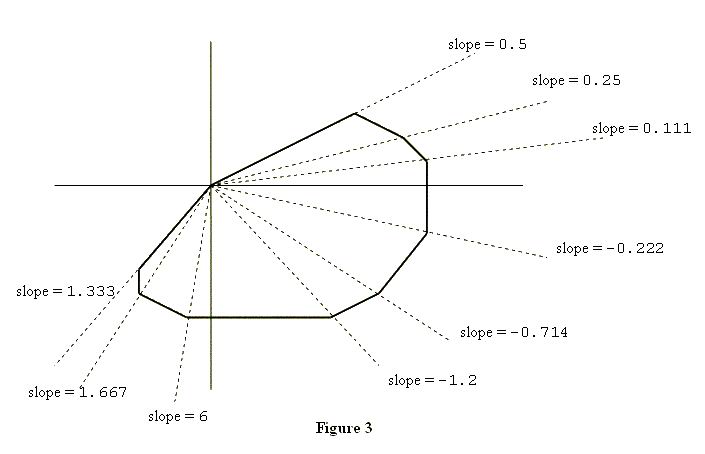
To describe the second property, suppose you "take a trip" around the polygon: start at (0, 0), visit all other vertices exactly once, and arrive at (0, 0). As you visit each vertex (other than (0, 0)), draw the diagonal that connects the current vertex with (0, 0), and calculate the slope of this diagonal. Then, within each quadrant, the slopes of these diagonals will form a decreasing or increasing sequence of numbers, i.e., they will be sorted. Figure 3 illustrates this point. 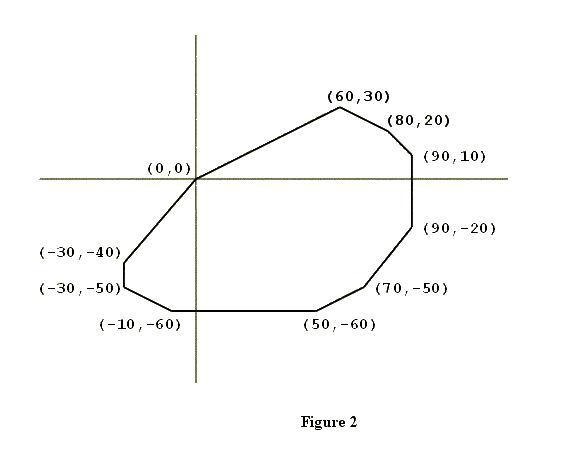
Input
Output
Sample Input
0 0

70 -50

60 30

-30 -50

80 20

50 -60

90 -20

-30 -40

-10 -60

90 10
Sample Output
(0,0)

(-30,-40)

(-30,-50)

(-10,-60)

(50,-60)

(70,-50)

(90,-20)

(90,10)

(80,20)

(60,30)
Source
 #include<iostream>

 #include<algorithm>

 #include<cmath>

 #include<cstdio>

 using namespace std;

 const int maxn = ;

 typedef struct point {

     double x, y;

     point() {

     }

     point(double a, double b) {

         x = a;

         y = b;

     }

     point operator -(const point &b) const{

         return point(x - b.x, y - b.x);

     }

     double operator *(const point &b)const {

         return x*b.x + y*b.y;

     }

 }point;

 point p[maxn];

 int n=, res[maxn];

 int top;//top模拟栈顶

 bool cmp(point a, point b) {

     if (a.y == b.y)    return a.x < b.x;

     return a.y < b.y;

 }

 bool multi(point p1, point p2, point p0) {  //判断p1p0和p2p0的关系,<0,p1p0在p2p0的逆时针方向,>0,p1p0在p2p0的顺时针方向

     return (p1.x - p0.x)*(p2.y - p0.y) >= (p2.x - p0.x)*(p1.y - p0.y);

 }

 void Graham(){

     int i, len;//top模拟栈顶

     sort(p, p + n, cmp);

     top = ;

     //少于3个点也就没有办法形成凸包

     if (n == )return; res[] = ;

     if (n == )return; res[] = ;

     if (n == )return; res[] = ;

     for (i = ;  i < n; i++) {

         while (top&&multi(p[i], p[res[top]], p[res[top - ]]))    //如果当前这个点和栈顶两个点构成折线右拐了,就回溯到上一个点

             top--;                                                //弹出栈顶

         res[++top] = i;                                            //否则将这个点入栈

     }

     len = top;

     res[++top] = n - ;

     for (i = n - ; i >= ; i--) {

         while (top!=len&&multi(p[i], p[res[top]], p[res[top - ]]))

             top--;

         res[++top] = i;

     }

 }

 int main(void) {

     int i, s;//s为起点坐标

     while (scanf("%lf%lf", &p[n].x, &p[n].y)!=EOF)n++;

     Graham();

     for (s = ; s < top; s++) {

         if (!p[res[s]].x && !p[res[s]].y)    //找到原点

             break;

     }

     for (i = s; i < top; i++) {

         printf("(%.lf,%.lf)\n",p[res[i]].x, p[res[i]].y);

     }

     for (i = ; i < s; i++) {

         printf("(%.lf,%.lf)\n", p[res[i]].x, p[res[i]].y);

     }

     return ;

 }
POJ 2007--Scrambled Polygon(计算凸包,点集顺序)的更多相关文章
- POJ 2007 Scrambled Polygon 凸包
Scrambled Polygon Time Limit: 1000MS Memory Limit: 30000K Total Submissions: 7214 Accepted: 3445 ...
- POJ 2007 Scrambled Polygon [凸包 极角排序]
Scrambled Polygon Time Limit: 1000MS Memory Limit: 30000K Total Submissions: 8636 Accepted: 4105 ...
- POJ 2007 Scrambled Polygon 极角序 水
LINK 题意:给出一个简单多边形,按极角序输出其坐标. 思路:水题.对任意两点求叉积正负判断相对位置,为0则按长度排序 /** @Date : 2017-07-13 16:46:17 * @File ...
- POJ 2007 Scrambled Polygon 凸包点排序逆时针输出
题意:如题 用Graham,直接就能得到逆时针的凸包,找到原点输出就行了,赤果果的水题- 代码: /* * Author: illuz <iilluzen[at]gmail.com> * ...
- poj 2007 Scrambled Polygon(极角排序)
http://poj.org/problem?id=2007 Time Limit: 1000MS Memory Limit: 30000K Total Submissions: 6701 A ...
- ●POJ 2007 Scrambled Polygon
题链: http://poj.org/problem?id=2007 题解: 计算几何,极角排序 按样例来说,应该就是要把凸包上的i点按 第三像限-第四像限-第一像限-第二像限 的顺序输出. 按 叉积 ...
- 简单几何(极角排序) POJ 2007 Scrambled Polygon
题目传送门 题意:裸的对原点的极角排序,凸包貌似不行. /************************************************ * Author :Running_Time ...
- POJ 2007 Scrambled Polygon(简单极角排序)
水题,根本不用凸包,就是一简单的极角排序. 叉乘<0,逆时针. #include <iostream> #include <cstdio> #include <cs ...
- POJ 2007 Scrambled Polygon (简单极角排序)
题目链接 题意 : 对输入的点极角排序 思路 : 极角排序方法 #include <iostream> #include <cmath> #include <stdio. ...
- poj 2007 Scrambled Polygon 极角排序
/** 极角排序输出,,, 主要atan2(y,x) 容易失精度,,用 bool cmp(point a,point b){ 5 if(cross(a-tmp,b-tmp)>0) 6 retur ...
随机推荐
- poj 1655 树的重心 && define注意事项
http://blog.csdn.net/acdreamers/article/details/16905653 题意:给定一棵树,求树的重心的编号以及重心删除后得到的最大子树的节点个数size,如果 ...
- 【代码笔记】Java学习一阶段总结
写笔记需要打开eclipse写 哈哈哈哈,不然写什么都屡不清了 ……还需要打开API说明文档. JFrame 窗体组件. JFrame里面常用的函数: setSize 设置窗体大小 setDefaul ...
- querySelector()与querySelectorAll()的区别及NodeList和HTMLCollection对象的区别
querySelector().Document.Element类型均可调用该方法. 当用Document类型调用querySelector()方法时,会在文档元素范围内查找匹配的元素:而当用Elem ...
- jQuery之检测分析纠错------地狱的镰刀
1. 答: 或者: $(selector).eq(0).hide(); 解答:get() 方法获得由选择器指定的 DOM 元素. 2. 答: 3, 答1: 答2: 4. slideDown()方法格式 ...
- JavaScript的数据类型与变量
JavaScript数据类型 1.原始数据类型: 数值型,如十进制数.十六进制数.八进制数和特殊值(Infinity.NaN),注意:NaN不能和自身比较 字符串型,如定界符.转义符: 布尔类型. 2 ...
- .Net中会存在内存泄漏吗
所谓内存泄露就是指一个不再被程序使用的对象或变量一直被占据在内存中..Net 中有垃圾回收机制,它可以保证一对象不再被引用的时候,即对象编程了孤儿的时候,对象将自动被垃圾回收器从内存中清除掉.虽然.N ...
- matlab练习程序(单源最短路径Dijkstra)
图的相关算法也算是自己的一个软肋了,当年没选修图论也是一大遗憾. 图像处理中,也有使用图论算法作为基础的相关算法,比如图割,这个算法就需要求最大流.最小割.所以熟悉一下图论算法对于图像处理还是很有帮助 ...
- jdk时区相差8小时
设置JVM的默认时区为东八区(北京时间)在下面四个目录(jre6\lib\zi\Etc.jre6\lib\zi.jdk1.6.0_18\jre\lib\zi\Etc.jdk1.6.0_18\jre\l ...
- 三大框架之list
前言: 在我们平常开发中难免会用到List集合来存储数据,一般都会选择ArrayList和LinkedList,以前只是大致知道ArrayList查询效率高LinkedList插入删除效率高,今天来实 ...
- event.cancelBubble=true
<tr><a href="xxx">连接</a></tr> 如上结构,单击tr的时候跳转至另一页面 <tr style=&qu ...