
吴裕雄 python 机器学习——支持向量机线性分类LinearSVC模型
import numpy as np

import matplotlib.pyplot as plt

from sklearn import datasets, linear_model,svm

from sklearn.model_selection import train_test_split

def load_data_classfication():

    '''

    加载用于分类问题的数据集

    '''

    # 使用 scikit-learn 自带的 iris 数据集

    iris=datasets.load_iris()

    X_train=iris.data

    y_train=iris.target

    # 分层采样拆分成训练集和测试集,测试集大小为原始数据集大小的 1/4

    return train_test_split(X_train, y_train,test_size=0.25,random_state=0,stratify=y_train)

#支持向量机线性分类LinearSVC模型

def test_LinearSVC(*data):

    X_train,X_test,y_train,y_test=data

    cls=svm.LinearSVC()

    cls.fit(X_train,y_train)

    print('Coefficients:%s, intercept %s'%(cls.coef_,cls.intercept_))

    print('Score: %.2f' % cls.score(X_test, y_test))

# 生成用于分类的数据集

X_train,X_test,y_train,y_test=load_data_classfication()

# 调用 test_LinearSVC

test_LinearSVC(X_train,X_test,y_train,y_test)

def test_LinearSVC_loss(*data):

    '''

    测试 LinearSVC 的预测性能随损失函数的影响

    '''

    X_train,X_test,y_train,y_test=data

    losses=['hinge','squared_hinge']

    for loss in losses:

        cls=svm.LinearSVC(loss=loss)

        cls.fit(X_train,y_train)

        print("Loss:%s"%loss)

        print('Coefficients:%s, intercept %s'%(cls.coef_,cls.intercept_))

        print('Score: %.2f' % cls.score(X_test, y_test))

# 调用 test_LinearSVC_loss

test_LinearSVC_loss(X_train,X_test,y_train,y_test)
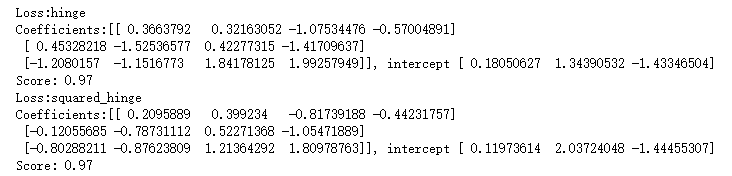
def test_LinearSVC_L12(*data):

    '''

    测试 LinearSVC 的预测性能随正则化形式的影响

    '''

    X_train,X_test,y_train,y_test=data

    L12=['l1','l2']

    for p in L12:

        cls=svm.LinearSVC(penalty=p,dual=False)

        cls.fit(X_train,y_train)

        print("penalty:%s"%p)

        print('Coefficients:%s, intercept %s'%(cls.coef_,cls.intercept_))

        print('Score: %.2f' % cls.score(X_test, y_test))

# 调用 test_LinearSVC_L12

test_LinearSVC_L12(X_train,X_test,y_train,y_test)

def test_LinearSVC_C(*data):

    '''

    测试 LinearSVC 的预测性能随参数 C 的影响

    '''

    X_train,X_test,y_train,y_test=data

    Cs=np.logspace(-2,1)

    train_scores=[]

    test_scores=[]

    for C in Cs:

        cls=svm.LinearSVC(C=C)

        cls.fit(X_train,y_train)

        train_scores.append(cls.score(X_train,y_train))

        test_scores.append(cls.score(X_test,y_test))

    ## 绘图

    fig=plt.figure()

    ax=fig.add_subplot(1,1,1)

    ax.plot(Cs,train_scores,label="Traing score")

    ax.plot(Cs,test_scores,label="Testing score")

    ax.set_xlabel(r"C")

    ax.set_ylabel(r"score")

    ax.set_xscale('log')

    ax.set_title("LinearSVC")

    ax.legend(loc='best')

    plt.show()

# 调用 test_LinearSVC_C

test_LinearSVC_C(X_train,X_test,y_train,y_test)

吴裕雄 python 机器学习——支持向量机线性分类LinearSVC模型的更多相关文章
- 吴裕雄 python 机器学习——支持向量机SVM非线性分类SVC模型
import numpy as np import matplotlib.pyplot as plt from sklearn import datasets, linear_model,svm fr ...
- 吴裕雄 python 机器学习——支持向量机非线性回归SVR模型
import numpy as np import matplotlib.pyplot as plt from sklearn import datasets, linear_model,svm fr ...
- 吴裕雄 python 机器学习——支持向量机线性回归SVR模型
import numpy as np import matplotlib.pyplot as plt from sklearn import datasets, linear_model,svm fr ...
- 吴裕雄 python 机器学习——局部线性嵌入LLE降维模型
# -*- coding: utf-8 -*- import numpy as np import matplotlib.pyplot as plt from sklearn import datas ...
- 吴裕雄 python 机器学习——数据预处理流水线Pipeline模型
from sklearn.svm import LinearSVC from sklearn.pipeline import Pipeline from sklearn import neighbor ...
- 吴裕雄 python 机器学习——K均值聚类KMeans模型
import numpy as np import matplotlib.pyplot as plt from sklearn import cluster from sklearn.metrics ...
- 吴裕雄 python 机器学习——混合高斯聚类GMM模型
import numpy as np import matplotlib.pyplot as plt from sklearn import mixture from sklearn.metrics ...
- 吴裕雄 python 机器学习——超大规模数据集降维IncrementalPCA模型
# -*- coding: utf-8 -*- import numpy as np import matplotlib.pyplot as plt from sklearn import datas ...
- 吴裕雄 python 机器学习——数据预处理正则化Normalizer模型
from sklearn.preprocessing import Normalizer #数据预处理正则化Normalizer模型 def test_Normalizer(): X=[[1,2,3, ...
随机推荐
- C语言 continue
C语言 continue 在循环语句中,如果希望立即终止本次循环,并执行下一次循环,此时就需要使用continue语句. 案例 #include<stdio.h> int main() { ...
- Python标准库之shutil模块
高级的文件.文件夹.压缩包处理模块. 文件复制 copyfileobj 将文件类对象 fsrc 的内容拷贝到文件类对象 fdst. shutil.copyfileobj(fsrc, fdst[, le ...
- c++ 踩坑大法好 char字符,char数组,char*
1,基本语法 1,定义一个char字符: char hehe='a'; //单引号 2,定义一个由char字符组成的数组: char daqing[] = "abcd"; char ...
- KMP小扩展,找出子串在主串中出现的所有位置
KMP算法能够高效地匹配字符串,找出子串(T串)在主串(S串)中出现的首个位置的原算法网上已经有很多优秀的博文进行详细讲解,这里就不多赘述. 这篇博文主要是对KMP原算法稍作改动,使其能够在主串中把所 ...
- day02_1hibernate
对象状态与一级缓存 一.对象缓存状态的介绍: ①在使用hibernate时对象的三种状态:(代码如下) 瞬时状态 :没有与session关联,没有主键OID标识(主键的OID指的是对象id,在配置文件 ...
- Sql 语句常语法
以前感觉在这个方面很欠缺,于是就找了些这方面的材料,自己也做了些总结,汇总到了一块.便于以后的查阅. --1.获取表的主键字段SELECT name FROM SysColumns WHERE id= ...
- 【PAT甲级】1119 Pre- and Post-order Traversals (30分)(已知先序后序输出是否二叉树唯一并输出中序遍历)
题意: 输入一个正整数N(<=30),接着输入两行N个正整数第一行为先序遍历,第二行为后续遍历.输出是否可以构造一棵唯一的二叉树并输出其中一颗二叉树的中序遍历. trick: 输出完毕中序遍历后 ...
- 增删改查-删除(php)
<!DOCTYPE html> <html><script type="text/javascript" src="jquery-1.11. ...
- AspxDashBorad_OnDashboardLoaded 获取对应的DashboardParameter
protected void ASPxDashboardViewerThrend_OnDashboardLoaded(object sender, DashboardLoadedWebEventArg ...
- Python之旅第二天(第一天补充部分、数据类型、运算逻辑、部分方法的引入、pycharm)
今天其实是有点小忙的,但是干自己不喜欢事情的结果就是,要睡觉了都不知道自己在忙鸡毛,所以还是不继续想了,脑仁疼.回忆一下今天的学习内容,着实有点少,本大侠还没怎么过瘾呢.废话不多说. while补充两 ...