
吴裕雄 python 机器学习——支持向量机线性回归SVR模型
import numpy as np

import matplotlib.pyplot as plt

from sklearn import datasets, linear_model,svm

from sklearn.model_selection import train_test_split

def load_data_regression():

    '''

    加载用于回归问题的数据集

    '''

    diabetes = datasets.load_diabetes() #使用 scikit-learn 自带的一个糖尿病病人的数据集

    # 拆分成训练集和测试集,测试集大小为原始数据集大小的 1/4

    return train_test_split(diabetes.data,diabetes.target,test_size=0.25,random_state=0)

#支持向量机线性回归SVR模型

def test_LinearSVR(*data):

    X_train,X_test,y_train,y_test=data

    regr=svm.LinearSVR()

    regr.fit(X_train,y_train)

    print('Coefficients:%s, intercept %s'%(regr.coef_,regr.intercept_))

    print('Score: %.2f' % regr.score(X_test, y_test))

# 生成用于回归问题的数据集

X_train,X_test,y_train,y_test=load_data_regression()

# 调用 test_LinearSVR

test_LinearSVR(X_train,X_test,y_train,y_test)

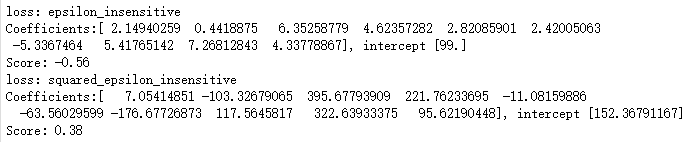
def test_LinearSVR_loss(*data):

    '''

   测试 LinearSVR 的预测性能随不同损失函数的影响

    '''

    X_train,X_test,y_train,y_test=data

    losses=['epsilon_insensitive','squared_epsilon_insensitive']

    for loss in losses:

        regr=svm.LinearSVR(loss=loss)

        regr.fit(X_train,y_train)

        print("loss:%s"%loss)

        print('Coefficients:%s, intercept %s'%(regr.coef_,regr.intercept_))

        print('Score: %.2f' % regr.score(X_test, y_test))

# 调用 test_LinearSVR_loss

test_LinearSVR_loss(X_train,X_test,y_train,y_test)
def test_LinearSVR_epsilon(*data):

    '''

    测试 LinearSVR 的预测性能随 epsilon 参数的影响

    '''

    X_train,X_test,y_train,y_test=data

    epsilons=np.logspace(-2,2)

    train_scores=[]

    test_scores=[]

    for  epsilon in  epsilons:

        regr=svm.LinearSVR(epsilon=epsilon,loss='squared_epsilon_insensitive')

        regr.fit(X_train,y_train)

        train_scores.append(regr.score(X_train, y_train))

        test_scores.append(regr.score(X_test, y_test))

    fig=plt.figure()

    ax=fig.add_subplot(1,1,1)

    ax.plot(epsilons,train_scores,label="Training score ",marker='+' )

    ax.plot(epsilons,test_scores,label= " Testing  score ",marker='o' )

    ax.set_title( "LinearSVR_epsilon ")

    ax.set_xscale("log")

    ax.set_xlabel(r"$\epsilon$")

    ax.set_ylabel("score")

    ax.set_ylim(-1,1.05)

    ax.legend(loc="best",framealpha=0.5)

    plt.show()

# 调用 test_LinearSVR_epsilon

test_LinearSVR_epsilon(X_train,X_test,y_train,y_test)

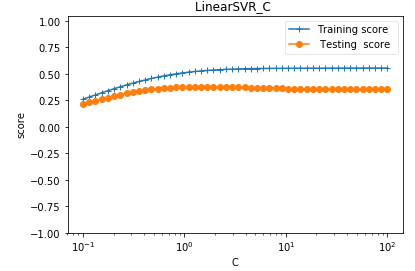
def test_LinearSVR_C(*data):

    '''

    测试 LinearSVR 的预测性能随 C 参数的影响

    '''

    X_train,X_test,y_train,y_test=data

    Cs=np.logspace(-1,2)

    train_scores=[]

    test_scores=[]

    for  C in  Cs:

        regr=svm.LinearSVR(epsilon=0.1,loss='squared_epsilon_insensitive',C=C)

        regr.fit(X_train,y_train)

        train_scores.append(regr.score(X_train, y_train))

        test_scores.append(regr.score(X_test, y_test))

    fig=plt.figure()

    ax=fig.add_subplot(1,1,1)

    ax.plot(Cs,train_scores,label="Training score ",marker='+' )

    ax.plot(Cs,test_scores,label= " Testing  score ",marker='o' )

    ax.set_title( "LinearSVR_C ")

    ax.set_xscale("log")

    ax.set_xlabel(r"C")

    ax.set_ylabel("score")

    ax.set_ylim(-1,1.05)

    ax.legend(loc="best",framealpha=0.5)

    plt.show()

# 调用 test_LinearSVR_C

test_LinearSVR_C(X_train,X_test,y_train,y_test)
吴裕雄 python 机器学习——支持向量机线性回归SVR模型的更多相关文章
- 吴裕雄 python 机器学习——支持向量机非线性回归SVR模型
import numpy as np import matplotlib.pyplot as plt from sklearn import datasets, linear_model,svm fr ...
- 吴裕雄 python 机器学习——支持向量机SVM非线性分类SVC模型
import numpy as np import matplotlib.pyplot as plt from sklearn import datasets, linear_model,svm fr ...
- 吴裕雄 python 机器学习——支持向量机线性分类LinearSVC模型
import numpy as np import matplotlib.pyplot as plt from sklearn import datasets, linear_model,svm fr ...
- 吴裕雄 python 机器学习——层次聚类AgglomerativeClustering模型
import numpy as np import matplotlib.pyplot as plt from sklearn import cluster from sklearn.metrics ...
- 吴裕雄 python 机器学习——密度聚类DBSCAN模型
import numpy as np import matplotlib.pyplot as plt from sklearn import cluster from sklearn.metrics ...
- 吴裕雄 python 机器学习——KNN回归KNeighborsRegressor模型
import numpy as np import matplotlib.pyplot as plt from sklearn import neighbors, datasets from skle ...
- 吴裕雄 python 机器学习——KNN分类KNeighborsClassifier模型
import numpy as np import matplotlib.pyplot as plt from sklearn import neighbors, datasets from skle ...
- 吴裕雄 python 机器学习——半监督学习LabelSpreading模型
import numpy as np import matplotlib.pyplot as plt from sklearn import metrics from sklearn import d ...
- 吴裕雄 python 机器学习——线性回归模型
import numpy as np from sklearn import datasets,linear_model from sklearn.model_selection import tra ...
随机推荐
- 假期学习【十一】Python切词,以及从百度爬取词典
今天主要对从CSDN爬取的标题利用jieba(结巴)进行分词,但在分词过程中发现,如大数据被分成了大/数据,云计算被分隔成了云/计算. 后来又从百度百科--->信息领域爬取了相关词语作为词典,预 ...
- 深信服SCSA
最近应公司要求报了SCSA课程,老师讲解的可谓是非常的专业以及详细,不止深信服产品及其配置,还有VPN,网络基础的原理介绍等等,产品不用说,工作中会遇到,能学即学.最好的要数网络发包原理,建立连接等底 ...
- Common Subsequence POJ - 1458 最长公共子序列 线性DP
#include <iostream> #include <algorithm> #include <string> #include <cstring> ...
- 如何在Windows上开启Ping或者禁止PING
方法1:命令行模式 进入服务器后 点击 开始——运行 输入命令: netsh firewall set icmpsetting 8 这样就可以在外部ping到服务器了 非常简单实用! 同样道理,如果想 ...
- netcore 添加swagger
1.添加相应的nuget包 2.配置服务和swaggerui startup.cs 中 configureServices 中添加下面代码: //swagger services.AddSwagge ...
- chrome查看js报错Uncaught SyntaxError: Unexpected string
个人博客原文http://wenhaofan.com/article/20180912123136 js报错,最后发现是$(function(){})这部分()不完整 $(function({ $(& ...
- leetcode腾讯精选练习之相交链表(六)
相交链表 题目: 编写一个程序,找到两个单链表相交的起始节点. 如下面的两个链表: 在节点 c1 开始相交. 示例 1: 输入:intersectVal = 8, listA = [4,1,8,4,5 ...
- Qt VS Tools插件官方下载及安装
下载 官方下载地址:https://download.qt.io/development_releases/vsaddin/(国外网站直接打开超级慢) 找到对应的VS版本下载 安装 下载完成后安装,打 ...
- AcWing 892. 台阶-Nim游戏
#include<iostream> using namespace std; int n; int main() { cin>>n; ; ; i<=n; i++) { ...
- 继 “多闪”后“飞聊”再被diss?其实社交还能这么玩
近日头条低调上线了新的社交APP——飞聊,目前在AppStore社交排行榜第7位.但很多人使用了之后都觉得新产品的各个功能都让人想起其他的产品.兴趣小组让人想到豆瓣的兴趣小组,生活动态让人想到微博动态 ...