
吴裕雄 python 机器学习——支持向量机线性分类LinearSVC模型
import numpy as np

import matplotlib.pyplot as plt

from sklearn import datasets, linear_model,svm

from sklearn.model_selection import train_test_split

def load_data_classfication():

    '''

    加载用于分类问题的数据集

    '''

    # 使用 scikit-learn 自带的 iris 数据集

    iris=datasets.load_iris()

    X_train=iris.data

    y_train=iris.target

    # 分层采样拆分成训练集和测试集,测试集大小为原始数据集大小的 1/4

    return train_test_split(X_train, y_train,test_size=0.25,random_state=0,stratify=y_train)

#支持向量机线性分类LinearSVC模型

def test_LinearSVC(*data):

    X_train,X_test,y_train,y_test=data

    cls=svm.LinearSVC()

    cls.fit(X_train,y_train)

    print('Coefficients:%s, intercept %s'%(cls.coef_,cls.intercept_))

    print('Score: %.2f' % cls.score(X_test, y_test))

# 生成用于分类的数据集

X_train,X_test,y_train,y_test=load_data_classfication()

# 调用 test_LinearSVC

test_LinearSVC(X_train,X_test,y_train,y_test)

def test_LinearSVC_loss(*data):

    '''

    测试 LinearSVC 的预测性能随损失函数的影响

    '''

    X_train,X_test,y_train,y_test=data

    losses=['hinge','squared_hinge']

    for loss in losses:

        cls=svm.LinearSVC(loss=loss)

        cls.fit(X_train,y_train)

        print("Loss:%s"%loss)

        print('Coefficients:%s, intercept %s'%(cls.coef_,cls.intercept_))

        print('Score: %.2f' % cls.score(X_test, y_test))

# 调用 test_LinearSVC_loss

test_LinearSVC_loss(X_train,X_test,y_train,y_test)
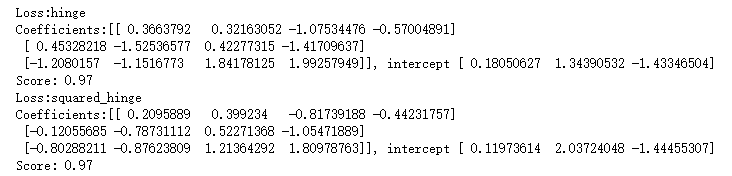
def test_LinearSVC_L12(*data):

    '''

    测试 LinearSVC 的预测性能随正则化形式的影响

    '''

    X_train,X_test,y_train,y_test=data

    L12=['l1','l2']

    for p in L12:

        cls=svm.LinearSVC(penalty=p,dual=False)

        cls.fit(X_train,y_train)

        print("penalty:%s"%p)

        print('Coefficients:%s, intercept %s'%(cls.coef_,cls.intercept_))

        print('Score: %.2f' % cls.score(X_test, y_test))

# 调用 test_LinearSVC_L12

test_LinearSVC_L12(X_train,X_test,y_train,y_test)

def test_LinearSVC_C(*data):

    '''

    测试 LinearSVC 的预测性能随参数 C 的影响

    '''

    X_train,X_test,y_train,y_test=data

    Cs=np.logspace(-2,1)

    train_scores=[]

    test_scores=[]

    for C in Cs:

        cls=svm.LinearSVC(C=C)

        cls.fit(X_train,y_train)

        train_scores.append(cls.score(X_train,y_train))

        test_scores.append(cls.score(X_test,y_test))

    ## 绘图

    fig=plt.figure()

    ax=fig.add_subplot(1,1,1)

    ax.plot(Cs,train_scores,label="Traing score")

    ax.plot(Cs,test_scores,label="Testing score")

    ax.set_xlabel(r"C")

    ax.set_ylabel(r"score")

    ax.set_xscale('log')

    ax.set_title("LinearSVC")

    ax.legend(loc='best')

    plt.show()

# 调用 test_LinearSVC_C

test_LinearSVC_C(X_train,X_test,y_train,y_test)

吴裕雄 python 机器学习——支持向量机线性分类LinearSVC模型的更多相关文章
- 吴裕雄 python 机器学习——支持向量机SVM非线性分类SVC模型
import numpy as np import matplotlib.pyplot as plt from sklearn import datasets, linear_model,svm fr ...
- 吴裕雄 python 机器学习——支持向量机非线性回归SVR模型
import numpy as np import matplotlib.pyplot as plt from sklearn import datasets, linear_model,svm fr ...
- 吴裕雄 python 机器学习——支持向量机线性回归SVR模型
import numpy as np import matplotlib.pyplot as plt from sklearn import datasets, linear_model,svm fr ...
- 吴裕雄 python 机器学习——局部线性嵌入LLE降维模型
# -*- coding: utf-8 -*- import numpy as np import matplotlib.pyplot as plt from sklearn import datas ...
- 吴裕雄 python 机器学习——数据预处理流水线Pipeline模型
from sklearn.svm import LinearSVC from sklearn.pipeline import Pipeline from sklearn import neighbor ...
- 吴裕雄 python 机器学习——K均值聚类KMeans模型
import numpy as np import matplotlib.pyplot as plt from sklearn import cluster from sklearn.metrics ...
- 吴裕雄 python 机器学习——混合高斯聚类GMM模型
import numpy as np import matplotlib.pyplot as plt from sklearn import mixture from sklearn.metrics ...
- 吴裕雄 python 机器学习——超大规模数据集降维IncrementalPCA模型
# -*- coding: utf-8 -*- import numpy as np import matplotlib.pyplot as plt from sklearn import datas ...
- 吴裕雄 python 机器学习——数据预处理正则化Normalizer模型
from sklearn.preprocessing import Normalizer #数据预处理正则化Normalizer模型 def test_Normalizer(): X=[[1,2,3, ...
随机推荐
- IndexedDB基本概念
控制台 IndexedDB下为数据库 数据库下为表,表内容展现为主键值和其余值,其中其余值包括索引和其他任意字段,以对象形式表现 表下为索引字段表,用来展现拥有同一种索引字段的所有数据(有多少种索引就 ...
- Real-time Compressive Tracking
这是RTC算法的文献blog Real-time Compressive Tracking Kaihua Zhang1, Lei Zhang1, Ming-Hsuan Yang2 1Dept. of ...
- 其他 - PotPlayer - 基础快捷键总结
概述 尝试使用 potplayer 的快捷键 背景 最近需要反复看录像 回看 慢速 其他各种 没错, 我的需求就是 游戏复盘... 环境 os win10.1903 player potplayer. ...
- Codeforces 383C Propagating tree, 线段树, 黑白染色思想
按深度染色,奇深度的点存反权值. #include <bits/stdc++.h> using namespace std; vector <]; ],a[],s[],vis[],i ...
- C语言-无符号数与有符号数不为人知的秘密
一.无符号数与有符号数 1.计算机中的符号位 数据类型的最高位用于标识数据的符号 -最高位为1,表明这个数为负数 -最高位为0,表明这个数为正数 #include <stdio.h> in ...
- 用MyEclipse远程debug
第一步 编辑 tomcat下的文件startup.sh文件,我的路径是 /root/apache-tomcat-6.0.24/bin/startup.sh 命令:vim startup.sh将decl ...
- 浅析网页meta标签中X-UA-Compatible属性的使用
今天有一个做开发的朋友突然问你知道很多网站上面加入的X-UA-Compatible属性的意义么?其实这个在以前还专门花了一点时间来验证我自己的想法,结果也确实如自己所预想的那样,八九不离十,当然有一点 ...
- 并查集路径分裂优化 UnionFind PathSpliting(C++)
/* * UnionFind.h * 有两种实现方式,QuickFind和QuickUnion * QuickFind: * 查找O(1) * 合并O(n) * QuickUnion:(建议使用) * ...
- RMQ(区间最值问题)
问题: RMQ (Range Minimum/Maximum Query)问题是指:对于长度为n的数列A,回答若干询问RMQ(A,i,j)(i,j<=n),返回数列A中下标在i,j里的最小(大) ...
- Execl导出系统
前台代码: <button class="btn btn-warning" type="button" onclick="location.hr ...