
吴裕雄 python神经网络 水果图片识别(1)
import os
import numpy as np
import matplotlib.pyplot as plt
from skimage import color,data,transform,io
labelList = os.listdir("F:\\MachineLearn\\ML-xiaoxueqi\\fruits\\Training")
allFruitsImageName = []
for i in range(len(labelList)):
allFruitsImageName.append(os.listdir("F:\\MachineLearn\\ML-xiaoxueqi\\fruits\\Training\\"+labelList[i]))
allsortImageName = []
for i in range(len(allFruitsImageName)):
oneClass = allFruitsImageName[i]
nr = []
r = []
r2 = []
for i in range(len(oneClass)):
if(oneClass[i].split("_")[0].isdigit()):
nr.append(int(oneClass[i].split("_")[0]))
else:
if(len(oneClass[i].split("_")[0])==1):
r.append(int(oneClass[i].split("_")[1]))
else:
r2.append(int(oneClass[i].split("_")[1]))
sortnr = sorted(nr)
sortnrImageName = []
for i in range(len(sortnr)):
sortnrImageName.append(str(sortnr[i])+"_100.jpg")
sortr = sorted(r)
sortrImageName = []
for i in range(len(sortr)):
sortrImageName.append("r_"+str(sortr[i])+"_100.jpg")
sortr2 = sorted(r2)
sortr2ImageName = []
for i in range(len(sortr2)):
sortr2ImageName.append("r2_"+str(sortr2[i])+"_100.jpg")
sortnrImageName.extend(sortrImageName)
sortnrImageName.extend(sortr2ImageName)
allsortImageName.append(sortnrImageName)
trainData = []
for i in range(len(allsortImageName)):
one = []
for j in range(len(allsortImageName[i])):
rgb=io.imread("F:\\MachineLearn\\ML-xiaoxueqi\\fruits\\Training\\"+labelList[i]+"\\" + allsortImageName[i][j]) #读取图片
gray=color.rgb2gray(rgb) #将彩色图片转换为灰度图片
dst=transform.resize(gray,(64,64)) #调整大小,图像分辨率为64*64
one.append(dst)
trainData.append(one)
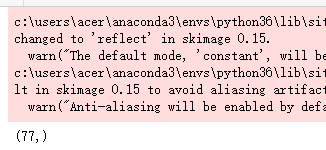
print(np.shape(trainData))
trainLabelNum = []
for i in range(len(trainData)):
for j in range(len(trainData[i])):
trainLabelNum.append(i)
imageGray = trainData[i][j]
io.imsave("F:\\MachineLearn\\ML-xiaoxueqi\\fruits\\trainGrayImage\\"+str(i)+"_"+str(j)+".jpg",imageGray)
np.save("F:\\MachineLearn\\ML-xiaoxueqi\\fruits\\trainLabelNum",trainLabelNum)
print("图片处理完了")
testLabelList = os.listdir("F:\\MachineLearn\\ML-xiaoxueqi\\fruits\\Test")
testallFruitsImageName = []
for i in range(len(testLabelList)):
testallFruitsImageName.append(os.listdir("F:\\MachineLearn\\ML-xiaoxueqi\\fruits\\Test\\"+testLabelList[i]))
testallsortImageName = []
for i in range(len(testallFruitsImageName)):
oneClass = testallFruitsImageName[i]
nr = []
r = []
r2 = []
for i in range(len(oneClass)):
if(oneClass[i].split("_")[0].isdigit()):
nr.append(int(oneClass[i].split("_")[0]))
else:
if(len(oneClass[i].split("_")[0])==1):
r.append(int(oneClass[i].split("_")[1]))
else:
r2.append(int(oneClass[i].split("_")[1]))
sortnr = sorted(nr)
sortnrImageName = []
for i in range(len(sortnr)):
sortnrImageName.append(str(sortnr[i])+"_100.jpg")
sortr = sorted(r)
sortrImageName = []
for i in range(len(sortr)):
sortrImageName.append("r_"+str(sortr[i])+"_100.jpg")
sortr2 = sorted(r2)
sortr2ImageName = []
for i in range(len(sortr2)):
sortr2ImageName.append("r2_"+str(sortr2[i])+"_100.jpg")
sortnrImageName.extend(sortrImageName)
sortnrImageName.extend(sortr2ImageName)
testallsortImageName.append(sortnrImageName)
testData = []
for i in range(len(testallsortImageName)):
one = []
for j in range(len(testallsortImageName[i])):
rgb=io.imread("F:\\MachineLearn\\ML-xiaoxueqi\\fruits\\Test\\"+testLabelList[i]+"\\" + testallsortImageName[i][j])
gray=color.rgb2gray(rgb)
dst=transform.resize(gray,(64,64))
one.append(dst)
testData.append(one)
print(np.shape(testData))

testLabelNum = []
for i in range(len(testData)):
for j in range(len(testData[i])):
testLabelNum.append(i)
imageGray = testData[i][j]
io.imsave("F:\\MachineLearn\\ML-xiaoxueqi\\fruits\\testGrayImage\\"+str(i)+"_"+str(j)+".jpg",imageGray)
np.save("F:\\MachineLearn\\ML-xiaoxueqi\\fruits\\testLabelNum",testLabelNum)
print("图片处理完了")

import os
import numpy as np
import matplotlib.pyplot as plt
from skimage import color,data,transform,io
trainDataDirList = os.listdir("F:\\MachineLearn\\ML-xiaoxueqi\\fruits\\trainGrayImage")
trainDataList = []
for i in range(len(trainDataDirList)):
image = io.imread("F:\\MachineLearn\\ML-xiaoxueqi\\fruits\\trainGrayImage\\"+trainDataDirList[i])
trainDataList.append(image)
trainLabelNum = np.load("F:\\MachineLearn\\ML-xiaoxueqi\\fruits\\trainLabelNum.npy")
testDataDirList = os.listdir("F:\\MachineLearn\\ML-xiaoxueqi\\fruits\\testGrayImage")
testDataList = []
for i in range(len(testDataDirList)):
image = io.imread("F:\\MachineLearn\\ML-xiaoxueqi\\fruits\\testGrayImage\\"+testDataDirList[i])
testDataList.append(image)
testLabelNum = np.load("F:\\MachineLearn\\ML-xiaoxueqi\\fruits\\testLabelNum.npy")
import tensorflow as tf
from random import shuffle
INPUT_NODE = 64*64
OUT_NODE = 77
IMAGE_SIZE = 64
NUM_CHANNELS = 1
NUM_LABELS = 77
#第一层卷积层的尺寸和深度
CONV1_DEEP = 64
CONV1_SIZE = 5
#第二层卷积层的尺寸和深度
CONV2_DEEP = 128
CONV2_SIZE = 5
#全连接层的节点数
FC_SIZE = 1024
def inference(input_tensor, train, regularizer):
#卷积
with tf.variable_scope('layer1-conv1'):
conv1_weights = tf.Variable(tf.random_normal([CONV1_SIZE,CONV1_SIZE,NUM_CHANNELS,CONV1_DEEP],stddev=0.1),name='weight')
conv1_biases = tf.Variable(tf.Variable(tf.random_normal([CONV1_DEEP])),name="bias")
conv1 = tf.nn.conv2d(input_tensor,conv1_weights,strides=[1,1,1,1],padding='SAME')
relu1 = tf.nn.relu(tf.nn.bias_add(conv1,conv1_biases))
#池化
with tf.variable_scope('layer2-pool1'):
pool1 = tf.nn.max_pool(relu1,ksize=[1,2,2,1],strides=[1,2,2,1],padding='SAME')
#卷积
with tf.variable_scope('layer3-conv2'):
conv2_weights = tf.Variable(tf.random_normal([CONV2_SIZE,CONV2_SIZE,CONV1_DEEP,CONV2_DEEP],stddev=0.1),name='weight')
conv2_biases = tf.Variable(tf.random_normal([CONV2_DEEP]),name="bias")
#卷积向前学习
conv2 = tf.nn.conv2d(pool1,conv2_weights,strides=[1,1,1,1],padding='SAME')
relu2 = tf.nn.relu(tf.nn.bias_add(conv2,conv2_biases))
#池化
with tf.variable_scope('layer4-pool2'):
pool2 = tf.nn.max_pool(relu2,ksize=[1,2,2,1],strides=[1,2,2,1],padding='SAME')
#卷积
with tf.variable_scope('layer5-conv3'):
conv3_weights = tf.Variable(tf.random_normal([5,5,CONV2_DEEP,512],stddev=0.1),name='weight')
conv3_biases = tf.Variable(tf.random_normal([512]),name="bias")
#卷积向前学习
conv3 = tf.nn.conv2d(pool2,conv3_weights,strides=[1,1,1,1],padding='SAME')
relu3 = tf.nn.relu(tf.nn.bias_add(conv3,conv3_biases))
#池化
with tf.variable_scope('layer6-pool3'):
pool3 = tf.nn.max_pool(relu3,ksize=[1,2,2,1],strides=[1,2,2,1],padding='SAME')
#卷积
with tf.variable_scope('layer7-conv4'):
conv4_weights = tf.Variable(tf.random_normal([5,5,512,64],stddev=0.1),name='weight')
conv4_biases = tf.Variable(tf.random_normal([64]),name="bias")
#卷积向前学习
conv4 = tf.nn.conv2d(pool3,conv4_weights,strides=[1,1,1,1],padding='SAME')
relu4 = tf.nn.relu(tf.nn.bias_add(conv4,conv4_biases))
#池化
with tf.variable_scope('layer7-pool4'):
pool4 = tf.nn.max_pool(relu3,ksize=[1,2,2,1],strides=[1,2,2,1],padding='SAME')
#变型
pool_shape = pool4.get_shape().as_list()
#计算最后一次池化后对象的体积(数据个数\节点数\像素个数)
nodes = pool_shape[1]*pool_shape[2]*pool_shape[3]
#根据上面的nodes再次把最后池化的结果pool2变为batch行nodes列的数据
reshaped = tf.reshape(pool4,[-1,nodes])
#全连接层
with tf.variable_scope('layer8-fc1'):
fc1_weights = tf.Variable(tf.random_normal([nodes,FC_SIZE],stddev=0.1),name='weight')
if(regularizer != None):
tf.add_to_collection('losses',tf.contrib.layers.l2_regularizer(0.03)(fc1_weights))
fc1_biases = tf.Variable(tf.random_normal([FC_SIZE]),name="bias")
#预测
fc1 = tf.nn.relu(tf.matmul(reshaped,fc1_weights)+fc1_biases)
if(train):
fc1 = tf.nn.dropout(fc1,0.5)
#全连接层
with tf.variable_scope('layer9-fc2'):
fc2_weights = tf.Variable(tf.random_normal([FC_SIZE,64],stddev=0.1),name="weight")
if(regularizer != None):
tf.add_to_collection('losses',tf.contrib.layers.l2_regularizer(0.03)(fc2_weights))
fc2_biases = tf.Variable(tf.random_normal([64]),name="bias")
#预测
fc2 = tf.nn.relu(tf.matmul(fc1,fc2_weights)+fc2_biases)
if(train):
fc2 = tf.nn.dropout(fc2,0.5)
#全连接层
with tf.variable_scope('layer10-fc3'):
fc3_weights = tf.Variable(tf.random_normal([64,NUM_LABELS],stddev=0.1),name="weight")
if(regularizer != None):
tf.add_to_collection('losses',tf.contrib.layers.l2_regularizer(0.03)(fc3_weights))
fc3_biases = tf.Variable(tf.random_normal([NUM_LABELS]),name="bias")
#预测
logit = tf.matmul(fc2,fc3_weights)+fc3_biases
return logit
import keras
import time
from keras.utils import np_utils
X = np.vstack(trainDataList).reshape(-1, 64,64,1)
Y = np.vstack(trainLabelNum).reshape(-1, 1)
Xrandom = []
Yrandom = []
index = [i for i in range(len(X))]
shuffle(index)
for i in range(len(index)):
Xrandom.append(X[index[i]])
Yrandom.append(Y[index[i]])
np.save("E:\\Xrandom",Xrandom)
np.save("E:\\Xrandom",Yrandom)
X = Xrandom
Y = Yrandom
Y=keras.utils.to_categorical(Y,OUT_NODE)
batch_size = 200
n_classes=77
epochs=20#循环次数
learning_rate=1e-4
batch_num=int(np.shape(X)[0]/batch_size)
dropout=0.75
x=tf.placeholder(tf.float32,[None,64,64,1])
y=tf.placeholder(tf.float32,[None,n_classes])
# keep_prob = tf.placeholder(tf.float32)
pred=inference(x,1,"regularizer")
cost=tf.reduce_mean(tf.nn.softmax_cross_entropy_with_logits(logits=pred,labels=y))
# 三种优化方法选择一个就可以
optimizer=tf.train.AdamOptimizer(1e-4).minimize(cost)
# train_step = tf.train.GradientDescentOptimizer(0.001).minimize(cost)
# train_step = tf.train.MomentumOptimizer(0.001,0.9).minimize(cost)
keep_prob = tf.placeholder(dtype=tf.float32, name="keep_prob")
correct_pred=tf.equal(tf.argmax(pred,1),tf.argmax(y,1))
accuracy=tf.reduce_mean(tf.cast(correct_pred,tf.float32))
# merged = tf.summary.merge_all()
init=tf.global_variables_initializer()
start_time = time.time()
with tf.Session() as sess:
sess.run(init)
# writer = tf.summary.FileWriter('./fruit', sess.graph)
for i in range(epochs):
for j in range(batch_num):
start = (j*batch_size)
end = start+batch_size
sess.run(optimizer, feed_dict={x:X[start:end],y:Y[start:end],keep_prob: 0.5})
loss,acc = sess.run([cost,accuracy],feed_dict={x:X[start:end],y:Y[start:end],keep_prob: 1})
# result = sess.run(merged, feed_dict={x:X[start:end],y:Y[start:end]})
# writer.add_summary(result, i)
if epochs % 1 == 0:
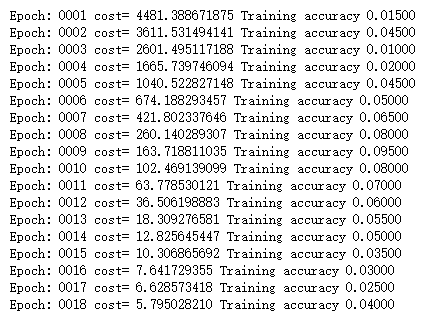
print("Epoch:", '%04d' % (i+1),"cost=", "{:.9f}".format(loss),"Training accuracy","{:.5f}".format(acc*100))
end_time = time.time()
print('运行时间:',(end_time-start_time))
print('Optimization Completed')

def gen_small_data(inputs,batch_size):
i=0
j = True
while j:
small_data=inputs[i:(batch_size+i)]
i+=batch_size
if len(small_data)!=0:
yield small_data
if len(small_data)==0:
j=False
with tf.Session() as sess:
sess.run(init)
# writer = tf.summary.FileWriter('./fruit', sess.graph)
for i in range(epochs):
x_=gen_small_data(X,batch_size)
y_=gen_small_data(Y,batch_size)
X = next(x_)
Y = next(y_)
sess.run(optimizer, feed_dict={x:X,y:Y})
loss,acc = sess.run([cost,accuracy],feed_dict={x:X,y:Y})
# result = sess.run(merged, feed_dict={x:X[start:end],y:Y[start:end]})
# writer.add_summary(result, i)
if epochs % 1 == 0:
print("Epoch:", '%04d' % (i+1),"cost=", "{:.9f}".format(loss),"Training accuracy","{:.5f}".format(acc))
labelNameList = []
for i in range(len(labelList)):
labelNameList.append("label:"+labelList[i])
theFireImage = []
for i in range(len(allsortImageName)):
theFireImage.append(plt.imread("F:\\MachineLearn\\ML-xiaoxueqi\\fruits\\Training\\"+labelList[i]+"\\" + allsortImageName[i][4]))
gs = plt.GridSpec(11,7)
fig = plt.figure(figsize=(10,10))
imageIndex = 0
ax = plt.gca()
for i in range(11):
for j in range(7):
fi = fig.add_subplot(gs[i,j])
fi.imshow(theFireImage[imageIndex])
plt.xticks(())
plt.yticks(())
plt.axis('off')
plt.title(labelNameList[imageIndex],fontsize=7)
ax.set_xticks([])
ax.set_yticks([])
ax.spines['top'].set_color('none')
ax.spines['left'].set_color('none')
ax.spines['right'].set_color('none')
ax.spines['bottom'].set_color('none')
imageIndex += 1
plt.show()
吴裕雄 python神经网络 水果图片识别(1)的更多相关文章
- 吴裕雄 python神经网络 水果图片识别(5)
#-*- coding:utf-8 -*-### required libaraiedimport osimport matplotlib.image as imgimport matplotlib. ...
- 吴裕雄 python神经网络 水果图片识别(4)
# coding: utf-8 # In[1]:import osimport numpy as npfrom skimage import color, data, transform, io # ...
- 吴裕雄 python神经网络 水果图片识别(3)
import osimport kerasimport timeimport numpy as npimport tensorflow as tffrom random import shufflef ...
- 吴裕雄 python神经网络 水果图片识别(2)
import osimport numpy as npimport matplotlib.pyplot as pltfrom skimage import color,data,transform,i ...
- 吴裕雄 python神经网络 花朵图片识别(10)
import osimport numpy as npimport matplotlib.pyplot as pltfrom PIL import Image, ImageChopsfrom skim ...
- 吴裕雄 python神经网络 花朵图片识别(9)
import osimport numpy as npimport matplotlib.pyplot as pltfrom PIL import Image, ImageChopsfrom skim ...
- 吴裕雄 python 神经网络——TensorFlow图片预处理调整图片
import numpy as np import tensorflow as tf import matplotlib.pyplot as plt def distort_color(image, ...
- 吴裕雄 python 神经网络——TensorFlow 花瓣识别2
import glob import os.path import numpy as np import tensorflow as tf from tensorflow.python.platfor ...
- 吴裕雄 python 神经网络——TensorFlow图片预处理
import numpy as np import tensorflow as tf import matplotlib.pyplot as plt # 使用'r'会出错,无法解码,只能以2进制形式读 ...
随机推荐
- ML(1): 入门理论
机器学习相关的文章太多,选取一篇本人认为最赞的,copy文章中部分经典供自己学习,摘抄至 http://www.cnblogs.com/subconscious/p/4107357.html#firs ...
- 【shell】awk命令
简介 awk是一个强大的文本分析工具,相对于grep的查找,sed的编辑,awk在其对数据分析并生成报告时,显得尤为强大.简单来说awk就是把文件逐行的读入,以空格为默认分隔符将每行切片,切开的部分再 ...
- dede频道页实现三级栏目嵌套调用文章
dede频道页实现三级栏目嵌套调用文章: //支持arclist标签开始--> $typeid = $row['id']; if((class_exists('PartView'))) { ...
- Python 中的变量
Python采用基于值得内存管理模式,赋值语句的执行过程是:首先把等号右侧标识的表达式计算出来,然后在内存中找一个位置把值存放进去,最后创建变量并指向这个内存地址.Python中的变量并不直接存储值, ...
- JavaScript if(x),==和===解析(翻译整理)
一.if()中的布尔判断 if ( Expression ) 表达式会通过ES5定义的ToBoolean方法强制把Expression 转换成布尔值. 数据类型 转换结果 Undefined fals ...
- MessageFormat用法(转载)
MessageFormat用来格式化一个消息,通常是一个字符串,比如: String str = "I'm not a {0}, age is {1,number,short}", ...
- [转]修改DLL
部分内容来自:http://blog.csdn.net/csdncshuan/article/details/51477705 为没有源码的DLL文件添加强名称 如果项目中引用了其他没有源码的dll文 ...
- 与PHP5.3.5的战斗----记php5.3.5安装过程
与PHP5.3.5的战斗----记php5.3.5安装过程 摘自:http://blog.csdn.net/lgg201/article/details/6125189这篇文章写的很是不错,,,也是我 ...
- javascript的焦点管理
HTML5也添加了辅助管理DOM焦点的功能. 元素获得焦点的方式有页面加载,用户输入和代码中调用的focus()方法. 而document.activeElement属性保存着当前获得焦点的引用. v ...
- iOS whose view is not in the window hierarchy!
解决方法: viewController只Load完毕,没有Appear,此时应该将语句转移到ViewDidAppear方法中