
吴裕雄 python 机器学习-KNN算法(1)
import numpy as np

import operator as op

from os import listdir

def classify0(inX, dataSet, labels, k):

    dataSetSize = dataSet.shape[0]

    diffMat = np.tile(inX, (dataSetSize,1)) - dataSet

    sqDiffMat = diffMat**2

    sqDistances = sqDiffMat.sum(axis=1)

    distances = sqDistances**0.5

    sortedDistIndicies = distances.argsort()

    classCount={}

    for i in range(k):

        voteIlabel = labels[sortedDistIndicies[i]]

        classCount[voteIlabel] = classCount.get(voteIlabel,0) + 1

    sortedClassCount = sorted(classCount.items(), key=op.itemgetter(1), reverse=True)

    return sortedClassCount[0][0]

def createDataSet():

    group = np.array([[1.0,1.1],[1.0,1.0],[0,0],[0,0.1]])

    labels = ['A','A','B','B']

    return group, labels

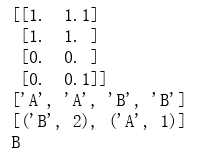
data,labels = createDataSet()

print(data)

print(labels)

test = np.array([[0,0.5]])

result = classify0(test,data,labels,3)

print(result)
import numpy as np

import operator as op

from os import listdir

def classify0(inX, dataSet, labels, k):

    dataSetSize = dataSet.shape[0]

    diffMat = np.tile(inX, (dataSetSize,1)) - dataSet

    sqDiffMat = diffMat**2

    sqDistances = sqDiffMat.sum(axis=1)

    distances = sqDistances**0.5

    sortedDistIndicies = distances.argsort()

    classCount={}

    for i in range(k):

        voteIlabel = labels[sortedDistIndicies[i]]

        classCount[voteIlabel] = classCount.get(voteIlabel,0) + 1

    sortedClassCount = sorted(classCount.items(), key=op.itemgetter(1), reverse=True)

    return sortedClassCount[0][0]

def file2matrix(filename):

    fr = open(filename)

    returnMat = []

    classLabelVector = []                       #prepare labels return

    for line in fr.readlines():

        line = line.strip()

        listFromLine = line.split('\t')

        returnMat.append([float(listFromLine[0]),float(listFromLine[1]),float(listFromLine[2])])

        classLabelVector.append(int(listFromLine[-1]))

    return np.array(returnMat),np.array(classLabelVector)

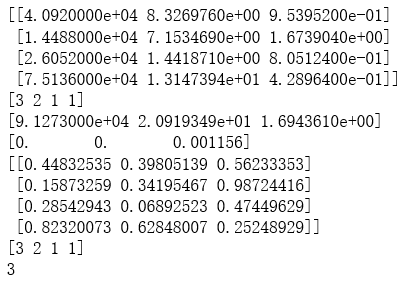
trainData,trainLabel = file2matrix("D:\\LearningResource\\machinelearninginaction\\Ch02\\datingTestSet2.txt")

print(trainData[0:4])

print(trainLabel[0:4])

def autoNorm(dataSet):

    minVals = dataSet.min(0)

    maxVals = dataSet.max(0)

    ranges = maxVals - minVals

    normDataSet = np.zeros(np.shape(dataSet))

    m = dataSet.shape[0]

    normDataSet = dataSet - np.tile(minVals, (m,1))

    normDataSet = normDataSet/np.tile(ranges, (m,1))   #element wise divide

    return normDataSet, ranges, minVals

normDataSet, ranges, minVals = autoNorm(trainData)

print(ranges)

print(minVals)

print(normDataSet[0:4])

print(trainLabel[0:4])

testData = np.array([[0.5,0.3,0.5]])

result = classify0(testData, normDataSet, trainLabel, 5)

print(result)
import numpy as np

import operator as op

from os import listdir

def classify0(inX, dataSet, labels, k):

    dataSetSize = dataSet.shape[0]

    diffMat = np.tile(inX, (dataSetSize,1)) - dataSet

    sqDiffMat = diffMat**2

    sqDistances = sqDiffMat.sum(axis=1)

    distances = sqDistances**0.5

    sortedDistIndicies = distances.argsort()

    classCount={}

    for i in range(k):

        voteIlabel = labels[sortedDistIndicies[i]]

        classCount[voteIlabel] = classCount.get(voteIlabel,0) + 1

    sortedClassCount = sorted(classCount.items(), key=op.itemgetter(1), reverse=True)

    return sortedClassCount[0][0]

def file2matrix(filename):

    fr = open(filename)

    returnMat = []

    classLabelVector = []                       #prepare labels return

    for line in fr.readlines():

        line = line.strip()

        listFromLine = line.split('\t')

        returnMat.append([float(listFromLine[0]),float(listFromLine[1]),float(listFromLine[2])])

        classLabelVector.append(listFromLine[-1])

    return np.array(returnMat),np.array(classLabelVector)

def autoNorm(dataSet):

    minVals = dataSet.min(0)

    maxVals = dataSet.max(0)

    ranges = maxVals - minVals

    normDataSet = np.zeros(np.shape(dataSet))

    m = dataSet.shape[0]

    normDataSet = dataSet - np.tile(minVals, (m,1))

    normDataSet = normDataSet/np.tile(ranges, (m,1))   #element wise divide

    return normDataSet, ranges, minVals

normDataSet, ranges, minVals = autoNorm(trainData)

def datingClassTest():

    hoRatio = 0.10      #hold out 10%

    datingDataMat,datingLabels = file2matrix("D:\\LearningResource\\machinelearninginaction\\Ch02\\datingTestSet.txt")

    normMat, ranges, minVals = autoNorm(datingDataMat)

    m = normMat.shape[0]

    numTestVecs = int(m*hoRatio)

    errorCount = 0.0

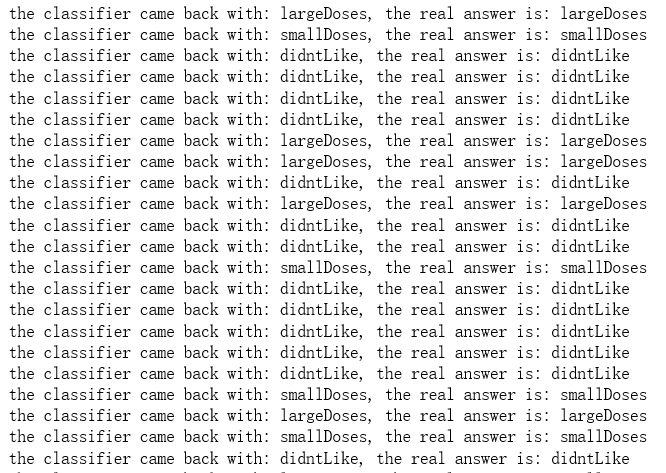
    for i in range(numTestVecs):

        classifierResult = classify0(normMat[i,:],normMat[numTestVecs:m,:],datingLabels[numTestVecs:m],3)

        print(('the classifier came back with: %s, the real answer is: %s') % (classifierResult, datingLabels[i]))

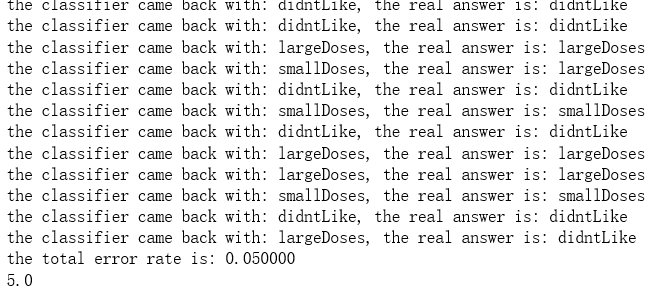
        if (classifierResult != datingLabels[i]):

            errorCount += 1.0

    print(('the total error rate is: %f') % (errorCount/float(numTestVecs)))

    print(errorCount)

datingClassTest()
import numpy as np

import operator as op

from os import listdir

def classify0(inX, dataSet, labels, k):

    dataSetSize = dataSet.shape[0]

    diffMat = np.tile(inX, (dataSetSize,1)) - dataSet

    sqDiffMat = diffMat**2

    sqDistances = sqDiffMat.sum(axis=1)

    distances = sqDistances**0.5

    sortedDistIndicies = distances.argsort()

    classCount={}

    for i in range(k):

        voteIlabel = labels[sortedDistIndicies[i]]

        classCount[voteIlabel] = classCount.get(voteIlabel,0) + 1

    sortedClassCount = sorted(classCount.items(), key=op.itemgetter(1), reverse=True)

    return sortedClassCount[0][0]

def file2matrix(filename):

    fr = open(filename)

    returnMat = []

    classLabelVector = []                       #prepare labels return

    for line in fr.readlines():

        line = line.strip()

        listFromLine = line.split('\t')

        returnMat.append([float(listFromLine[0]),float(listFromLine[1]),float(listFromLine[2])])

        classLabelVector.append(listFromLine[-1])

    return np.array(returnMat),np.array(classLabelVector)

def autoNorm(dataSet):

    minVals = dataSet.min(0)

    maxVals = dataSet.max(0)

    ranges = maxVals - minVals

    normDataSet = np.zeros(np.shape(dataSet))

    m = dataSet.shape[0]

    normDataSet = dataSet - np.tile(minVals, (m,1))

    normDataSet = normDataSet/np.tile(ranges, (m,1))   #element wise divide

    return normDataSet, ranges, minVals

normDataSet, ranges, minVals = autoNorm(trainData)

def datingClassTest():

    hoRatio = 0.10      #hold out 10%

    datingDataMat,datingLabels = file2matrix("D:\\LearningResource\\machinelearninginaction\\Ch02\\datingTestSet.txt")

    normMat, ranges, minVals = autoNorm(datingDataMat)

    m = normMat.shape[0]

    numTestVecs = int(m*hoRatio)

    errorCount = 0.0

    for i in range(numTestVecs):

        classifierResult = classify0(normMat[i,:],normMat[numTestVecs:m,:],datingLabels[numTestVecs:m],3)

        print(('the classifier came back with: %s, the real answer is: %s') % (classifierResult, datingLabels[i]))

        if (classifierResult != datingLabels[i]):

            errorCount += 1.0

    print(('the total error rate is: %f') % (errorCount/float(numTestVecs)))

    print(errorCount)

datingClassTest()
................................................
import numpy as np

import operator as op

from os import listdir

def classify0(inX, dataSet, labels, k):

    dataSetSize = dataSet.shape[0]

    diffMat = np.tile(inX, (dataSetSize,1)) - dataSet

    sqDiffMat = diffMat**2

    sqDistances = sqDiffMat.sum(axis=1)

    distances = sqDistances**0.5

    sortedDistIndicies = distances.argsort()

    classCount={}

    for i in range(k):

        voteIlabel = labels[sortedDistIndicies[i]]

        classCount[voteIlabel] = classCount.get(voteIlabel,0) + 1

    sortedClassCount = sorted(classCount.items(), key=op.itemgetter(1), reverse=True)

    return sortedClassCount[0][0]

def file2matrix(filename):

    fr = open(filename)

    returnMat = []

    classLabelVector = []                       #prepare labels return

    for line in fr.readlines():

        line = line.strip()

        listFromLine = line.split('\t')

        returnMat.append([float(listFromLine[0]),float(listFromLine[1]),float(listFromLine[2])])

        classLabelVector.append(int(listFromLine[-1]))

    return np.array(returnMat),np.array(classLabelVector)

def autoNorm(dataSet):

    minVals = dataSet.min(0)

    maxVals = dataSet.max(0)

    ranges = maxVals - minVals

    normDataSet = np.zeros(np.shape(dataSet))

    m = dataSet.shape[0]

    normDataSet = dataSet - np.tile(minVals, (m,1))

    normDataSet = normDataSet/np.tile(ranges, (m,1))   #element wise divide

    return normDataSet, ranges, minVals

def classifyPerson():

    resultList = ["not at all", "in samll doses", "in large doses"]

    percentTats = float(input("percentage of time spent playing video game?"))

    ffMiles = float(input("frequent flier miles earned per year?"))

    iceCream = float(input("liters of ice cream consumed per year?"))

    testData = np.array([percentTats,ffMiles,iceCream])

    trainData,trainLabel = file2matrix("D:\\LearningResource\\machinelearninginaction\\Ch02\\datingTestSet2.txt")

    normDataSet, ranges, minVals = autoNorm(trainData)

    result = classify0((testData-minVals)/ranges, normDataSet, trainLabel, 3)

    print("You will probably like this person: ",resultList[result-1])

classifyPerson()
import numpy as np

import operator as op

from os import listdir

def classify0(inX, dataSet, labels, k):

    dataSetSize = dataSet.shape[0]

    diffMat = np.tile(inX, (dataSetSize,1)) - dataSet

    sqDiffMat = diffMat**2

    sqDistances = sqDiffMat.sum(axis=1)

    distances = sqDistances**0.5

    sortedDistIndicies = distances.argsort()

    classCount={}

    for i in range(k):

        voteIlabel = labels[sortedDistIndicies[i]]

        classCount[voteIlabel] = classCount.get(voteIlabel,0) + 1

    sortedClassCount = sorted(classCount.items(), key=op.itemgetter(1), reverse=True)

    return sortedClassCount[0][0]

def file2matrix(filename):

    fr = open(filename)

    returnMat = []

    classLabelVector = []                       #prepare labels return

    for line in fr.readlines():

        line = line.strip()

        listFromLine = line.split('\t')

        returnMat.append([float(listFromLine[0]),float(listFromLine[1]),float(listFromLine[2])])

        classLabelVector.append(int(listFromLine[-1]))

    return np.array(returnMat),np.array(classLabelVector)

def autoNorm(dataSet):

    minVals = dataSet.min(0)

    maxVals = dataSet.max(0)

    ranges = maxVals - minVals

    normDataSet = np.zeros(np.shape(dataSet))

    m = dataSet.shape[0]

    normDataSet = dataSet - np.tile(minVals, (m,1))

    normDataSet = normDataSet/np.tile(ranges, (m,1))   #element wise divide

    return normDataSet, ranges, minVals

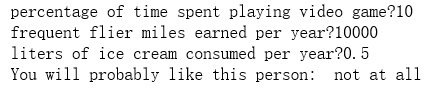
def classifyPerson():

    resultList = ["not at all", "in samll doses", "in large doses"]

    percentTats = float(input("percentage of time spent playing video game?"))

    ffMiles = float(input("frequent flier miles earned per year?"))

    iceCream = float(input("liters of ice cream consumed per year?"))

    testData = np.array([percentTats,ffMiles,iceCream])

    trainData,trainLabel = file2matrix("D:\\LearningResource\\machinelearninginaction\\Ch02\\datingTestSet2.txt")

    normDataSet, ranges, minVals = autoNorm(trainData)

    result = classify0((testData-minVals)/ranges, normDataSet, trainLabel, 3)

    print("You will probably like this person: ",resultList[result-1])

classifyPerson()
import numpy as np

import operator as op

from os import listdir

def classify0(inX, dataSet, labels, k):

    dataSetSize = dataSet.shape[0]

    diffMat = np.tile(inX, (dataSetSize,1)) - dataSet

    sqDiffMat = diffMat**2

    sqDistances = sqDiffMat.sum(axis=1)

    distances = sqDistances**0.5

    sortedDistIndicies = distances.argsort()

    classCount={}

    for i in range(k):

        voteIlabel = labels[sortedDistIndicies[i]]

        classCount[voteIlabel] = classCount.get(voteIlabel,0) + 1

    sortedClassCount = sorted(classCount.items(), key=op.itemgetter(1), reverse=True)

    return sortedClassCount[0][0]

def img2vector(filename):

    returnVect = []

    fr = open(filename)

    for i in range(32):

        lineStr = fr.readline()

        for j in range(32):

            returnVect.append(int(lineStr[j]))

    return np.array([returnVect])

def handwritingClassTest():

    hwLabels = []

    trainingFileList = listdir('D:\\LearningResource\\machinelearninginaction\\Ch02\\trainingDigits')           #load the training set

    m = len(trainingFileList)

    trainingMat = np.zeros((m,1024))

    for i in range(m):

        fileNameStr = trainingFileList[i]

        fileStr = fileNameStr.split('.')[0]     #take off .txt

        classNumStr = int(fileStr.split('_')[0])

        hwLabels.append(classNumStr)

        trainingMat[i,:] = img2vector('D:\\LearningResource\\machinelearninginaction\\Ch02\\trainingDigits\\%s' % fileNameStr)

    testFileList = listdir('D:\\LearningResource\\machinelearninginaction\\Ch02\\testDigits')        #iterate through the test set

    mTest = len(testFileList)

    errorCount = 0.0

    for i in range(mTest):

        fileNameStr = testFileList[i]

        fileStr = fileNameStr.split('.')[0]     #take off .txt

        classNumStr = int(fileStr.split('_')[0])

        vectorUnderTest = img2vector('D:\\LearningResource\\machinelearninginaction\\Ch02\\testDigits\\%s' % fileNameStr)

        classifierResult = classify0(vectorUnderTest, trainingMat, hwLabels, 3)

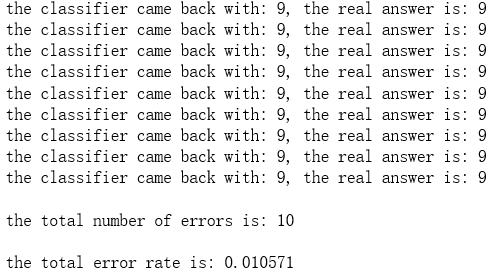
        print("the classifier came back with: %d, the real answer is: %d" % (classifierResult, classNumStr))

        if (classifierResult != classNumStr):

            errorCount += 1.0

    print("\nthe total number of errors is: %d" % errorCount)

    print("\nthe total error rate is: %f" % (errorCount/float(mTest)))

handwritingClassTest()

.......................................
吴裕雄 python 机器学习-KNN算法(1)的更多相关文章
- 吴裕雄 python 机器学习——KNN回归KNeighborsRegressor模型
import numpy as np import matplotlib.pyplot as plt from sklearn import neighbors, datasets from skle ...
- 吴裕雄 python 机器学习——KNN分类KNeighborsClassifier模型
import numpy as np import matplotlib.pyplot as plt from sklearn import neighbors, datasets from skle ...
- 吴裕雄 python 机器学习-KNN(2)
import matplotlib import numpy as np import matplotlib.pyplot as plt from matplotlib.patches import ...
- 吴裕雄 python 机器学习——半监督学习标准迭代式标记传播算法LabelPropagation模型
import numpy as np import matplotlib.pyplot as plt from sklearn import metrics from sklearn import d ...
- 吴裕雄 python 机器学习——集成学习AdaBoost算法回归模型
import numpy as np import matplotlib.pyplot as plt from sklearn import datasets,ensemble from sklear ...
- 吴裕雄 python 机器学习——集成学习AdaBoost算法分类模型
import numpy as np import matplotlib.pyplot as plt from sklearn import datasets,ensemble from sklear ...
- 吴裕雄 python 机器学习——人工神经网络感知机学习算法的应用
import numpy as np from matplotlib import pyplot as plt from sklearn import neighbors, datasets from ...
- 吴裕雄 python 机器学习——半监督学习LabelSpreading模型
import numpy as np import matplotlib.pyplot as plt from sklearn import metrics from sklearn import d ...
- 吴裕雄 python 机器学习——人工神经网络与原始感知机模型
import numpy as np from matplotlib import pyplot as plt from mpl_toolkits.mplot3d import Axes3D from ...
随机推荐
- Java基础方面
1.作用域public,private,protected,以及不写时的区别 答:区别如下: 作用域 当前类 同一package 子孙类 其他package ...
- css(层叠样式表)属性
CSS属性相关 宽和高 width属性可以为元素设置宽度. height属性可以为元素设置高度. 块级标签才能设置宽度,内联标签的宽度由内容来决定. 字体属性 文字字体 font-family可以把多 ...
- Struts2学习:Action使用@Autowired注入为null的解决方案
1.pom.xml引入struts2-spring-plugin <dependency> <groupId>org.apache.struts</groupId> ...
- Microsoft Visual Studio正在等待操作完成
在编译项目的时候,有时会遇到 Microsoft Visual Studio正忙,结果就是半天没反应,要等待很长时间才能编译完成,在网上查了一下资料,微软官方是这样解释的: 阻止某些 devenv.e ...
- ios8.1.1系统怎么取消下划线
http://zhidao.baidu.com/link?url=y-3oAiOsuCSvoCD-7H2Uvgl_UI1BQQuNvA2jHKCRAGmZSH7_RrwDijKtRouMBa5yF_L ...
- Windows下python库的常用安装方法
目录: 1.pip安装(需要pip) 2.通过下载whl文件安装(需要pip) 3.在pythn官网下载安装包安装(不需要pip) 方法一:pip安装. 这是最 ...
- UI学习网站
以下是我收集的UI设计的网站提供给大家参考: 站酷 www.zcool.com.cn UI中国 www.ui.cn 学UI网 www.xueui.cn UIGREAT www.uigreat.com ...
- Linux 文件查找(find)
find(选项)(参数) 选项 -amin<分钟>:查找在指定时间曾被存取过的文件或目录,单位以分钟计算: -anewer<参考文件或目录>:查找其存取时间较指定文件或目录的存 ...
- git push error HTTP code = 413
error: RPC failed; HTTP 413 curl 22 The requested URL returned error: 413 Request Entity Too Large 将 ...
- https://www.52pojie.cn/thread-688820-1-1.html
https://www.52pojie.cn/thread-688820-1-1.html