
吴裕雄 python 机器学习——层次聚类AgglomerativeClustering模型
import numpy as np

import matplotlib.pyplot as plt

from sklearn import  cluster

from sklearn.metrics import adjusted_rand_score

from sklearn.datasets.samples_generator import make_blobs

def create_data(centers,num=100,std=0.7):

    X, labels_true = make_blobs(n_samples=num, centers=centers, cluster_std=std)

    return  X,labels_true

#层次聚类AgglomerativeClustering模型

def test_AgglomerativeClustering(*data):

    '''

    测试 AgglomerativeClustering 的用法

    '''

    X,labels_true=data

    clst=cluster.AgglomerativeClustering()

    predicted_labels=clst.fit_predict(X)

    print("ARI:%s"% adjusted_rand_score(labels_true,predicted_labels))

# 用于产生聚类的中心点

centers=[[1,1],[2,2],[1,2],[10,20]]

# 产生用于聚类的数据集

X,labels_true=create_data(centers,1000,0.5)

#  调用 test_AgglomerativeClustering 函数

test_AgglomerativeClustering(X,labels_true)

def test_AgglomerativeClustering_nclusters(*data):

    '''

    测试 AgglomerativeClustering 的聚类结果随 n_clusters 参数的影响

    '''

    X,labels_true=data

    nums=range(1,50)

    ARIs=[]

    for num in nums:

        clst=cluster.AgglomerativeClustering(n_clusters=num)

        predicted_labels=clst.fit_predict(X)

        ARIs.append(adjusted_rand_score(labels_true,predicted_labels))

    ## 绘图

    fig=plt.figure()

    ax=fig.add_subplot(1,1,1)

    ax.plot(nums,ARIs,marker="+")

    ax.set_xlabel("n_clusters")

    ax.set_ylabel("ARI")

    fig.suptitle("AgglomerativeClustering")

    plt.show()

#  调用 test_AgglomerativeClustering_nclusters 函数

test_AgglomerativeClustering_nclusters(X,labels_true)

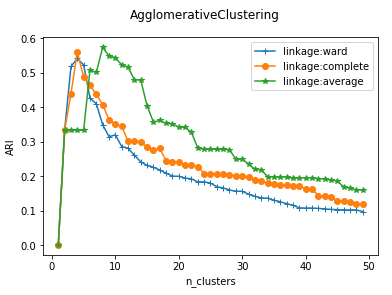
def test_AgglomerativeClustering_linkage(*data):

    '''

    测试 AgglomerativeClustering 的聚类结果随链接方式的影响

    '''

    X,labels_true=data

    nums=range(1,50)

    fig=plt.figure()

    ax=fig.add_subplot(1,1,1)

    linkages=['ward','complete','average']

    markers="+o*"

    for i, linkage in enumerate(linkages):

        ARIs=[]

        for num in nums:

            clst=cluster.AgglomerativeClustering(n_clusters=num,linkage=linkage)

            predicted_labels=clst.fit_predict(X)

            ARIs.append(adjusted_rand_score(labels_true,predicted_labels))

        ax.plot(nums,ARIs,marker=markers[i],label="linkage:%s"%linkage)

    ax.set_xlabel("n_clusters")

    ax.set_ylabel("ARI")

    ax.legend(loc="best")

    fig.suptitle("AgglomerativeClustering")

    plt.show()

#  调用 test_AgglomerativeClustering_linkage 函数

test_AgglomerativeClustering_linkage(X,labels_true)
吴裕雄 python 机器学习——层次聚类AgglomerativeClustering模型的更多相关文章
- 吴裕雄 python 机器学习——密度聚类DBSCAN模型
import numpy as np import matplotlib.pyplot as plt from sklearn import cluster from sklearn.metrics ...
- 吴裕雄 python 机器学习——支持向量机非线性回归SVR模型
import numpy as np import matplotlib.pyplot as plt from sklearn import datasets, linear_model,svm fr ...
- 吴裕雄 python 机器学习——KNN回归KNeighborsRegressor模型
import numpy as np import matplotlib.pyplot as plt from sklearn import neighbors, datasets from skle ...
- 吴裕雄 python 机器学习——KNN分类KNeighborsClassifier模型
import numpy as np import matplotlib.pyplot as plt from sklearn import neighbors, datasets from skle ...
- 吴裕雄 python 机器学习——半监督学习LabelSpreading模型
import numpy as np import matplotlib.pyplot as plt from sklearn import metrics from sklearn import d ...
- 吴裕雄 python 机器学习——支持向量机线性回归SVR模型
import numpy as np import matplotlib.pyplot as plt from sklearn import datasets, linear_model,svm fr ...
- 吴裕雄 python 机器学习——混合高斯聚类GMM模型
import numpy as np import matplotlib.pyplot as plt from sklearn import mixture from sklearn.metrics ...
- 吴裕雄 python 机器学习——K均值聚类KMeans模型
import numpy as np import matplotlib.pyplot as plt from sklearn import cluster from sklearn.metrics ...
- 吴裕雄 python 机器学习——分类决策树模型
import numpy as np import matplotlib.pyplot as plt from sklearn import datasets from sklearn.model_s ...
随机推荐
- UVa 10820 - Send a Table(欧拉函数)
链接: https://uva.onlinejudge.org/index.php?option=com_onlinejudge&Itemid=8&page=show_problem& ...
- 【题解】洛谷P1879 [USACO06NOV] Corn Fields(状压DP)
洛谷P1879:https://www.luogu.org/problemnew/show/P1879 思路 把题目翻译成人话 在n*m的棋盘 每个格子不是0就是1 1表示可以种 0表示不能种 相邻的 ...
- php编程零基础如何快速入门。门头沟编程
昨天遇到一个人,说知道thinktphp,不过几年前的事了. 我先跟他讲了下,xyhcms后台功能,各个版块,以及数据库都介绍了一下. 跟他说了一个功能现场实现,说了实现方法. 然后上机操作,发现他表 ...
- java中匿名内部类总结
在java的世界里,提供了匿名内部类语法糖,用于帮助大家简化代码,本文简要从接口,抽象类以及常规类以代码的形式描述其常用模式. 1. 接口模式 public interface IWriter { v ...
- 工具 | Axure基础操作 No.1
Axure作为一款热门的原型设计工具,是产品汪必备的一个技能.对于我个人来说,虽然更加喜欢墨刀这种小清新并且易用的网页版轻量级工具. 我在这里进行一些简单操作的动图,方便和我一样刚入门的同学容易看得明 ...
- MySQL/MariaDB学习笔记——mysql.user表中存在多个root用户问题理解
mysql.user表中存在多个root用户问题 问题描述:使用 SELECT host,user FROM mysql.user 发现mysql.user表中存在三个root用户,如下 持着对中几个 ...
- js滚动监听
下边代码,是监听滚动条只要移动,下方的返回顶部的div显示与隐藏的代码 ? 1 2 3 4 5 6 7 8 window.onscroll = function () { var t = docum ...
- Redis(八):Redis的复制(Master/Slave)
Redis的复制(Master/Slave)目录导航: 是什么 能干嘛 怎么玩 复制原理 哨兵模式(sentinel) 复制的缺点 是什么 官网 行话:也就是我们所说的主从复制,主机数据更新后根据配置 ...
- windows下MySQL免安装版配置教程mysql-8.0.12-winx64.zip版本
引用1:https://blog.csdn.net/weixin_42831477/article/details/81589325 引用2:https://blog.csdn.net/qq_3193 ...
- Spring : Spring Security
==========================================================================spring-security-过滤器: 顶级Fil ...