
《DSP using MATLAB》Problem 9.4
只放第1小题。
代码:
%% ------------------------------------------------------------------------

%%            Output Info about this m-file

fprintf('\n***********************************************************\n');

fprintf('        <DSP using MATLAB> Problem 9.4.1 \n\n');

banner();

%% ------------------------------------------------------------------------

% ------------------------------------------------------------

%                  PART 1

% ------------------------------------------------------------

% Discrete time signal

n1_start = 0; n1_end = 100;

      n1 = [n1_start:1:n1_end];

xn1 = cos(0.15*pi*n1);                 % digital signal

     D = 4;                            % downsample by factor D

OFFSET = 0;

     y = downsample(xn1, D, OFFSET);

    ny = [n1_start:n1_end/D];

%    ny = [n1_start:n1_end/D-1];        % OFFSET=2

figure('NumberTitle', 'off', 'Name', 'Problem 9.4.1 xn1 and y')

set(gcf,'Color','white');

subplot(2,1,1); stem(n1, xn1, 'b');

xlabel('n'); ylabel('x(n)');

title('xn1 original sequence');  grid on;

subplot(2,1,2); stem(ny, y, 'r');

xlabel('ny'); ylabel('y(n)');

title(sprintf('y sequence, downsample by D=%d offset=%d', D, OFFSET));  grid on;

% ----------------------------

%       DTFT of xn1

% ----------------------------

M = 500;

[X1, w] = dtft1(xn1, n1, M);

magX1  = abs(X1);  angX1  = angle(X1);  realX1  = real(X1);  imagX1  = imag(X1);

max(magX1)

%% --------------------------------------------------------------------

%%              START X(w)'s  mag ang real imag

%% --------------------------------------------------------------------

figure('NumberTitle', 'off', 'Name', 'Problem 9.4.1 X1 DTFT');

set(gcf,'Color','white');

subplot(2,1,1); plot(w/pi,magX1); grid on; %axis([-2, -1, -0.5, 0, 0.15, 0.5, 1, 2]);

title('Magnitude Response');

xlabel('digital frequency in \pi units'); ylabel('Magnitude  |H|');

set(gca, 'xtick', [-2,-1.85,-1.5,-1,-0.15,0,0.15,0.5,1,1.5,1.85,2]);

subplot(2,1,2); plot(w/pi, angX1/pi); grid on;  %axis([-1,1,-1.05,1.05]);

title('Phase Response');

xlabel('digital frequency in \pi units'); ylabel('Radians/\pi');

figure('NumberTitle', 'off', 'Name', 'Problem 9.4.1 X1 DTFT');

set(gcf,'Color','white');

subplot(2,1,1); plot(w/pi, realX1); grid on;

title('Real Part');

xlabel('digital frequency in \pi units'); ylabel('Real');

subplot(2,1,2); plot(w/pi, imagX1); grid on;

title('Imaginary Part');

xlabel('digital frequency in \pi units'); ylabel('Imaginary');

%% -------------------------------------------------------------------

%%             END X's  mag ang real imag

%% -------------------------------------------------------------------

% ----------------------------

%       DTFT of y

% ----------------------------

M = 500;

[Y, w] = dtft1(y, ny, M);

magY_DTFT = abs(Y);  angY_DTFT = angle(Y);  realY_DTFT = real(Y);  imagY_DTFT = imag(Y);

max(magY_DTFT)

ratio = max(magX1)/max(magY_DTFT)

%% --------------------------------------------------------------------

%%              START Y(w)'s  mag ang real imag

%% --------------------------------------------------------------------

figure('NumberTitle', 'off', 'Name', 'Problem 9.4.1 Y DTFT');

set(gcf,'Color','white');

subplot(2,1,1); plot(w/pi, magY_DTFT); grid on;  %axis([-2,2, -1, 2]);

title('Magnitude Response');

xlabel('digital frequency in \pi units'); ylabel('Magnitude  |H|');

set(gca, 'xtick', [-2,-1.4,-1,-0.6,0,0.6,1,1.4,2]);

subplot(2,1,2); plot(w/pi, angY_DTFT/pi); grid on;  %axis([-1,1,-1.05,1.05]);

title('Phase Response');

xlabel('digital frequency in \pi units'); ylabel('Radians/\pi');

figure('NumberTitle', 'off', 'Name', 'Problem 9.4.1 Y DTFT');

set(gcf,'Color','white');

subplot(2,1,1); plot(w/pi, realY_DTFT); grid on;

title('Real Part');

xlabel('digital frequency in \pi units'); ylabel('Real');

subplot(2,1,2); plot(w/pi, imagY_DTFT); grid on;

title('Imaginary Part');

xlabel('digital frequency in \pi units'); ylabel('Imaginary');

%% -------------------------------------------------------------------

%%             END Y's  mag ang real imag

%% -------------------------------------------------------------------

figure('NumberTitle', 'off', 'Name', sprintf('Problem 9.4.1 X1 & Y--DTFT of x and y, D=%d offset=%d', D,OFFSET));

set(gcf,'Color','white');

subplot(2,1,1); plot(w/pi,magX1); grid on;  %axis([-1,1,0,1.05]);

title('Magnitude Response');

xlabel('digital frequency in \pi units'); ylabel('Magnitude  |H|');

set(gca, 'xtick', [-2,-1.85,-1.4,-1,-0.6,-0.5,-0.15,0,0.15,0.5,0.6,1,1.4,1.85,2]);

set(gca, 'ytick', [-0.2, 0, 13.5, 20, 40, 51, 60]);

hold on;

plot(w/pi, magY_DTFT, 'r'); gtext('magY(\omega)', 'Color', 'r');

hold off;

subplot(2,1,2); plot(w/pi, angX1/pi); grid on;  %axis([-1,1,-1.05,1.05]);

title('Phase Response');

xlabel('digital frequency in \pi units'); ylabel('Radians/\pi');

hold on;

plot(w/pi, angY_DTFT/pi, 'r'); gtext('AngY(\omega)', 'Color', 'r');

hold off;
运行结果:
分两种情况
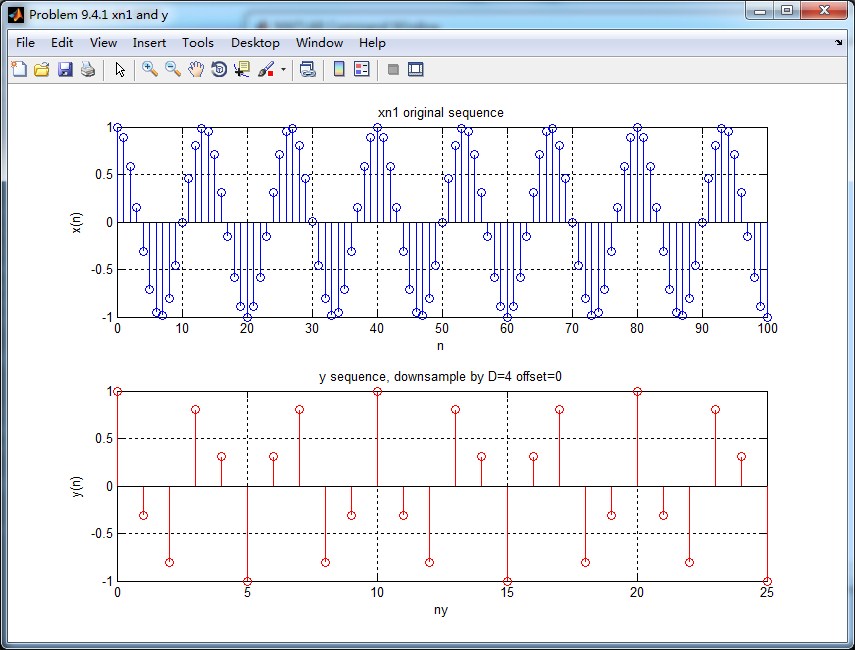
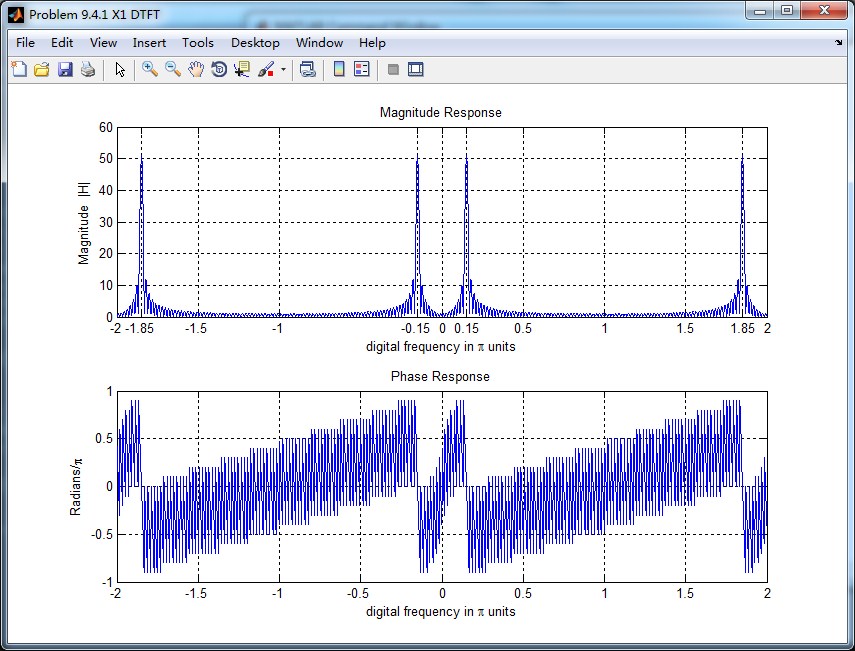
1、按照D=4抽取,offset=0
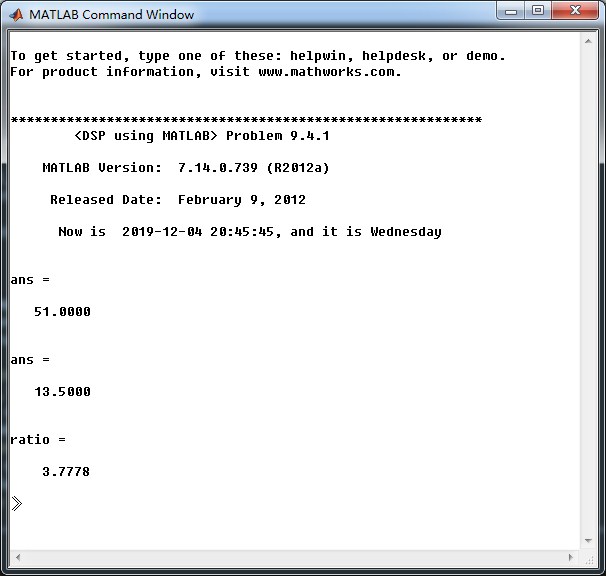
原始序列,抽取序列
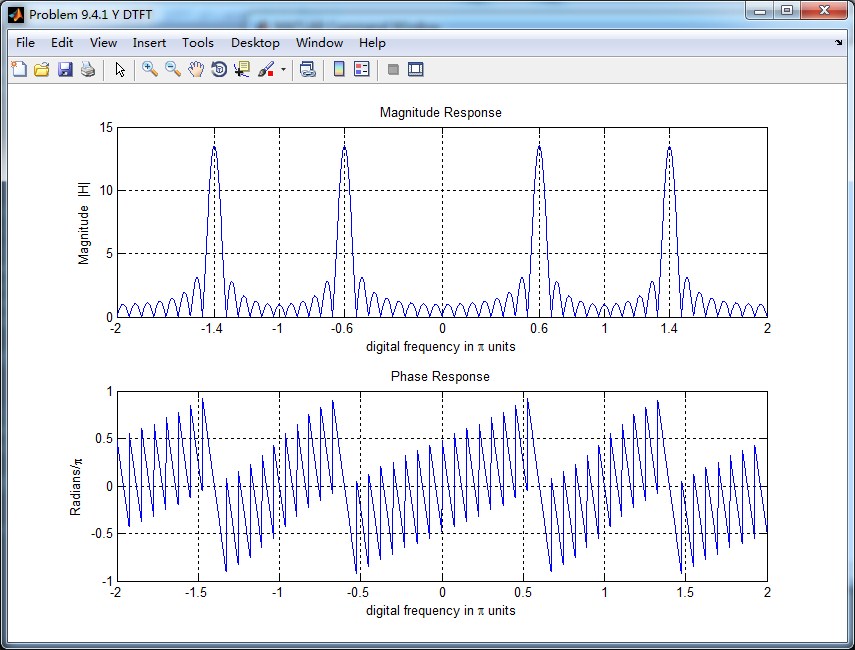
原始序列的谱
抽取序列的谱
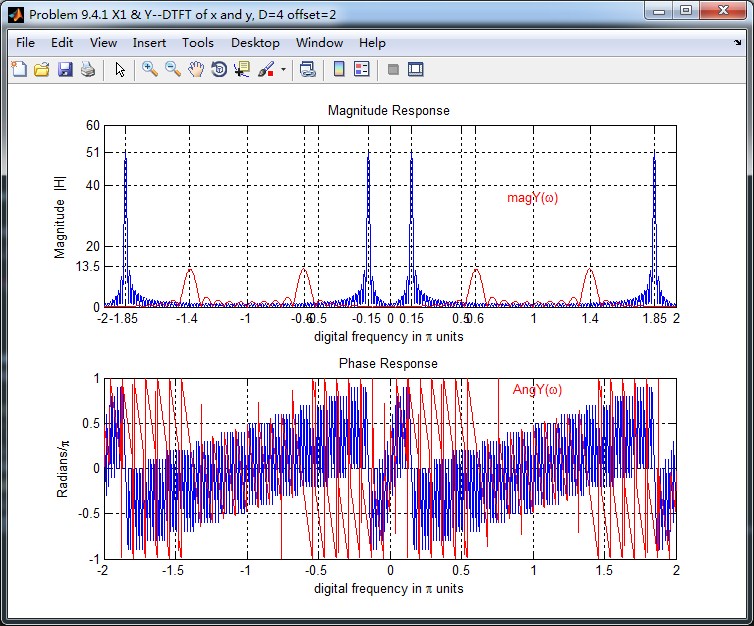
二者的DTFT混叠到一起,红颜色曲线是抽取序列的DTFT,可看出,其幅度大致为原始序列的谱幅度的1/4(精确值是1/3.7778)。

2、按照D=4抽取,offset=2
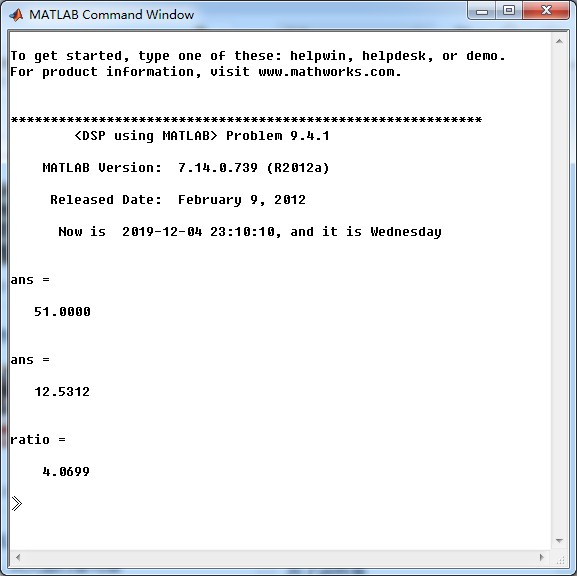


二者的DTFT混叠到一起,红颜色曲线是抽取序列的DTFT,可看出,其幅度大致为原始序列的谱幅度的1/4(精确值是1/4.0699)。
《DSP using MATLAB》Problem 9.4的更多相关文章
- 《DSP using MATLAB》Problem 7.27
代码: %% ++++++++++++++++++++++++++++++++++++++++++++++++++++++++++++++++++++++++++++++++ %% Output In ...
- 《DSP using MATLAB》Problem 7.26
注意:高通的线性相位FIR滤波器,不能是第2类,所以其长度必须为奇数.这里取M=31,过渡带里采样值抄书上的. 代码: %% +++++++++++++++++++++++++++++++++++++ ...
- 《DSP using MATLAB》Problem 7.25
代码: %% ++++++++++++++++++++++++++++++++++++++++++++++++++++++++++++++++++++++++++++++++ %% Output In ...
- 《DSP using MATLAB》Problem 7.24
又到清明时节,…… 注意:带阻滤波器不能用第2类线性相位滤波器实现,我们采用第1类,长度为基数,选M=61 代码: %% +++++++++++++++++++++++++++++++++++++++ ...
- 《DSP using MATLAB》Problem 7.23
%% ++++++++++++++++++++++++++++++++++++++++++++++++++++++++++++++++++++++++++++++++ %% Output Info a ...
- 《DSP using MATLAB》Problem 7.16
使用一种固定窗函数法设计带通滤波器. 代码: %% ++++++++++++++++++++++++++++++++++++++++++++++++++++++++++++++++++++++++++ ...
- 《DSP using MATLAB》Problem 7.15
用Kaiser窗方法设计一个台阶状滤波器. 代码: %% +++++++++++++++++++++++++++++++++++++++++++++++++++++++++++++++++++++++ ...
- 《DSP using MATLAB》Problem 7.14
代码: %% ++++++++++++++++++++++++++++++++++++++++++++++++++++++++++++++++++++++++++++++++ %% Output In ...
- 《DSP using MATLAB》Problem 7.13
代码: %% ++++++++++++++++++++++++++++++++++++++++++++++++++++++++++++++++++++++++++++++++ %% Output In ...
- 《DSP using MATLAB》Problem 7.12
阻带衰减50dB,我们选Hamming窗 代码: %% ++++++++++++++++++++++++++++++++++++++++++++++++++++++++++++++++++++++++ ...
随机推荐
- Delphi GDI+ 安装方法
[转]Delphi GDI+ 安装方法转自:万一博客(http://www.cnblogs.com/del/)GDI+ 是 Windows 的一个函数库, 来自 Windows\System32\GD ...
- ASP.NET Core学习——3
中间件 中间件是用于组成应用程序管道来处理请求和相应的组件.管道内的每一个组件都可以选择是否将请求交给下一个组件,并在管道中调用下一个组件之前和之后执行某些操作.请求委托被用来建立请求管道,请求委托处 ...
- Centos7.4安装elasticsearch6.3+kibana6.3集群
Centos7.4安装elasticsearch+kibana集群 Centos7.4安装elasticsearch+kibana集群 主机环境 软件环境 主机规划 主机安装前准备 安装jdk1.8 ...
- mysql的数据类型int、bigint、smallint 和 tinyint及id 类型变换
bigint 从 -2^63 (-9223372036854775808) 到 2^63-1 (9223372036854775807) 的整型数据(所有数字).存储大小为 8 个字节. int 从 ...
- win 解除鼠标右键关联
点击「开始」→「运行」→「输入Regedit」→「确定」,打开注册表编辑器,找到子键: 「HKEY_CLASSES_ROOT\*\shellex\UltroEdit」,删除此项即可:
- Display与 Visibility的区别
隐藏元素的方法有: display:none或visibility:hidden visibility:hidden可以隐藏某个元素,但隐藏的元素仍需占用与未隐藏之前一样的空间.也就是说,该元素虽然被 ...
- 洛谷 P4173 残缺的字符串 (FFT)
题目链接:P4173 残缺的字符串 题意 给定长度为 \(m\) 的模式串和长度为 \(n\) 的目标串,两个串都带有通配符,求所有匹配的位置. 思路 FFT 带有通配符的字符串匹配问题. 设模式串为 ...
- sed 删除含有某个字符串的行 (在文件txt)
#删除a.txt中含有“aaa”的行 sed -i “/aaa/d” a.txt
- nuxt 利用lru-cache 做服务器数据请求缓存
// 运行与服务端的js // node.js lru-cache import LRU from 'lru-cache' const lruCache = LRU({ // 缓存队列长度 max: ...
- pytest_fixture-----conftest共享数据及不同层次共享
场景:你与其他测试工程师合作一起开发时,公共的模块要在不同文件中,要 在大家都访问到的地方. 解决:使用conftest.py 这个文件进行数据共享,并且他可以放在不同位置起 着不同的范围共享作用. ...